Schisms¶
A schism is a split in a religious body. And in order to best understand modern Christianity it can be instructive to first understand the historic schisms.
Brief History¶
There were many schisms in early Christianity, usually from heretical movements that broke away from the church. These disputes often provoked ecumenical councils, which articulated the faith of the churches that remained in communion.
early schisms
- Montanism, condemned in AD 177, and died out after a few centuries
- Arianism, defined against at the First Council of Nicea in AD 325
- Donatism, addressed at the Conference of Carthage in AD 411
- Pelagianism, condemned at the Council of Carthage in AD 418
- Nestorianism, defined against at the Council of Chalcedon in AD 451 (the Church of the East continues outside Byzantine communion)
Those early breaks were largely heresies: movements that denied what the councils confessed. For the first millennium, east and west still shared one holy catholic and apostolic church -- one baptism, one creed, councils that spoke for the whole Church, and a pentarchy of patriarchates at Rome, Constantinople, Alexandria, Antioch, and Jerusalem.
East and West¶
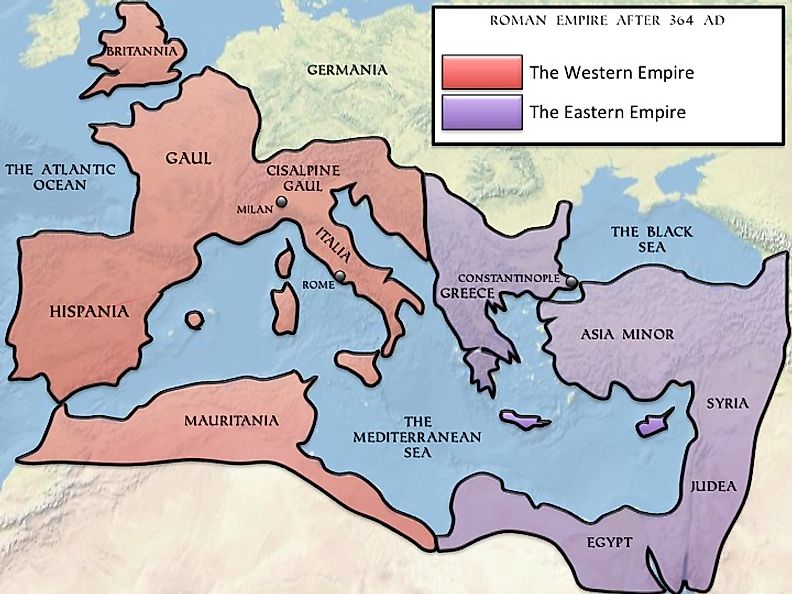
As Christianity spread into the world, the Roman empire had been divided between East and West (first by Diocletian), and later the empire was temporarily reunited by Constantine who converted to Christianity and moved the capital away from old Rome and into Byzantium which would later be renamed Constantinople.
Western Rome fell in AD 476, while Eastern Rome, also known as the Byzantine Empire, would continue the Roman empire (now as a Christian empire) for nearly a thousand more years.
East and West Rome
The Great Schism¶
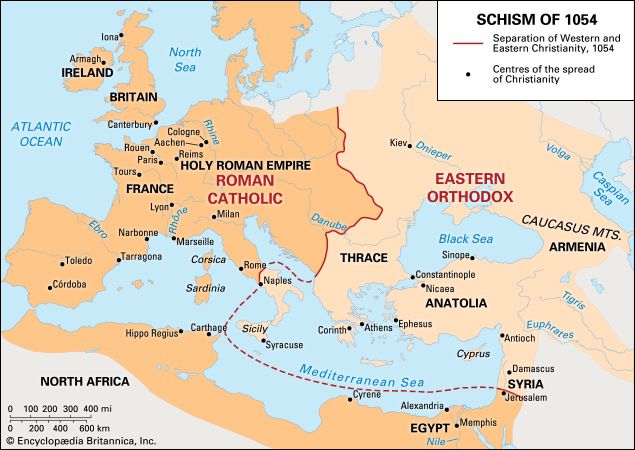
In AD 1054, Rome and Constantinople excommunicated one another -- the breach later called the Great Schism. It followed centuries of growing distance: disputes over jurisdiction, the filioque in the Creed, liturgical and disciplinary differences, and the long political fracture between Eastern and Western Rome. The line of division fell roughly along the old imperial border.
This was a different kind of schism from the patristic heresies. East and west each claimed to be the Church Christ founded. Neither side simply vanished like the Arian or Donatist movements. The wound remained open.
The East did not simply continue the first-millennium pentarchy intact. Rome was now absent from Eastern communion, so the old five-patriarch order was broken in fact even when it was still named in theory. Constantinople -- "New Rome" -- became the senior see still in communion with Alexandria, Antioch, and Jerusalem, exercising a primus inter pares role among Eastern bishops through the Byzantine centuries. That is not the same thing as Rome's Petrine primacy transferred wholesale; it is Constantinople leading the Eastern patriarchates until imperial Constantinople itself fell in AD 1453.
Eastern Christendom was not free of further schism. The sack of Constantinople in AD 1204 deepened the East-West breach. Later reunion councils -- Lyons (1274) and especially Florence (1439) -- split Eastern bishops between those who accepted union with Rome and those who rejected it; Moscow broke communion with Constantinople in AD 1448 over Florence. After 1453, Moscow's rising power, Ottoman rule, and national awakenings slowly replaced the old patriarchal order with the autocephalous national churches familiar today. Internal fractures continued as well -- the Old Believer schism in Russia (1666), ethnophyletism disputes (condemned in 1872), and modern jurisdictional conflicts over autocephaly -- so that even the Eastern Orthodox world, for all its claim to continuity, bears its own wounds of divided authority.
The Great Schism
Reformation Schisms¶
In the 16th century, the protestant reformation broke Latin Christendom again -- this time within the West, driven by theological disputes over grace, authority, and Scripture, though the break often followed political and ethnic boundaries. It succeeded in much of northern Europe (England, Germany, the Netherlands, and elsewhere), with notable exceptions such as Ireland.
The Holy Roman Empire, established in AD 962, is part of the Western political background to these later centuries; it is not the same thing as the apostolic Church, nor a simple explanation for the schism of AD 1054. After the Reformation, Roman Catholicism remained dominant across much of southern Europe, notably within the boundaries of the Romance languages (Italy, France, Spain, Portugal).
The Reformation
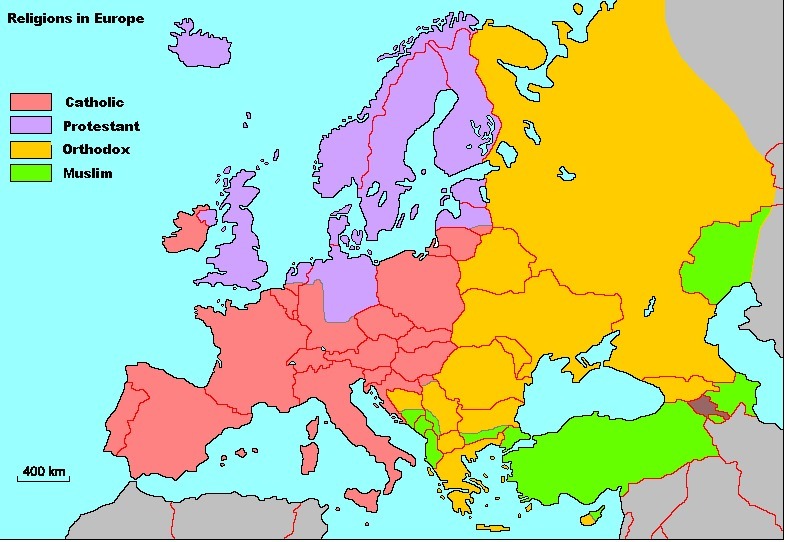
Along these lines, Roman Catholicism spread into Central and South America through Spanish and Portuguese colonies, while Protestantism spread into North America through immigrants from northern Europe -- including settlers fleeing persecution (such as the various anabaptist sects and the Puritans).
Protestant splintering did not stop with the Reformation. Confessional churches multiplied, merged, and divided again. Today there are tens of thousands of competing "Christian" groups. That fragmentation belongs to the same modern crisis of divided authority that runs through our modern worldview. Many local congregations, especially in the evangelical world, depend on little more than a popular pastor to hold them together -- another face of the same divided authority, not an exception to it.
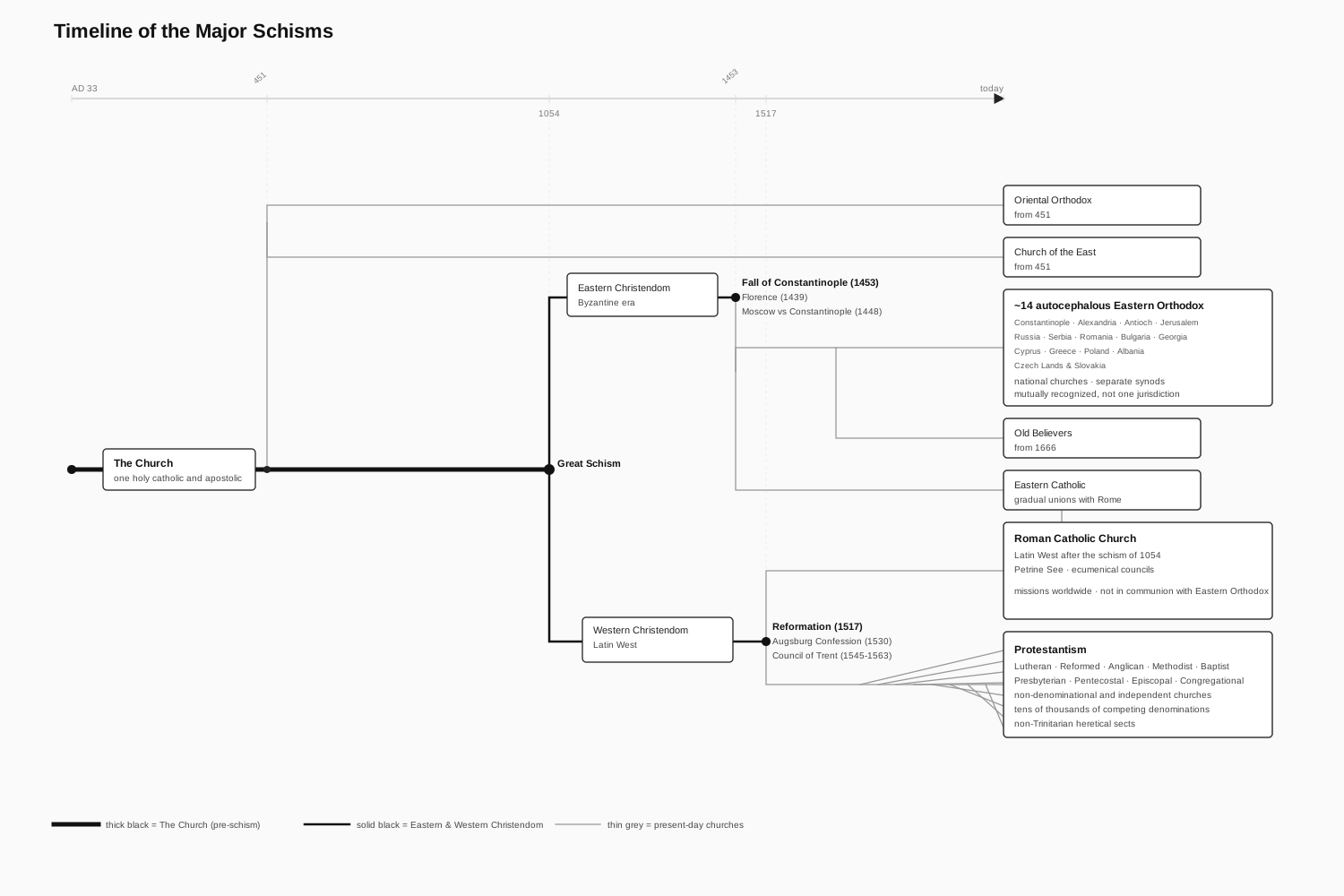
Timeline of the Major Schisms
Most modern churches like to imagine a single unbroken line from AD 33 straight through to their own church today. Such arrogant claims are misleading and historically illiterate. Church history is far more branched, contested, and nuanced than a simple pedigree suggests. Every schism (and there are countless more than any diagram can contain) is a tragedy, repeating the Fall of Man, a mortal wound due directly to our sin, to our pride in judging for ourselves what is His Church, rather than humbly submitting to His Church as guided by the Holy Spirit. Pursue Truth and submit to where Truth takes you, do not ever presume to judge His Church.
Christ's Church¶
In the midst of these continuous schisms, when someone says they are a Christian, what does that even mean?
As atheists are wont to point out, it is as if the so-called "Christians" are arbitrarily picking and choosing passages from scriptures that adhere to their modern secular worldview. In other words, is it Christ or antichrist that we are following?
One holy catholic and apostolic church has ostensibly become many: protestant, Roman Catholic, and Orthodox churches.
How does one find Truth in this chaos? How does one find the one holy catholic and apostolic church?
Matthew 16:18
And I also say to you that you are Peter, and on this rock I will build My church, and the gates of Hades shall not prevail against it.
Protestantism¶
The Protestant Reformation was not, in its own telling, a desire to multiply churches. It was a call to return to Christ and to Scripture -- to recover the gospel when the medieval church had obscured it through corruption and abuse. For Luther, Calvin, and the confessional traditions that followed them, sola scriptura meant conscience bound to God's written word, not license for each believer to invent his own religion. The Bible judges the church; the Christian submits.
Protestant ecclesiology, at its strongest, still affirms a visible church. The local congregation preaching the gospel, administering the sacraments, and exercising discipline is not optional spirituality but Christ's body in a definite place. Confessions such as the Augsburg Confession and the Westminster Confession were meant to guard that body against drift -- fixed standards by which a church could be recognized as faithful, not a menu of personal opinions.
Thoughtful Protestants have always known schism is a tragedy, not a triumph. The reformers broke communion with Rome because they believed the truth required it; they did not thereby solve the problem of where final authority resides when Christians disagree. Who judges disputed readings of Scripture when two confessing parties both appeal to the same Bible? Why have reformations and counter-reformations multiplied into tens of thousands of sects if one Holy Spirit guides one people? The softer Mere Christianity approach popular among mainline protestants -- major doctrines held in common, details left aside -- retreats from these questions rather than answering them.
The historical fruits are instructive. Institutions founded to preserve orthodoxy have not always endured on their own terms. The Puritans, for all their zeal to purify the church according to Scripture, bequeathed universities and denominations that, by the standards of their own founders, suggest the gates of hell can and did prevail against a church that lacks the visible unity Christ promised to Peter.
John 6:68
Then Simon Peter answered him, Lord, to whom shall we go? thou hast the words of eternal life.
The creed nevertheless confesses one holy catholic and apostolic church, not many. Protestantism's "invisible church" -- Christ's faithful known to God across separated bodies -- cannot be squared with that confession without making each believer the final court of appeal. If we name any single protestant denomination as the one church, we reason in circles; if we name none, we abandon visibility. Christ did not remain a spirit without a body; He was visible to His disciples, to the Pharisees, to the Romans, to the Canaanite woman, to everyone. The church He promised to Peter must be as visible as He is.
We must seek that one holy catholic and apostolic church. Protestantism named real abuses in Western Christendom; it does not, by itself, restore the unity Christ willed.
Orthodoxy¶
When Orthodox churches fall out of communion with one another, the breach is public. Reconciliation is not settled by a single "vicar of Christ" issuing judgment behind closed doors; the two sides must settle their differences before God, traditionally at an ecumenical council. There has been no council received as ecumenical by the whole Church in over a thousand years -- and from an Eastern perspective, that is largely because Rome departed from the conciliar order that defined the first millennium.
For the Orthodox, the goal is not unity purchased at the expense of truth. The goal is Christ. Apostolic tradition is not a dead archive but a living continuity: the same conciliar method that produced Nicea, Constantinople, Ephesus, and Chalcedon; the same liturgical life; the same patristic theology that guarded Christ's revelation before east and west divided. If the Church exists to draw souls into communion with Christ, then the faith once delivered to the saints is not a starting point to be revised but the very path by which He is known.
This is why many in the East do not see themselves as a sect that broke away. They see Rome as the one who left -- altering the Creed, claiming universal jurisdiction, defining dogmas without conciliar consent -- while the Eastern churches preserved what the undivided Church had received. The contrast with Protestantism is instructive: where the West's post-schism path produced scholastic systems and, eventually, endless fragmentation, Eastern Christianity did not undergo a reformation that shattered into tens of thousands of competing sects. Orthodoxy remained bound by conciliar authority and patristic consensus rather than private interpretation.
When error arises, the Orthodox method remains what it was in the ancient world: make every difference public, and resolve it in council under the guidance of the Holy Spirit. The schisms of the early centuries were, in this light, a painful but necessary feature of the Church's life -- the means by which the faith was clarified before communion could be restored. Councils were convoked in the Eastern Roman Empire under Constantine and his successors, and they deepened the Church's articulation of Christ's truth precisely because division forced the Church to speak with one voice.
In the first millennium, Rome herself was honored within the pentarchy of patriarchates -- first in dignity, presiding in charity, yet without the universal jurisdiction later claimed. Supreme authority belonged to ecumenical councils, not to one bishop acting alone. On this reading, the East did not "stagnate." It remained at the father's house, preserving the inheritance of the one holy catholic and apostolic church while Rome and its protestant offspring went into a far country.
The hardest questions Rome must answer
From the Eastern perspective, several matters stand between east and west -- not mere cultural misunderstandings, but substantive differences that must be resolved before unity can be discussed honestly.
The filioque is foremost: the addition of "and the Son" to the Nicene Creed without the consent of an ecumenical council. If no single church may rewrite what a council defined for the whole Church, on what authority was the Creed altered -- and why did the East not fall into the heresy the clause was said to guard against, even without it?
St. Photius the Great
If the Spirit proceeds from the Son as well as from the Father, then there are two principles in the Trinity, which is intolerable.
St. Gregory Palamas
The Spirit is from the Father, not from the Son; but through the Son He is sent to us.
Papal supremacy and infallibility raise the same structural difficulty. For most of church history, no bishop -- including the bishop of Rome -- claimed the universal, immediate jurisdiction and doctrinal finality defined at Vatican I in AD 1870. Was the entire early Church wrong until modern Rome corrected it? And what of Vatican II -- does it deepen conciliar Christianity, or extend the same pattern of Roman unilateralism that the East has resisted since the eleventh century?
If Rome accuses the East of refusing to develop, the East turns the question back: what heresy does Orthodoxy teach today that it did not teach when east and west were one? If apostolic tradition is the standard by which innovation is judged, why is Rome's post-schism development the measure of faithfulness, and Constantinople's continuity a failure?
Many Orthodox Christians have concluded that Rome is in heresy and in schism from Christ's Church -- that the See of Peter, once first in honor, claimed what no council granted, altered the Creed, and demanded submission as the price of reunion. The East, on this reading, has kept the father's household while awaiting Rome's repentance and return.
The parable of the prodigal son
Christ's parable admits more than one honest reading, and both east and west have reached for it. It is worth hearing each before we assign roles.
In the Eastern reading, Rome is the younger son who took his inheritance early -- the authority and dignity of the apostolic See -- and departed for a far country of innovation: the filioque, papal supremacy, scholastic theology, and the Reformation schisms that followed. The East remained in the father's house, preserving liturgy, councils, and sacramental life. Rome, even while lost, remained a son; reunion remains possible. But the older son's sin in the parable is not that he stayed home. It is that he refused to rejoice when his brother returned. Any reunion that does not restore the conciliar faith of the first millennium is no reunion at all.
In the Catholic reading, both sons failed the father in different ways. The younger son squandered visible unity; the older son hardened his heart against the father's joy. East and west alike are wounded. The question is not only who left, but who will humble himself and come to the feast when Christ restores communion. Neither side may claim to stand sinless in a schism that has lasted a thousand years.
We ought to see ourselves in both sons -- called to return where we have wandered, and called to rejoice where we have refused forgiveness. The parable does not permit a comfortable identification with only one side.
Luke 15:11-24
And he said, A certain man had two sons: And the younger of them said to his father, Father, give me the portion of goods that falleth to me. And he divided unto them his living. And not many days after the younger son gathered all together, and took his journey into a far country, and there wasted his substance with riotous living. And when he had spent all, there arose a mighty famine in that land; and he began to be in want. And he went and joined himself to a citizen of that country; and he sent him into his fields to feed swine. And he would fain have filled his belly with the husks that the swine did eat: and no man gave unto him. And when he came to himself, he said, How many hired servants of my father's have bread enough and to spare, and I perish with hunger! I will arise and go to my father, and will say unto him, Father, I have sinned against heaven, and before thee, And am no more worthy to be called thy son: make me as one of thy hired servants.
And he arose, and came to his father.
But when he was yet a great way off, his father saw him, and had compassion, and ran, and fell on his neck, and kissed him. And the son said unto him, Father, I have sinned against heaven, and in thy sight, and am no more worthy to be called thy son. But the father said to his servants, Bring forth the best robe, and put it on him; and put a ring on his hand, and shoes on his feet: And bring hither the fatted calf, and kill it; and let us eat, and be merry: For this my son was dead, and is alive again, he was lost, and is found. And they began to be merry.
Now his elder son was in the field: and as he came and drew nigh to the house, he heard musick and dancing. And he called one of the servants, and asked what these meant. And he said unto him, Thy brother is come; and thy father hath killed the fatted calf, because he hath received him safe and sound. And he was angry, and would not go in: therefore came his father out, and intreated him. And he answering said to his father, Lo, these many years do I serve thee, neither transgressed I at any time thy commandment: and yet thou never gavest me a kid, that I might make merry with my friends: But as soon as this thy son was come, which hath devoured thy living with harlots, thou hast killed for him the fatted calf.
And he said unto him, Son, thou art ever with me, and all that I have is thine. It was meet that we should make merry, and be glad: for this thy brother was dead, and is alive again; and was lost, and is found.
Where the Catholic Church must answer
The Eastern case is strong. It must be engaged on its own terms, not dismissed. Yet the accusation that Rome alone "innovated" must be analyzed carefully, and that standard must be held universally.
The Catholic Church affirms that Eastern Orthodox churches possess valid apostolic succession and sacraments (see Vatican II's Unitatis Redintegratio §15). The reverse is not affirmed in the same way: Eastern Orthodox churches generally hold that Catholic sacraments are not valid, even though the points of difference do not rise to the Christological errors -- such as Arianism -- that historically invalidated orders. If innovation is the test, both sides must submit to it.
One very significant post-schism development on the Eastern side is autocephaly. The word means "self-headed," and in modern Orthodox usage it denotes a national church that governs itself fully: its own primate, its own Holy Synod, its own right to consecrate bishops and (in most cases) Holy Chrism, subject to no higher earthly authority. That is not what the pre-schism Church looked like.
In the first millennium, the Church was organized as a pentarchy of patriarchates -- Rome, Constantinople, Alexandria, Antioch, and Jerusalem -- within one visible communion. Rome held primacy of honor; Constantinople, after the relocation of the imperial capital, was second. The patriarchs were not sovereign equals in the modern sense. They were bound to one another, to ecumenical councils, and -- in the Latin West and in countless Eastern appeals -- to the See of Peter at Rome as the court of final resort. When disputes arose, churches did not settle them by declaring national independence. They appealed to Rome, or they waited for the next council.
That order did not survive the collapse of Christian empire in the East. Constantinople fell to the Ottomans in AD 1453. The Byzantine state that had convoked and sustained ecumenical councils was gone. Moscow had already broken communion with Constantinople over Florence and elevated its own metropolitan in AD 1448; decades later, Russia would be recognized as a patriarchate, but on a new political footing, not as one member of a living pentarchy under Rome. The ancient framework of five patriarchs in one universal Church gave way, slowly, to a world of Ottoman millet politics, tsarist synods, and national awakenings.
The strict autocephalous ecclesiology familiar today -- a diptych of fourteen or more fully independent churches, each issuing tomoses of autocephaly to the others, often along ethnic or national lines -- did not fully emerge until long after 1453. It took shape across the nineteenth and twentieth centuries: the Church of Greece declared independent of Constantinople in the 1830s; Romania, Serbia, and Bulgaria followed as nation-states formed; the Moscow Patriarchate was reconstituted under Soviet auspices in 1943; Albania, Poland, and Czechoslovakia received tomoses in the twentieth century. When the Patriarchate of Constantinople condemned ethnophyletism at a council in AD 1872 -- the organizing of the Church by race and nation rather than by catholic unity -- it was responding to a model of church governance that was already spreading and would only spread further.
This is a dramatic change from the pre-schism Church. The third-century fathers did not envision a federation of fully sovereign national synods. Neither did the fathers of Nicea, Chalcedon, or the pentarchy. They knew one Church, one faith, one visible communion -- with Rome as Peter's chair and councils as the voice of the whole Church when bishops assembled in the Holy Spirit. Modern autocephaly, however defensible in pastoral terms, replaces that catholic structure with a system in which the highest court of appeal is often another autocephalous church's synod, or Constantinople's grant of a tomos, rather than the universal primacy Christ entrusted to Peter. It is difficult to see how the Church Fathers would have recognized this as the same ecclesiology they died defending.
St. Cyprian, On the Unity of the Church (c. 251)
There is one God and one Christ, and one Church, and one chair founded on Peter by the word of the Lord. It is not possible to set up another altar or to constitute another priesthood besides that one altar and one priesthood. If someone does not hold fast to this unity of Peter, can he imagine that he still holds the faith? If he desert the chair of Peter upon whom the Church was built, can he still be confident that he is in the Church?
The schism is a tragedy beyond measure. It has lasted a thousand years, and the gates of hell have not prevailed on either east nor west. The wound of division has endured because of our sins, which only Christ can heal.
Catholicism¶
The word catholic simply means universal, and the creed confesses one holy catholic and apostolic church. That is the starting point. Prior to the Great Schism, that church existed in both the East and the West -- one faith, one baptism, one communion, governed under Christ by councils and bishops, with Rome already recognized as first in honor and final in appeal.
There is a thousand years of historical evidence for this unity: ecumenical councils, church fathers, and even pagan Roman history attesting to the persecution of Christians who belonged to one Church, not many. Necessarily, both east and west were Christ's church in that first millennium. Other than the wound of division growing deeper over time, the question is whether either side at some point ceased to be His church at all.
For centuries after AD 1054, most Christians had no idea a schism had occurred. Entire generations lived and died unaware. Those who did know assumed it would be healed, as prior schisms had been. The wound was real from the beginning; it was only the pace at which its gravity became undeniable that varied.
Likewise, one or both sides of the Great Schism is necessarily in error. This is true of any schism. The parable of the prodigal son does not permit either east or west to stand sinless before the Father. It is perhaps wise to approach both traditions with humility, looking for Christ obediently rather than confirming what we already prefer.
While earlier schisms often produced failed sects, like the many gnostic or Arian groups, Eastern and Western Christianity have both endured over a thousand years in division. The gates of hell have not prevailed against either. Worldly empires rose and fell on both sides; the Church survived.
A common objection
Much confusion comes from the name Roman Catholic. The word Roman is often taken to mean the church of the Holy Roman Empire -- as though Catholic unity were the universal authority of a medieval Germanic state. That empire dates to AD 962, less than a century before the Great Schism of AD 1054. For centuries after its founding it was not even called "Holy Roman"; it later became known as the Holy Roman Empire of the Germanic Nation. Prior to its rise, there was no presumption of a supreme worldly Christian authority over all Christendom. The Church was unified under Christ and guided by the Holy Spirit, not by a kingdom that would not exist until nearly a thousand years after Christ.
Despite the name, the Holy Roman Empire was not the continuation of the old Roman Empire, nor even the Western Roman Empire which had fallen in AD 476.
Voltaire
This agglomeration which was called and which still calls itself the Holy Roman Empire was neither holy, nor Roman, nor an empire.
The objection has force. But the name is not the claim. The creed's one holy catholic and apostolic church predates the Holy Roman Empire by centuries. The Catholic claim rests on apostolic succession, conciliar history, and Christ's promise to Peter -- not on the politics of medieval Germany.
We cannot choose; we must be led
Importantly, we as Christians cannot judge His church as though from outside it. Truth is not decided by our judgement, but by His revelation and His judgment. If "you" decide to be Catholic or Orthodox or even protestant, you are choosing nihilism and not Christ.
"You" do not determine truth.
"You" can only rationalize beliefs.
And your beliefs are irrelevant to Truth, who is the person Christ Jesus.
This does not leave us paralyzed. Christ did not promise an invisible church discernible only by private preference. He promised one Church, visible as He is visible, and gave Peter the keys. We are not asked to invent the Church by feeling. We are asked to submit to the Church He founded -- which means discerning, in fear and trembling, where the visible continuity with Peter and the apostles still lives. The Great Schism has persisted nearly a thousand years as the fruit of human sin, and only Christ can and will restore the visible unity He prayed for. Our task is to follow Him there, not to appoint ourselves judge.
Objections from the East
The Orthodox section above named the filioque, papal supremacy, and post-schism dogmatic development as obstacles to reunion. Those objections must be answered, not waved away.
From the East, the sharpest form of the case runs like this: Rome altered the Creed, claimed universal jurisdiction, and defined new dogmas unilaterally. Unification, if it comes at all, must begin with Rome's repentance. From Rome, the answer begins differently: the Eastern Catholic Churches show that reunion does not require the East to abandon its liturgy, spirituality, or patristic heritage. What is required is communion with Peter. The Catholic answer to whether heretical innovations block reunion is therefore maybe -- it depends on whether a given difference is a genuine departure from the deposit of faith, or a legitimate development of what the first millennium already contained.
One objection states the Catholic position in its most suspicious form: reunion is not about Christ at all, but only about the universal jurisdiction of the Roman Pontiff (primacy of jurisdiction over the whole Church of God, both episcopal and immediate, as defined at Vatican I). If that were the whole story, the East would be right to refuse. But is that what Catholicism actually teaches?
Catholics claim that the primacy of Peter did not begin at Vatican I. It was witnessed across the first millennium. The harder questions concern infallibility: whether Peter's successors can speak without error when defining doctrine for the whole Church, and why such a charism would be defined only in AD 1870.
The Catholic Church must answer these charges on their merits. Papal infallibility, when the Roman Pontiff speaks ex cathedra, guards the Church's definitive teaching, not the Pope's personal sinlessness. It does not mean the Pope cannot sin, err in private judgment, or require fraternal correction in matters of conduct. Paul rebuked Peter at Antioch over table fellowship with Gentiles -- a failure of consistency in behavior, not a dogmatic definition binding the whole Church. Christ rebuked Peter's refusal to accept the Cross -- a rebuke of carnal thinking, not a revocation of the keys He had just given.
Galatians 2:14
But when I saw that they walked not uprightly according to the truth of the gospel, I said unto Peter before them all, If thou, being a Jew, livest after the manner of Gentiles, and not as do the Jews, why compellest thou the Gentiles to live as do the Jews?
And, most fascinating and perhaps with great prescience, the greatest rebuke to Peter came immediately after Christ promised that Peter is the rock upon which Christ will build His church.
Matthew 16:21-23
From that time forth began Jesus to shew unto his disciples, how that he must go unto Jerusalem, and suffer many things of the elders and chief priests and scribes, and be killed, and be raised again the third day. Then Peter took him, and began to rebuke him, saying, Be it far from thee, Lord: this shall not be unto thee. But he turned, and said unto Peter, Get thee behind me, Satan: thou art an offence unto me: for thou savourest not the things that be of God, but those that be of men.
No man except the God-man is infallible. But even if we grant the claim of papal infallibility, why would its formal definition come in AD 1870? Why Rome alone? Peter also founded the church in Antioch. Old Rome had fallen long before the schism hardened. These are serious questions.
Ecumenical councils continued through the first millennium alongside real Roman primacy, not because Rome was absent, but because the Church's life included both local bishops and a universal center of unity. The councils and Peter's chair were not rivals. Vatican II's Unitatis Redintegratio likewise did not replace the dogma of papal primacy with a new ecclesiology; it acknowledged the sacramental reality of the Eastern Orthodox Churches while calling for restoration of full communion under the one Christ.
And yet, like the prodigal son, the Roman Church remains Christ's church, even when she has squandered unity through pride and worldly ambition. The wound is real. The inheritance is not forfeited.
Even Pope Gregory the Great -- one of the greatest and most respected popes in history -- rejected the title of “universal bishop.” In letters written between 595 and 604, he called it a proud and dangerous innovation that would destroy the true unity of the Church and prepare the way for the antichrist.
Pope Gregory the Great (letters to Patriarch John IV and Emperor Maurice, 595-604)
I say it confidently, because whoever calls himself “universal bishop” or desires to be so called, is in his pride the forerunner of the antichrist... For if one is universal, it follows that you are not a bishop.
What exactly is the official position of the Catholic Church?
The Catholic Church teaches something more ancient and more careful than the objection allows.
The official doctrine, defined at the First Vatican Council (Pastor Aeternus, 1870) and rooted in the first millennium, is that the Roman Pontiff possesses a primacy of jurisdiction over the whole Church of God -- not as a worldly monarch, but as the visible center of unity and the servant of the servants of God. This jurisdiction is episcopal and immediate, meaning it can be exercised directly for the good of the whole flock, yet it does not abolish the ordinary jurisdiction of bishops in their own dioceses.
Pope Gregory the Great was right to condemn a "universal bishop" if that title is taken to mean a single earthly head replacing Christ. The head of the Church is Christ, exactly as the Catholic Church teaches:
Catechism of the Catholic Church (CCC 792)
Christ is the Head of the Church.
Gregory refused the title, yet exercised the care of the whole Church from Peter's chair. Catholics see no contradiction: primacy of jurisdiction is not papal replacement of Christ, but the office by which Christ willed His flock to remain one.
The primacy of jurisdiction is not a later invention. It is the development of what was already witnessed in the first thousand years.
Pope Victor I (c. 189-199) excommunicated the churches of Asia Minor over the date of Easter -- a direct exercise of authority over distant churches that provoked strong reaction from the East, proving it was understood as real power, not mere honor.
Pope Leo I the Great (440-461) saw his Tome to Flavian accepted by the Council of Chalcedon (451) as the orthodox definition of Christ’s two natures, with the fathers acclaiming “Peter has spoken through Leo.” Leo later annulled Canon 28 of Chalcedon, which attempted to elevate Constantinople -- a clear act of jurisdictional authority over an ecumenical council.
Pope Gregory the Great himself (590-604) sent St. Augustine of Canterbury to convert England and placed the new English Church under Roman authority. He intervened in the Frankish Church, corrected bishops, and defended the rights of the Roman See against Constantinople’s claims.
Pope Gregory the Great
The care of the whole Church has been committed to me, though unworthy, in the place of Peter, the prince of the apostles.
Pope Gregory the Great also referred to the Roman Church as having the “principatus” (primacy) and the duty to care for the universal Church.
These were not acts of mere honor. They were the exercise of real, recognized authority for the unity of the Church.
The Catholic Church also teaches that the Eastern Orthodox Churches possess valid apostolic succession and true sacraments (see Vatican II, Unitatis Redintegratio §15). The schism is real, but it has not destroyed the sacramental life Christ gave to His Church.
Ultimately, the wounds of the schism are manifest in our worldly ambitions. The Church has always been under attack -- not only from outside, but from within. Demonic powers and the spirit of antichrist have sought to undermine the visible unity Christ willed, through pride, division, and distortion of Truth in every age. And yet, the gates of hell have not prevailed, and will not prevail.
We began with chaos: tens of thousands of sects, three major traditions, and the question of where Christ's one Church is to be found. We do not answer that question by autonomous choice. We answer it by asking where Christ kept His promise -- that the gates of hell would not prevail against the Church built on Peter. The schism is a wound in that Church, not proof that Christ failed. East and west both bear guilt; east and west both bear the marks of apostolic continuity. The path forward is not comfortable identification with one son in the parable, but repentance, humility, and the hunger to come home to the Father -- together, at one altar, under one Christ.