Annunciation of Christ
The Annunciation is the moment the eternal Logos -- the very Word of God, objective Truth -- entered human history. In the womb of the Virgin Mary, the Word became flesh. This is not merely a historical event; it is the decisive turning point of all creation.
Annunciation of Christ
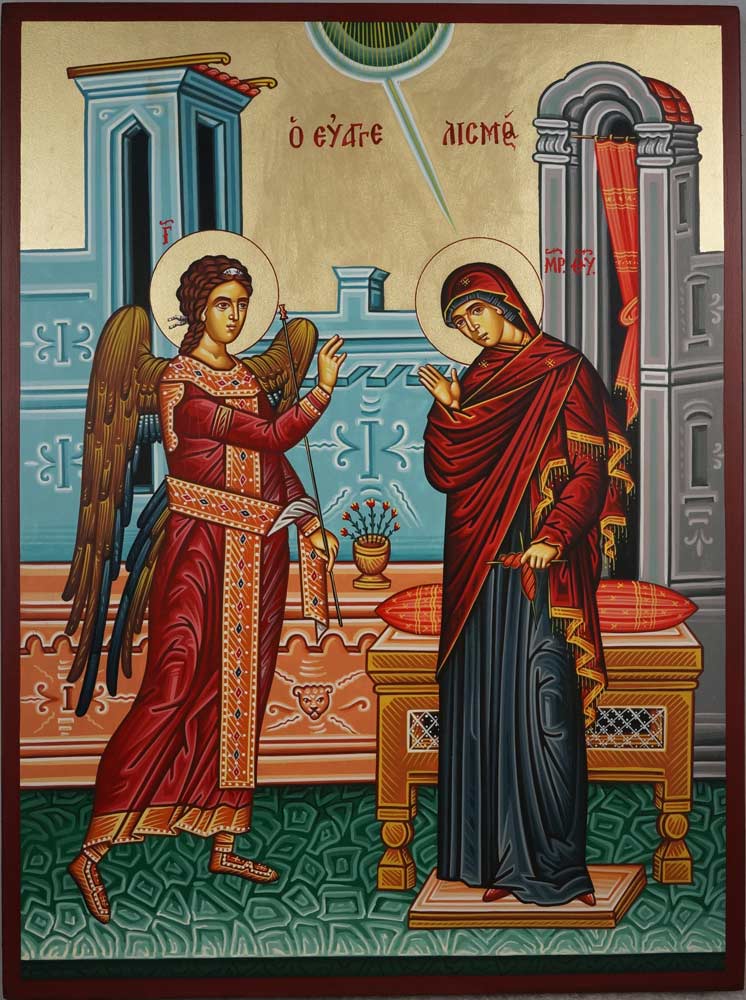
Byzantine icon of the Evangelismos (ὁ Εὐαγγελισμός). The Archangel Gabriel announces to the Virgin Mary that she will conceive and bear the Son of God. Mary raises both hands, palms outward, in the gesture of the orans -- the posture of humble acceptance before God, expressing her Fiat: be it unto me according to thy word. Lilies between the figures signify her virginity; the ray descending from above signifies the overshadowing of the Holy Spirit.
Fullness of Time
John 1:1-5
In the beginning was the Word, and the Word was with God, and the Word was God. The same was in the beginning with God. All things were made by him; and without him was not any thing made that was made. In him was life; and the life was the light of men. And the light shineth in darkness; and the darkness comprehended it not.
In the many centuries before Christ, the Roman Empire rose to power. In this era we see the stability of trade routes -- culture and art spread from one end of the empire to the other. We see the proliferation of the Greek language, the flourishing of a Jewish diaspora, and a synthesis of Greek philosophy and Judaism (see the Septuagint).
In this synthesis the heathens began to recognize the necessity of a first principle of logos. Meanwhile the remnants of the Babylonian and Medo-Persian empires had similarly been seeded with Jewish religious thought. From east to west the gentile world was infused with Jewish monotheism; the innovative idea that there was one and only one God, and that we are made in His image; moreover that our suffering was not due to the whims of careless parochial gods, but that there was a fall from grace, an original sin, that through pride man turned away from his created purpose, turning away from the one true God.
The more nuanced understanding was not just fallen man living in a depraved state -- but that there were several rebellions, the last of which left man scattered across the earth, speaking in foreign languages, and ruled over by principalities and powers. While the Romans attempted to shove every local god into their pantheon, it was understood that the God of Israel was the one true God, and that there would be a coming Messiah who would rule in the midst of his enemies. In other words, the Romans offered a worldly kingdom of man, and the Jewish prophecy spoke of redemption and a Kingdom of God.
In a very profound sense, the world (both Jew and Gentile) began to understand the nature of man's fallen state and their very real need for the Messiah. It was precisely then that God acted:
Galatians 4:4
But when the fulness of the time was come, God sent forth his Son
The eternal Logos -- the Son of God -- was about to enter history. And so the Word became flesh:
John 1:14
And the Word was made flesh, and dwelt among us, (and we beheld his glory, the glory as of the only begotten of the Father) full of grace and truth.
Angel Gabriel
The moment arrived. The angel Gabriel was sent to a virgin in Nazareth named Mary. What follows is one of the most pivotal conversations in human history:
Luke 1:30-38
And the angel said unto her, Fear not, Mary: for thou hast found favour with God. And, behold, thou shalt conceive in thy womb, and bring forth a son, and shalt call his name JESUS. He shall be great, and shall be called the Son of the Highest: and the Lord God shall give unto him the throne of his father David: And he shall reign over the house of Jacob for ever; and of his kingdom there shall be no end.
Then said Mary unto the angel, How shall this be, seeing I know not a man?
And the angel answered and said unto her, The Holy Ghost shall come upon thee, and the power of the Highest shall overshadow thee: therefore also that holy thing which shall be born of thee shall be called the Son of God. And, behold, thy cousin Elisabeth, she hath also conceived a son in her old age: and this is the sixth month with her, who was called barren. For with God nothing shall be impossible.
And Mary said, Behold the handmaid of the Lord; be it unto me according to thy word. And the angel departed from her.
Be it unto me according to thy word. This is Mary's Fiat -- her great act of faith and obedience. This young girl from the village of Nazareth became the first believer in Christ Jesus.
Mary's Song
Mary's response was not only obedience but overflowing praise. Her song, the Magnificat, echoes through the ages as the perfect hymn of the humble soul. As Matthew the Poor wrote, Mary's Song is a hymn belonging to both testaments:
Luke 1:46-55
My soul magnifies the Lord,
And my spirit has rejoiced in God my Savior.
For He has regarded the lowly state of His maidservant;
For behold, henceforth all generations will call me blessed.
For He who is mighty has done great things for me,
And holy is His name.
And His mercy is on those who fear Him
From generation to generation.
He has shown strength with His arm;
He has scattered the proud in the imagination of their hearts.
He has put down the mighty from their thrones,
And exalted the lowly.
He has filled the hungry with good things,
And the rich He has sent away empty.
He has helped His servant Israel,
In remembrance of His mercy,
As He spoke to our fathers,
To Abraham and to his seed forever.
The prophet Zechariah had already glimpsed this fulfillment:
Zechariah 9:9
Rejoice greatly, O daughter of Zion; shout, O daughter of Jerusalem: behold, thy King cometh unto thee: he is just, and having salvation; lowly, and riding upon an ass, and upon a colt the foal of an ass.
St. Ambrose, one of the great Fathers of the Church, saw in Mary's song the model for every Christian soul:
St. Ambrose
Let the soul of Mary be in each one of you to magnify the Lord. Let the spirit of Mary be in each one of you to rejoice in God. If we are faithful, Christ is born in us by faith; and the soul that has conceived Christ by faith magnifies the Lord.
Mary's humble Fiat and her Magnificat together reveal the pattern of all true discipleship: total surrender to the will of God, followed by joyful praise of His mercy and justice.
Emmanuel
Joseph, a just man, faced a profound mystery. As he pondered what to do with Mary, the angel of the Lord appeared to him in a dream and revealed the fulfillment of ancient prophecy:
Matthew 1:19-23
Then Joseph her husband, being a just man, and not willing to make her a publick example, was minded to put her away privily. But while he thought on these things, behold, the angel of the Lord appeared unto him in a dream, saying, Joseph, thou son of David, fear not to take unto thee Mary thy wife: for that which is conceived in her is of the Holy Ghost. And she shall bring forth a son, and thou shalt call his name JESUS: for he shall save his people from their sins.
Now all this was done, that it might be fulfilled which was spoken of the Lord by the prophet, saying, Behold, a virgin shall be with child, and shall bring forth a son, and they shall call his name Emmanuel, which being interpreted is, God with us.
In that name -- Emmanuel, God with us -- the eternal Logos took on human flesh. The objective Truth was no longer distant or abstract. He had come to dwell among us.
God With Us
At the Annunciation the eternal Logos -- the objective Truth Himself -- entered human history by becoming flesh in the womb of the Virgin Mary.
What began in Nazareth is not confined to the past. In the Catholic Church this same incarnate Logos remains objectively and fully present: Body, Blood, Soul, and Divinity, especially in the Holy Eucharist. Here the Word continues to dwell among us, nourishing His people with His own life until He comes again in glory.
The same Christ who was conceived by the power of the Holy Spirit in Mary’s womb is the Christ who is truly present on our altars today. In Him the promise of Emmanuel -- God with us -- is fulfilled not only historically, but sacramentally, generation after generation.