Agony in the Garden
Christ had just instituted the Holy Eucharist at the Last Supper. Judas had already departed to arrange the betrayal. Chriat leads the eleven apostles across the Kidron Valley to the Mount of Olives, to a garden called Gethsemane. Here the Passion begins in earnest.
Modern sentiment often reduces this scene to ordinary human anxiety or emotional weakness. The ancient Church has always beheld something far deeper: the incarnate God confronting in full the cup of divine wrath against sin. In Gethsemane the perfect obedience of the Son meets the full reality of human rebellion.
Agony in the Garden
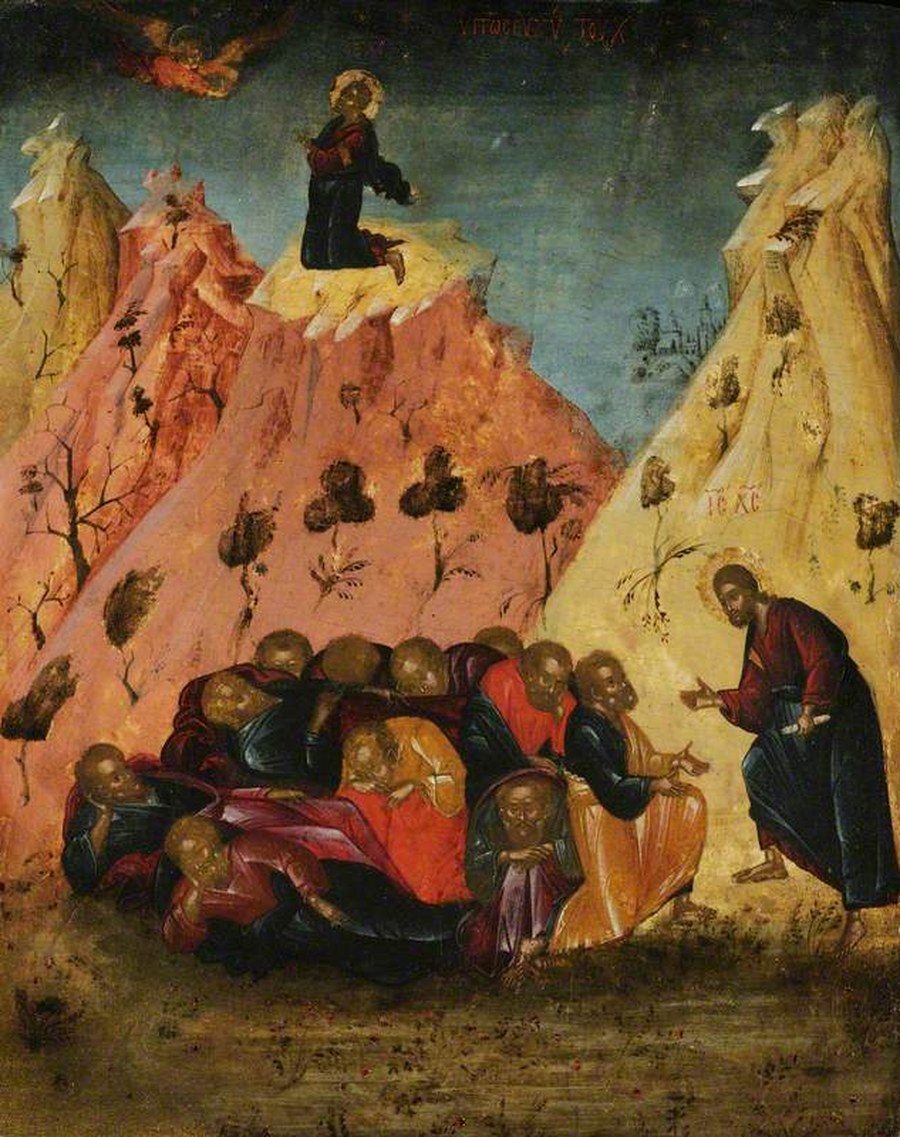
Byzantine icon of the Agony in the Garden (Μολή εἰς τὸν κῆπον). Cretan School; Christ Church, University of Oxford. Christ kneels in prayer upon the rock of Gethsemane as an angel descends from heaven; the apostles sleep below while He returns to find them and calls them to watch. The incarnate Son confronts the full weight of the Passion and submits His human will perfectly to the Father.
Gethsemane
The Gospels record the exact transition from the Upper Room to the place of agony. After the Last Supper and Judas’s departure, Christ leads the eleven apostles across the Kidron Valley to an olive grove on the Mount of Olives known as Gethsemane.
Matthew 26:36
Then cometh Jesus with them unto a place called Gethsemane, and saith unto the disciples, Sit ye here, while I go and pray yonder.
The ancient Church reads this arrival as deliberate. The Son of God chooses the very spot where the first Adam fell and where the second Adam will now reverse that fall through perfect obedience. No sentimental vagueness is permitted here: the incarnate Lord has come to this garden to begin the work that restores paradise.
Prayer in the Garden
Christ takes Peter, James, and John a little farther into the garden and commands them to watch with Him. He then withdraws alone, falls on His face, and prays.
Matthew 26:39
And he went a little further, and fell on his face, and prayed, saying, O my Father, if it be possible, let this cup pass from me: nevertheless not as I will, but as thou wilt.
The ancient Church reads this prayer as the supreme act of filial obedience. The incarnate Son confronts the full cup of divine wrath against sin and submits His human will perfectly to the Father. No modern psychologizing of mere anxiety is permitted here: this is the reversal of Adam’s disobedience. The patristic consensus sees in these words the foundation of our redemption.
Prayer in the Garden
Christ takes Peter, and the brothers James and John, into the garden and commands them to watch with Him. He then withdraws alone, falls on His face, and prays.
Matthew 26:39
And he went a little further, and fell on his face, and prayed, saying, O my Father, if it be possible, let this cup pass from me: nevertheless not as I will, but as thou wilt.
The ancient Church reads this prayer as the supreme act of filial obedience. The incarnate Son confronts the full cup of divine wrath against sin and submits His human will perfectly to the Father. No modern psychologizing of mere anxiety is permitted here: this is the reversal of Adam’s disobedience. The patristic consensus sees in these words the foundation of our redemption.
Sweating Blood
In the depth of that solitary prayer the incarnate Son enters into such profound sorrow that His sweat becomes blood. This is no mere metaphor or exaggeration. The Gospel records a literal physiological reality under the crushing weight of what He must do.
Luke 22:44
And being in an agony he prayed more earnestly: and his sweat was as it were great drops of blood falling down to the ground.
The ancient Church has always understood this as the true humanity of Christ pressed to its absolute limit. The sinless One bears the full guilt of the world, and His body responds with hematidrosis, a medically attested phenomenon that occurs only under extreme mental and spiritual anguish. The Fathers saw here the second Adam reversing the first: where Adam’s disobedience brought death, the Son’s perfect obedience begins to pour out His lifeblood before the nails ever touch Him. This is the Lamb of God already beginning the sacrifice that redeems the world. The blood that will flow from the cross has its first visible drops here in the garden.
Failed Vigil
Christ returns from His solitary prayer to Peter, James, and John, the three He had chosen to watch with Him. He finds them sleeping.
Matthew 26:40-41
And he cometh unto the disciples, and findeth them asleep, and saith unto Peter, What, could ye not watch with me one hour? Watch and pray, that ye enter not into temptation: the spirit indeed is willing, but the flesh is weak.
The ancient Church has always understood this as a profound revelation of human frailty even in the closest circle of the apostles. Fresh from the Eucharist and Christ’s own words, they could not keep vigil one hour, in the hour of His agony. Their heavy eyes expose the weakness of fallen flesh when left to itself. The Fathers therefore urge every soul to heed the Lord’s command: watch and pray. For the spirit may be willing, but without vigilant prayer the flesh will fail precisely when the battle for redemption is joined. Christ alone remains fully awake and obedient.
Betrayal
Judas arrives at the head of a multitude armed with swords and staves, sent from the chief priests, scribes, and elders. The traitor had given them a sign: the one he kisses is Jesus. He steps forward and kisses the Master.
Matthew 26:49-50
And forthwith he came to Jesus, and said, Hail, master; and kissed him. And Jesus said unto him, Friend, wherefore art thou come? Then came they, and laid hands on Jesus, and took him.
The ancient Church has always seen in this kiss the ultimate depth of human betrayal. One of the twelve, who had walked with the Lord, eaten at His table, and heard every word of the Kingdom, now delivers the Son of God into the hands of sinners. Yet even in this darkest moment the incarnate Christ addresses the traitor as “Friend.” The Fathers teach that this single word reveals the boundless mercy of the One who came to save even those who reject Him. The arrest that follows is not the victory of evil but the voluntary surrender of the Lamb who lays down His life. Here the Passion moves from prayer to fulfillment: the Shepherd is struck and the sheep are scattered, exactly as the Scriptures foretold.