Carrying the Cross
From the praetorium the Lord Jesus is led forth, condemned to die. The rough-hewn beam of the cross is laid upon His bleeding shoulders.
In this moment the incarnate Son of God takes up the wood of execution. He who is without sin bears in His own body the instrument of the curse. Here the Second Adam embraces the tree that the first Adam could not bear, reversing in His flesh the ancient fall.
The Church Fathers contemplated this procession as the supreme mystery of obedience. Through the wood death had entered the world; through this wood the Author of life now carries death itself back to the Father, that by His voluntary suffering the many might be made alive.
Carrying the Cross
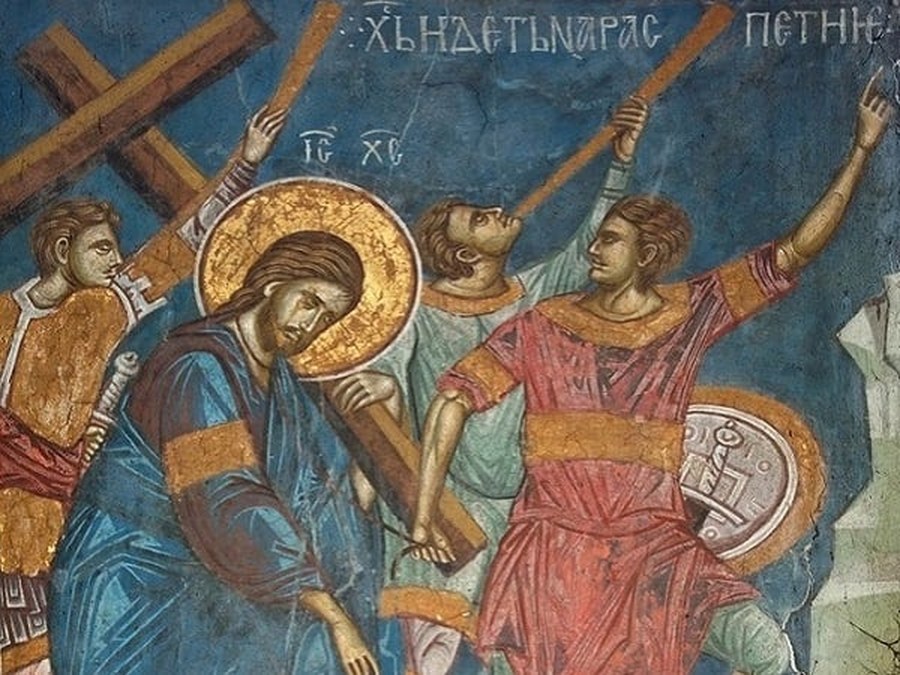
Byzantine fresco of the Carrying of the Cross (Ἡ Σταυροφορία / Ἡ Ἀνάβασις εἰς τὸν Σταυρόν). Christ advances toward Golgotha with the cross upon His shoulders; soldiers press around Him and force the wood of execution forward. The incarnate Son, who is without sin, bears in His own body the instrument of the curse and walks the sorrowful path of obedience that reverses the fall of the first Adam.
Road to Calvary
Out from the praetorium the Lord Jesus is led forth, the rough crossbeam laid upon His torn shoulders. The road stretches before Him, a narrow ascent through the streets of Jerusalem toward the place of execution.
John 19:17
And he bearing his cross went forth into a place called the place of a skull, which is called in the Hebrew Golgotha
This is no ordinary path of punishment. Here the incarnate Son of God walks as both Priest and Victim, bearing in His own body the full weight of the world’s guilt. Every step is an act of perfect obedience, the willing acceptance of the curse that fell upon humanity through the first Adam’s tree.
The Church Fathers contemplated this "via dolorosa" (sorrowful path) as the supreme reversal of Eden. Where Adam fled from God in the garden, the Second Adam now advances toward death. Where disobedience had barred the way to life, this obedient procession opens the gate to paradise once more.
In the God-Man staggering beneath the cross the mystery of our redemption is enacted: voluntary suffering offered in love, the innocent bearing the penalty of the guilty, so that by His stripes we might be healed and restored to the Father.
Simon of Cyrene
The Lord Jesus staggers beneath the crossbeam on the steep ascent to Calvary, His strength failing after the scourging. The soldiers seize a passer-by coming in from the fields and compel him to carry the cross after the condemned.
Mark 15:21
And they compel one Simon a Cyrenian, who passed by, coming out of the country, the father of Alexander and Rufus, to bear his cross.
The ancient Church beholds in Simon of Cyrene the living image of every disciple drawn into the mystery of the Passion. A stranger from the fields is suddenly yoked to the very wood of redemption. What begins as compulsion is transformed into participation in the Saviour’s obedience. The Fathers teach that this is the pattern of Christian life: the cross is frequently laid upon us by divine providence, that we may walk behind the Second Adam and share in His redemptive suffering.
In this forced helper the mystery of co-suffering with Christ is made visible. Simon carries the cross after Jesus, showing how the disciple is united to the Master not by choice alone but by the grace that enables voluntary acceptance of the burden. Through this one man the entire body of believers is invited to take up its own cross and follow.
Daughters of Jerusalem
The Lord Jesus presses on toward Golgotha amid the crowd. Women of Jerusalem follow, weeping and lamenting over the condemned.
Luke 23:27-31
And there followed him a great company of people, and of women, which also bewailed and lamented him. But Jesus turning unto them said, Daughters of Jerusalem, weep not for me, but weep for yourselves, and for your children. For, behold, the days are coming, in the which they shall say, Blessed are the barren, and the wombs that never bare, and the paps which never gave suck. Then shall they begin to say to the mountains, Fall on us; and to the hills, Cover us. For if they do these things in a green tree, what shall be done in the dry?
In this encounter the incarnate Son of God turns the women’s tears away from pity for His suffering and directs them toward the coming judgment upon their city and their sins. The Second Adam, bearing the wood of the curse, speaks with divine compassion and prophetic warning: the true sorrow must be for the soul that rejects the Saviour. The Church Fathers beheld here the merciful pedagogy of the Lord, who even in His agony teaches repentance and prepares His people for the hour of visitation.
Where Adam and Eve hid in shame after the first disobedience, the daughters of the new Jerusalem are called to weep for the fruit of their own rebellion. The green tree, Christ Himself, suffers; the dry tree of a faithless generation will face far worse. Through this exchange the mystery of redemptive love shines forth: the Victim becomes the Teacher, converting lamentation into contrition and opening the path of salvation even as He advances to the cross.
Take Up Your Cross
As the Lord Jesus bears the cross toward Golgotha, He reveals the true pattern of discipleship. What He does in the flesh, every follower is called to do in the spirit.
Luke 9:23
And he said to them all, If any man will come after me, let him deny himself, and take up his cross daily, and follow me.
The incarnate Son of God does not command from afar. He first takes up the cross Himself in perfect obedience. In this act the Second Adam shows forth the only way back from the fall: through self-denial, voluntary suffering, and total surrender to the will of the Father. The Church Fathers teach that the command to take up one’s cross is the very essence of Christian life, modeled perfectly by the Saviour in His Passion.
Where the first Adam refused obedience at the tree, the Second Adam embraces the tree of death. Thus every believer is invited to follow after Him, denying self and accepting their cross. In this mystery the way of the cross becomes the royal path to eternal life with God.