Resurrection of Christ
And on the third day He rose again. The stone is rolled away from the tomb. The grave clothes lie folded. The body is gone.
Resurrection of Christ
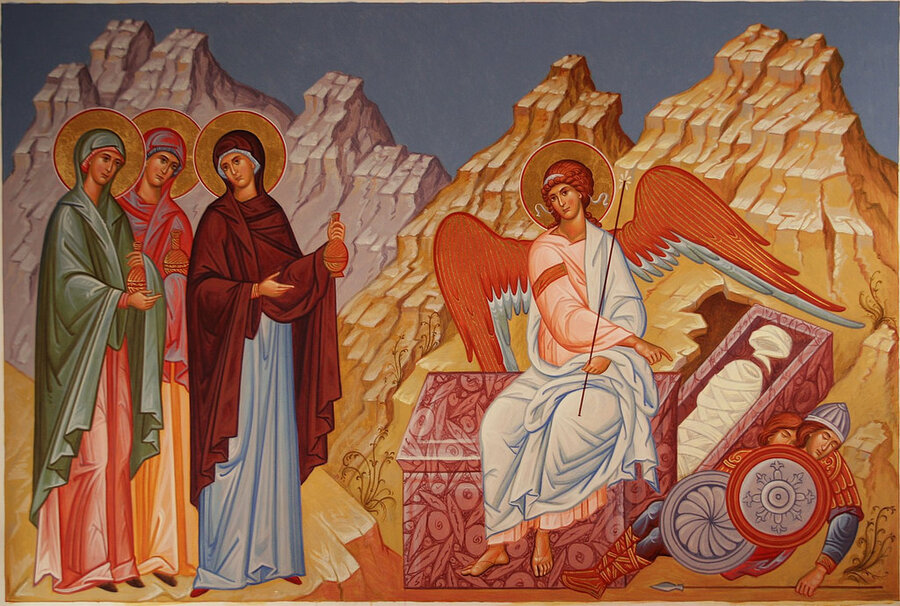
Byzantine icon of the Myrrhbearing Women at the Tomb (Αἱ Μυροφόροι). The angel sits upon the rolled stone and announces that Christ is risen; the burial cloths lie empty within the sepulchre while the guard lies fallen at the door. The women come bearing spices and find instead the first witness of the Paschal victory -- the tomb opened, the body gone, and life restored to the world.
Christ emerges victorious from the tomb. He who is without sin has born in His own body the full weight of death. Here the incarnate Son defeats death itself, reversing the ancient fall and opening the way of life for all who follow Him.
The Church Fathers contemplated the Resurrection as the climax of the Paschal Mystery and the decisive act of redemption. Through this victory death had held sway over the world; through this victory the Author of life defeats death, sin, and the devil.
What began with the crucifixion reaches its consummation here, that by His rising we might be raised and the gate to paradise restored.
Christ is Risen!
Christ is risen! -- Indeed He is risen!
Christos Anesti (Χριστός ἀνέστη) -- Alithos Anesti (Ἀληθῶς ἀνέστη)
Christus resurrexit -- Vere resurrexit
Cristo ha resucitado -- Verdaderamente ha resucitado
Christos Voskrese -- Voistinu Voskrese
Mshiho qom (ܡܫܝܚܐ ܩܡ) -- B'hokhot qom (ܒܗܩܘܛ ܩܡ)
Al-Masih qam (المسيح قام!) -- Haqqan qam (حقاً قام!)
The Empty Tomb
The women come to the tomb at dawn on the first day of the week. The great stone had been rolled away. The body of the Lord Jesus was not there.
The angels appear in shining garments and proclaim His rising.
Matthew 28:5-7
And the angel answered and said unto the women, Fear not ye: for I know that ye seek Jesus, which was crucified. He is not here: for he is risen, as he said. Come, see the place where the Lord lay. And go quickly, and tell his disciples that he is risen from the dead; and, behold, he goeth before you into Galilee; there shall ye see him: lo, I have told you.
Mary Magdalene hastens to Peter and John.
John 20:3-8
Peter therefore went forth, and that other disciple, and came to the sepulchre. So they ran both together: and the other disciple did outrun Peter, and came first to the sepulchre. And he stooping down, and looking in, saw the linen clothes lying; yet went he not in. Then cometh Simon Peter following him, and went into the sepulchre, and seeth the linen clothes lie, And the napkin, that was about his head, not lying with the linen clothes, but wrapped together in a place by itself. Then went in also that other disciple, which came first to the sepulchre, and he saw, and believed.
The empty tomb and the orderly arrangement of the grave clothes proclaim the bodily resurrection of Christ as an accomplished fact in history. The stone rolled aside, the tomb vacant, the linen cloths lying in their places and the napkin that had bound the Lord’s head wrapped separately; these details bear witness to sovereign victory rather than theft or confusion. No grave robber would have paused to fold the head cloth and set it apart. This deliberate order reveals the same calm authority with which the incarnate Son had commanded Lazarus to come forth and the sea to be still.
St. John Chrysostom, in his homily on John, draws out the profound significance of the apostles' foot-race race to the tomb. John arrives first yet yields entrance to Peter, manifesting the harmony of fervent love and ecclesial order that would characterize the apostolic college from its beginning. Peter’s bold inspection and John’s immediate belief without yet seeing the risen Lord mark the birth of faith grounded in the empty tomb alone.
The Church Fathers beheld in this scene the decisive reversal of Adam’s fall. What disobedience had sealed in corruption and death, the obedience of Christ has opened in incorruption and life. The same body that was crucified and buried now rises, the first fruits of the resurrection.
From the empty tomb the apostolic witness begins. The women are sent as the first evangelists. Peter and John become the eyewitnesses whose testimony undergirds the one, holy, catholic, and apostolic Church. Here the gate of paradise, long barred by sin and death, is thrown wide open for every soul united to the risen Christ through the sacraments He entrusted to His Church.
Road to Emmaus
Two disciples walk from Jerusalem to Emmaus. Their hearts are heavy with the events of the crucifixion. An unknown mam joins them on the way.
He expounds the Scriptures concerning the Messiah, beginning with Moses and all the prophets. It is the risen Christ, but they cannot yet see.
Luke 24:30-31
And it came to pass, as he sat at meat with them, he took bread, and blessed it, and brake, and gave to them. And their eyes were opened, and they knew him; and he vanished out of their sight.
The breaking of the bread becomes the moment of recognition. The same hands that were nailed to the cross now bless and distribute the bread, and in that sacred act the disciples behold the risen Lord.
St. Augustine, in his Homily on the Gospel of John, teaches that Christ deliberately withheld full sight until this moment so that the Church might learn where He is truly found: not in private speculation but in the breaking of the bread. The hearts of the disciples burned while He opened the Scriptures, yet recognition came only in the sacramental gesture. Here is the enduring pattern of the Church’s life: the word of Christ illuminating the mind and the sacrament of His Body and Blood opening the eyes of the heart.
The two disciples rise at once and return to Jerusalem that same night to join the apostolic company. The risen Christ gathers His scattered followers into one. From the road to Emmaus the Church receives the pattern that Scripture and Sacrament together reveal the living Lord, who remains present in the one, holy, catholic, and apostolic Church until the end of the age.
Peace be unto you
The apostles gather in the upper room behind locked doors on the evening of the first day of the week.
John 20:19-23
Then the same day at evening, being the first day of the week, when the doors were shut where the disciples were assembled for fear of the Jews, came Jesus and stood in the midst, and saith unto them, Peace be unto you. And when he had so said, he shewed unto them his hands and his side. Then were the disciples glad, when they saw the Lord. Then said Jesus to them again, Peace be unto you: as my Father hath sent me, even so send I you. And when he had said this, he breathed on them, and saith unto them, Receive ye the Holy Ghost: Whose soever sins ye remit, they are remitted unto them; and whose soever sins ye retain, they are retained.
The apostle Thomas is absent from this first appearance. When the other disciples tell him they have seen the Lord, Thomas declares he will not believe unless he sees the print of the nails in His hands and thrusts his hand into the side. Eight days later the apostles gather again with Thomas present.
John 20:26-29
And after eight days again his disciples were within, and Thomas with them: then came Jesus, the doors being shut, and stood in the midst, and said, Peace be unto you. Then saith he to Thomas, Reach hither thy finger, and behold my hands; and reach hither thy hand, and thrust it into my side: and be not faithless, but believing. And Thomas answered and said unto him, My Lord and my God. Jesus saith unto him, Thomas, because thou hast seen me, thou hast believed: blessed are they that have not seen, and yet have believed.
The risen Lord greets the fearful and scattered apostles with the words “Peace be unto you.” This peace is the fruit of His victory over death, restoring those who had fled from the Cross.
St. John Chrysostom, in a Homily on the Gospel of John, beholds divine providence at work in Thomas’s absence and subsequent doubt. The Lord permits the outspoken unbelief so that the entire Church might receive the strongest confirmation of the bodily resurrection. Thomas’s demand to touch the wounds leads to the clearest apostolic confession of Christ’s divinity: “My Lord and my God.” The Lord’s reply blesses all who will believe without seeing, establishing the foundation for the faith of the one, holy, catholic, and apostolic Church.
In this encounter the risen Christ grants peace, proves the reality of His glorified body, and institutes the apostolic ministry of forgiveness that continues in the sacraments until today, and then unto the end of the age.
Feed my sheep
The apostles return to fishing on the Sea of Tiberias. They toil all night and catch nothing. At dawn the risen Lord stands on the shore, unrecognized at first.
He directs them to cast the net on the right side of the boat.
John 21:11
Simon Peter went up, and drew the net to land full of great fishes, an hundred and fifty and three: and for all there were so many, yet was not the net broken.
The Lord prepares a fire of coals, fish, and bread. He invites them to breakfast. After they have eaten, He turns to Simon Peter.
John 21:15-17
So when they had dined, Jesus saith to Simon Peter, Simon, son of Jonas, lovest thou me more than these? He saith unto him, Yea, Lord; thou knowest that I love thee. He saith unto him, Feed my lambs. He saith to him again the second time, Simon, son of Jonas, lovest thou me? He saith unto him, Yea, Lord; thou knowest that I love thee. He saith unto him, Feed my sheep. He saith unto him the third time, Simon, son of Jonas, lovest thou me? Peter was grieved because he said unto him the third time, Lovest thou me? And he said unto him, Lord, thou knowest all things; thou knowest that I love thee. Jesus saith unto him, Feed my sheep.
The threefold question of love corresponds to Peter’s threefold denial. The Lord who knows all things does not rebuke but restores. Each affirmative answer is met with the commission to feed the lambs and the sheep.
St. John Chrysostom, in a Homily on the Gospel of John, beholds the divine mercy that heals the wound of denial by the very act of confession. The risen Christ does not merely forgive Peter; He entrusts him with the care of the entire flock. This personal encounter by the sea becomes the foundation of the Church’s pastoral office. The same Lord who restored the chief apostle continues to govern His flock through the successors of Peter in the one, holy, catholic, and apostolic Church. The miraculous catch and the unbroken net signify the unity and abundance that mark the Church’s mission until the end of the age.
In this appearance the risen Christ recommissions the disciples and establishes the visible shepherding of His people through the apostolic ministry He instituted that morning.
The Resurrection Body
The risen Lord appears to many witnesses over forty days. He is seen by Cephas, then by the twelve, then by more than five hundred brethren at once, then by James, then by all the apostles, and last by Paul.
1 Corinthians 15:3-8
For I delivered unto you first of all that which I also received, how that Christ died for our sins according to the scriptures; And that he was buried, and that he rose again the third day according to the scriptures: And that he was seen of Cephas, then of the twelve: After that, he was seen of above five hundred brethren at once; of whom the greater part remain unto this present, but some are fallen asleep. After that, he was seen of James; then of all the apostles. And last of all he was seen of me also, as of one born out of due time.
1 Corinthians 15:42-49
So also is the resurrection of the dead. It is sown in corruption; it is raised in incorruption: It is sown in dishonour; it is raised in glory: it is sown in weakness; it is raised in power: It is sown a natural body; it is raised a spiritual body. There is a natural body, and there is a spiritual body. And so it is written, The first man Adam was made a living soul; the last Adam was made a quickening spirit. Howbeit that was not first which is spiritual, but that which is natural; and afterward that which is spiritual. The first man is of the earth, earthy: the second man is the Lord from heaven. As is the earthy, such are they also that are earthy: and as is the heavenly, such are they also that are heavenly.
The same body that was crucified and buried now lives in glory. The testimony of more than five hundred living witnesses, most of whom were still alive when Paul wrote, anchors the resurrection in public, verifiable history. The risen flesh is continuous with the flesh that suffered, yet transformed: sown in corruption and raised in incorruption, sown in weakness and raised in power, sown a natural body and raised a spiritual body.
The Church Fathers beheld in this mystery the fulfillment of God’s plan for the human race. St. Irenaeus taught that the incarnate Son, as the last Adam, recapitulates and restores all that the first Adam lost. St. Athanasius explained that the Lord took a real body so that in that same body He might destroy death and bestow incorruption upon our flesh. The resurrection body of Christ is therefore the first fruits and the guarantee of the general resurrection. What was mortal is made immortal; what was corruptible is made incorruptible.
In the glorified yet physical reality of the risen Lord the one, holy, catholic, and apostolic Church proclaims the certain hope that every believer united to Him will one day rise in like manner.
The Great Commission
The eleven apostles go to Galilee, to the mountain where the Lord had appointed them. They see Him and worship Him.
Matthew 28:18-20
And Jesus came and spake unto them, saying, All power is given unto me in heaven and in earth. Go ye therefore, and teach all nations, baptizing them in the name of the Father, and of the Son, and of the Holy Ghost: Teaching them to observe all things whatsoever I have commanded you: and, lo, I am with you alway, even unto the end of the world. Amen.
The risen Christ claims universal authority and sends the apostles to every nation under heaven. The command to baptize in the name of the Father, the Son, and the Holy Ghost institutes the Trinitarian foundation of every Christian sacrament.
The charge to teach all that He commanded makes the apostolic doctrine the permanent rule of faith. The promise “I am with you alway, even unto the end of the world” is the assurance that the same risen Lord remains present in His Church through every age.
St. John Chrysostom, in Homily 90 on the Gospel of Matthew, beholds in this final charge the expansion of salvation from Israel to the whole human race. The apostles, once fearful and scattered, now receive the power that will found the one, holy, catholic, and apostolic Church. Through their preaching and baptism the victory of the resurrection is carried to every people, and the gate of paradise stands open until the end of the age.
What began in the empty tomb reaches its fulfillment here: the same Lord who rose in the flesh now sends His Body, the Church, to make disciples of all nations until He comes again.