The Crucifixion
The Lord Jesus is raised upon the cross. The rough-hewn beams receive the incarnate Son of God, fixed by nails through His hands and feet.
In this moment the New Adam embraces the tree of execution. He who is without sin bears in His own body the full weight of the curse that entered the world through the first Adam. Here the incarnate Son submits to death itself, reversing in His flesh the ancient fall and opening the way of life for all who believe.
The Church Fathers contemplated the Crucifixion as the climax of the Sorrowful Mysteries and the decisive act of redemption. Through this wood death had entered the world; through this wood the Author of life now defeats death, sin, and the devil.
What began with the carrying of the cross reaches its consummation here, that by His stripes we might be healed and the gate to paradise restored.
The Crucifixion
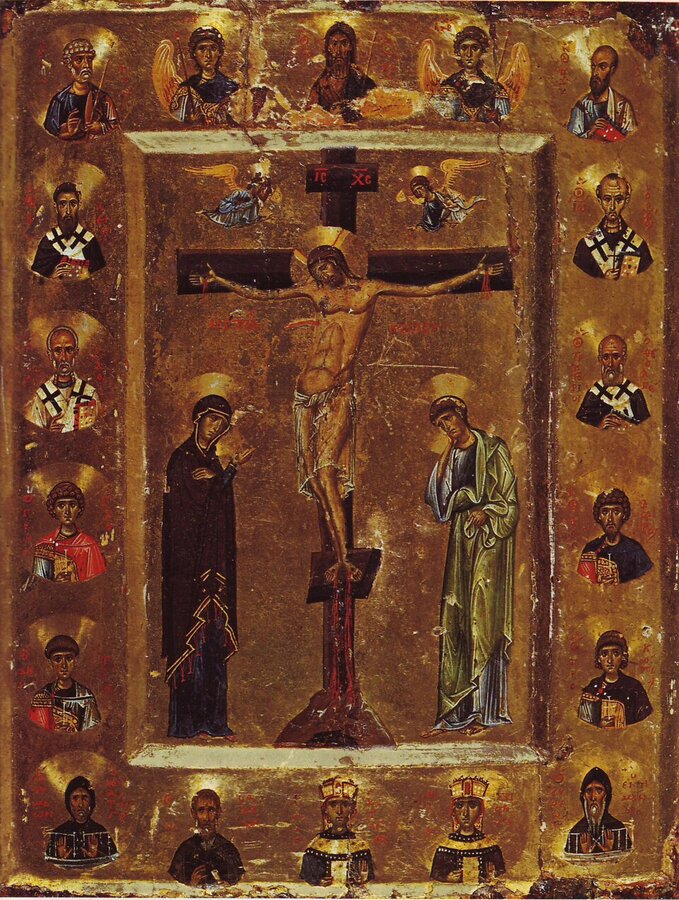
Byzantine icon of the Crucifixion (Ὁ Σταυρός). Late Comnenos style, second half of the 12th century, Saint Catherine's Monastery, Mount Sinai. Christ hangs upon the cross in the Orthodox manner, flanked by the Virgin Mary and John the Evangelist; the sun and moon darken above, and the skull of Adam lies beneath Golgotha, signifying that through this wood the curse of death is undone and the way of life restored.
INRI
Pilate causes the title to be written and fastened above the head of the Lord Jesus on the cross. The chief priests protest, demanding a change, but the governor stands firm.
John 19:18-22
There they crucified Him, and with Him two others, one on each side, with Jesus in the middle.
Pilate also had a notice posted on the cross. It read:
JESUS OF NAZARETH, THE KING OF THE JEWS.
Many of the Jews read this sign, because the place where Jesus was crucified was near the city, and it was written in Hebrew, Latin, and Greek. So the chief priests of the Jews said to Pilate, “Do not write, ‘The King of the Jews,’ but only that He said, ‘I am the King of the Jews.’”
Pilate answered, “What I have written, I have written.”
The inscription declares the kingship of the crucified One in the three languages of the known world. What the chief priests reject and Pilate writes in irony becomes the unchangeable witness of divine providence. The very instrument of Roman authority proclaims the royal dignity of Christ to Jew and Gentile alike. The Church Fathers beheld here the hand of God: even the pagan governor is made to testify to the truth that the King of the Jews reigns from the wood of the cross.
Titulus
INRI -- Latin phrase IESVS·NAZARENVS·REX·IVDÆORVM (Jesus Nazarenus, rex Judæorum)
INBI -- Greek version of the inscription, Ἰησοῦς ὁ Ναζωραῖος ὁ Bασιλεὺς τῶν Ἰουδαίων. Some representations change the title to "ΙΝΒΚ" ὁ Bασιλεὺς τοῦ κόσμου ("The King of the World"), or "ΙΝΒΔ" ὁ Bασιλεὺς τῆς Δόξης ("The King of Glory"), not implying that this was really what was written, but reflecting the tradition that icons depict the spiritual reality rather than the physical reality.
In Hebrew, the phrase is commonly rendered ישוע הנצרי ומלך היהודים (Yeshua` HaNotsri U'Melech HaYehudim IPA: [jeːʃuːɑʕ hɑnːɑtseri meleχ hɑjːəhuðiːm]), which translates to "Jesus the Nazarite and King of the Jews." This version has the acronym that constitute the tetragrammaton (יהוה) name corresponding with Yahweh or Jehovah.
The Seven Utterances
Upon the cross the Lord Jesus speaks seven times. These are His final public words as He completes the work of redemption.
Luke 23:34
Then said Jesus, Father, forgive them; for they know not what they do. And they parted his raiment, and cast lots.
Luke 23:43
And Jesus said unto him, Verily I say unto thee, To day shalt thou be with me in paradise.
John 19:26-27
When Jesus therefore saw his mother, and the disciple standing by, whom he loved, he saith unto his mother, Woman, behold thy son! Then saith he to the disciple, Behold thy mother! And from that hour that disciple took her unto his own home.
Matthew 27:46
And about the ninth hour Jesus cried with a loud voice, saying, Eli, Eli, lama sabachthani? that is to say, My God, my God, why hast thou forsaken me?
John 19:28
After this, Jesus knowing that all things were now accomplished, that the scripture might be fulfilled, saith, I thirst.
John 19:30
When Jesus therefore had received the vinegar, he said, It is finished: and he bowed his head, and gave up the ghost.
Luke 23:46
And when Jesus had cried with a loud voice, he said, Father, into thy hands I commend my spirit: and having said thus, he gave up the ghost.
In these words the High Priest intercedes for His executioners, the King opens paradise to the repentant, the Son cares for His Mother, fulfills the Psalm of dereliction, reveals the thirst of His sacred humanity, declares the completion of salvation, and commends His spirit into the hands of the Father. The Church Fathers saw here the perfect pattern of obedience, mercy, and victory in the hour of death.
Forgive Them
Even the midst of rejection and torment Jesus intercedes for His executioners, exactly as foretold by Isaiah when describing the suffering Servant.
Isaiah 53:12
Therefore will I divide him a portion with the great, and he shall divide the spoil with the strong; because he hath poured out his soul unto death: and he was numbered with the transgressors; and he bare the sin of many, and made intercession for the transgressors.
Luke 23:34
Then said Jesus, Father, forgive them; for they know not what they do. And they parted his raiment, and cast lots.
Even amid the miracles of the cross, the darkened sun, the rending rocks, the opened graves; Christ teaches by deed what He commanded in word.
The Church Fathers with one voice see the perfect High Priest of the New Covenant offering the atoning sacrifice. St. John Chrysostom beholds here the supreme example of meekness and love for our enemies. Augustine hears in this prayer the very voice of divine mercy that Stephen the martyr echoed while being stoned, proving every believer must imitate Christ.
This intercession reveals that all sin lies within reach of the Saviour’s compassion, opening the fountain of forgiveness that flows from Calvary to every contrite heart across the ages.
Thief of the Cross
While the Lord Jesus hung between two criminals, one railed upon Him in blasphemy. But the other, known in sacred tradition as Dismas, rebuked his fellow criminal, confessed the justice of his own condemnation, declared the perfect innocence of Christ, and cast himself entirely upon the mercy of the crucified King.
Luke 23:39-43
And one of the malefactors which were hanged railed on him, saying, If thou be Christ, save thyself and us. But the other answering rebuked him, saying, Dost not thou fear God, seeing thou art in the same condemnation? And we indeed justly; for we receive the due reward of our deeds: but this man hath done nothing amiss. And he said unto Jesus, Lord, remember me when thou comest into thy kingdom. And Jesus said unto him, Verily I say unto thee, Today shalt thou be with me in paradise.
Here shines forth one of the most radiant examples of repentance recorded in Holy Scripture. St. John Chrysostom marvels at this sudden and complete conversion, by grace upon the cross. A man who had lived by violence and theft is, in his final moments, transformed into the first citizen of the restored Paradise. In St. Dismas we behold the full pattern of true salvation: he openly confesses his guilt and receives his suffering as just, he rebukes blasphemy and turns from evil, and he surrenders himself completely to the Lord Jesus with living faith, calling the dying Saviour his King.
Where the first Adam closed the gates of Eden through disobedience, the New Adam flings them open wide through His atoning death, granting this penitent thief immediate entrance into Paradise. The Fathers proclaim this as an everlasting encouragement: no sinner should despair, however late the hour, if only he will confess, repent, and entrust himself wholly to the crucified Christ.
Behold Thy Mother
Even in the hour of His greatest suffering the Lord Jesus sees His mother standing by the cross and the disciple whom He loved, and with tender care He entrusts her to him, forming the new spiritual family of the Church.
John 19:26-27
When Jesus therefore saw his mother, and the disciple standing by, whom he loved, he saith unto his mother, Woman, behold thy son! Then saith he to the disciple, Behold thy mother! And from that hour that disciple took her unto his own home.
St. John Chrysostom marvels at the perfect filial piety of the crucified Lord: even amid the pains of the cross He remembers to honor His mother and provides for her. By giving Mary to the beloved disciple -- and through him to all the faithful -- He reveals her as mother to all, the New Eve.
Forsaken
In the darkness of the ninth hour the Lord Jesus, bearing the full weight of the world’s sin upon Himself, cries out with a loud voice the opening words of the great prophetic Psalm 22, entering into the abyss of divine abandonment on behalf of fallen humanity.
Matthew 27:46
And about the ninth hour Jesus cried with a loud voice, saying, Eli, Eli, lama sabachthani? that is to say, My God, my God, why hast thou forsaken me?
Psalm 22:1
My God, my God, why hast thou forsaken me? why art thou so far from helping me, and from the words of my roaring?
St. John Chrysostom teaches that Christ does not utter these words from any actual separation of His divinity from the Father, but in His assumed humanity He takes upon Himself the very desolation and curse that our sins deserve. The eternal Son willingly enters the depths of that forsakenness which the first Adam brought upon all his race through disobedience. By voicing this cry, the New Adam exhausts the penalty of sin and fulfills the ancient prophecy.
The Fathers declare that this is the very heart of the atonement: the innocent One is forsaken in the place of the guilty, so that no soul who trusts in Him will ever be ultimately abandoned. In this terrible word we find both the cost of our redemption and our greatest consolation.
It is Finished
Having received the vinegar, the Lord Jesus knows that all things are now accomplished and declares the triumphant completion of the work of redemption.
John 19:28
After this, Jesus knowing that all things were now accomplished, that the scripture might be fulfilled, saith, I thirst.
John 19:30
When Jesus therefore had received the vinegar, he said, It is finished: and he bowed his head, and gave up the ghost.
Luke 23:46
And when Jesus had cried with a loud voice, he said, Father, into thy hands I commend my spirit: and having said thus, he gave up the ghost.
St. John Chrysostom thunders that these mighty words ring out the victory of the cross. The long battle is won. The debt of sin is paid in full. The ancient curse is lifted, the sacrifices of the Law fulfilled, and the gates of Paradise thrown open wide. Where the first Adam’s disobedience brought ruin, the New Adam’s perfect obedience brings restoration.
“It is finished” is no cry of defeat but the shout of the Conqueror who has trampled death by death. This word echoes down the ages as the glorious assurance to every believer: the price has been paid completely, the work of salvation is accomplished forever, and whosoever believes in Him shall not perish but have everlasting life.