Descent of the Holy Spirit
Fifty days after the Passover, and ten days after the Lord ascended from the Mount of Olives, the promise spoken on the mountain is fulfilled. What the Ascension began -- the enthronement of Christ and the sending of the Comforter from the Father's right hand -- Pentecost completes in fire and wind upon the apostolic assembly. The Spirit descends, and the Church is born.
Pentecost is twofold mystery. It is the birth of the Church: the Holy Spirit comes upon the apostles, and Christ's presence continues in His Body on earth, no longer confined to one visible form but poured out upon the whole company of the faithful. It is also the completion of the Ascension: the Spirit is sent because Christ has gone up to the Father. He who said, It is expedient for you that I go away, now fulfills His word from the throne. The Son ascends; the Spirit descends; the one Paschal victory extends from the empty tomb to the ends of the earth.
Descent of the Holy Spirit
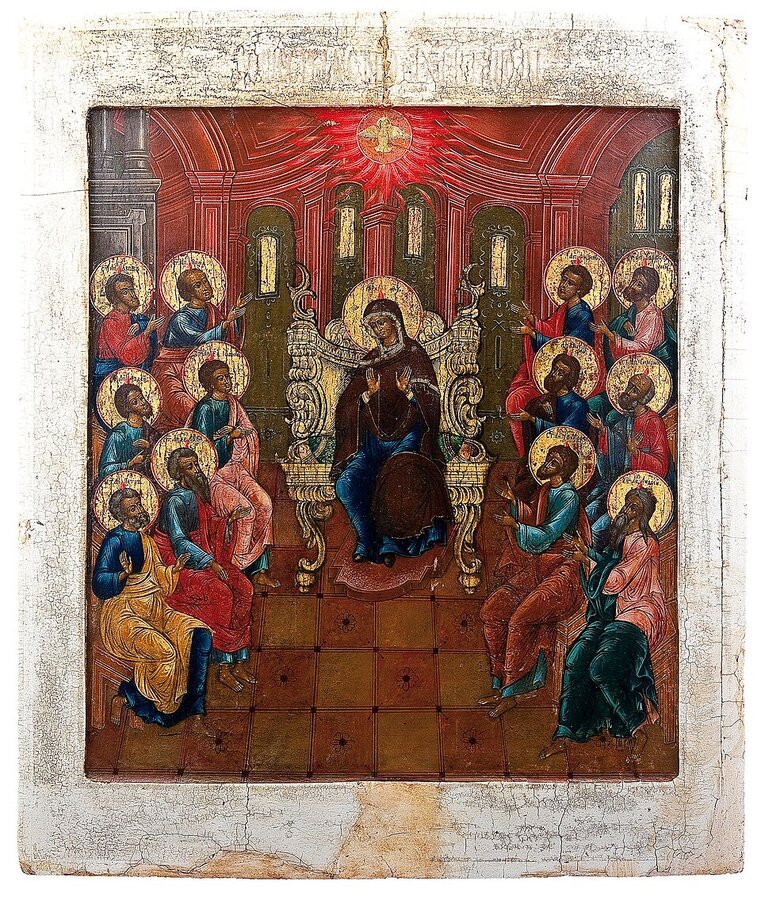
Byzantine icon of Pentecost (Ἡ Πεντηκοστή). Russian, 18th century, egg tempera on wood panel. The Theotokos is seated upon a carved throne at the center of the upper room, surrounded by the apostles; the Holy Spirit descends from above as a dove within a golden medallion, with red rays of divine light fanning downward upon the assembly. The scene unfolds within a columned interior with arched windows, as the apostles receive the outpouring that will carry the Gospel to all nations.
The Fathers of East and West behold in this feast the fulfillment of prophecy, the constitution of the apostolic Church, and the gift by which every sacrament and every mission draws its life. What the apostles received in the upper room remains the living power of the one, holy, catholic, and apostolic Church until Christ comes again.
To contemplate Pentecost is to contemplate how the risen and ascended Lord remains with His own. The flesh taken from the Virgin, glorified at the Father's right hand, now gives life to the Body through the Spirit He breathes upon the world. The Kingdom proclaimed in Galilee, sealed in the Resurrection, enthroned in the Ascension, is now carried into history by men who were once afraid behind locked doors and who will soon stand before nations declaring that Jesus is Lord.
Upper Room
When the day of Pentecost was fully come, the apostles are gathered in one place with one accord. The upper room that had known the institution of the Eucharist, the appearances of the risen Lord, and the fear of His absence now becomes the birthplace of the Church's public life. They have returned from the Mount of Olives with great joy, but they have not rushed into the streets. They wait in prayer, as the Lord commanded, until the promise of the Father is given.
Acts 2:1-4
And when the day of Pentecost was fully come, they were all with one accord in one place. And suddenly there came a sound from heaven as of a rushing mighty wind, and it filled all the house where they were sitting. And there appeared unto them cloven tongues like as of fire, and it sat upon each of them. And they were all filled with the Holy Ghost, and began to speak with other tongues, as the Spirit gave them utterance.
The Lord had prepared them for this hour throughout the farewell discourse. He promised that He would not leave them orphans, that the Comforter would come, and that the Spirit of Truth would guide them into all truth.
John 14:16-18
And I will pray the Father, and he shall give you another Comforter, that he may abide with you for ever; Even the Spirit of truth; whom the world cannot receive, because it seeth him not, neither knoweth him: but ye know him; for he dwelleth with you, and shall be in you. I will not leave you comfortless: I will come to you.
John 16:7
Nevertheless I tell you the truth; It is expedient for you that I go away: for if I go not away, the Comforter will not come unto you; but if I depart, I will send him unto you.
The Ascension and Pentecost are inseparable. Christ ascends so that the Spirit may descend. The same Lord who breathed peace upon the apostles after the Resurrection and said, Receive ye the Holy Ghost, now sends the fullness of that gift from the throne. What was pledged in the upper room after Easter is crowned on Pentecost with the public outpouring that will equip the Church for the world.
Between Ascension and Pentecost the apostles persevere in prayer with Mary the Mother of Jesus, with the women, and with His brethren. She who stood at the center of the icon of the Ascension -- prayerful, steadfast, already drawn into the mystery of her Son's glory -- now sits at the center of the Pentecost icon upon her throne in the upper room. The apostles are arranged around her as around their heart. She who received the Word in her womb now receives the fire of the Spirit in the midst of the apostolic college. The Church is born around the Theotokos because the Church is born from the incarnate Christ she bore.
St. John Chrysostom, preaching on the Acts of the Apostles, marvels at the unity of the disciples before the Spirit comes. They are not scattered in private ambition but gathered with one accord, having laid aside every earthly care in expectation of the heavenly gift.
St. John Chrysostom, Homily 4 on the Acts of the Apostles
And they were all together in one place. Observe the unanimity, the charity, the accord of the disciples. For where there is charity, there is no multitude of opinions, but one soul dwells in many bodies. They were waiting for the coming of the Spirit, and they were all together, not one absent, not one separated from the rest.
The upper room is therefore more than a location. It is the pattern of the Church at prayer: united to the apostles, gathered around the Mother of God, awaiting the gift that only the ascended Christ can send. Joel had foretold the day when God would pour out His Spirit upon all flesh. Ezekiel had promised a new heart and a new spirit within His people. In this room the prophecies converge upon the apostolic assembly that will carry them to every nation.
Joel 2:28-29
And it shall come to pass afterward, that I will pour out my spirit upon all flesh; and your sons and your daughters shall prophesy, your old men shall dream dreams, your young men shall see visions: And also upon the servants and upon the handmaids in those days will I pour out my spirit.
Ezekiel 36:26-27
A new heart also will I give you, and a new spirit will I put within you: and I will take away the stony heart out of your flesh, and I will give you an heart of flesh. And I will put my spirit within you, and cause you to walk in my statutes, and ye shall keep my judgments, and do them.
St. Cyril of Alexandria teaches that the Spirit who proceeds from the Father and is sent by the Son comes to dwell in the Church as the living bond between heaven and earth. The Comforter does not replace Christ; He makes Christ present in a new and universal way within the Body that shares His life.
St. Cyril of Alexandria, Commentary on the Gospel of John
The Spirit comes to us as the gift of the Son, sent from the Father through Him. He does not speak from Himself, but takes what is Christ's and declares it to us, so that the Lord who has ascended to the Father remains with us through the Spirit who glorifies Him in the Church.
The waiting is ended. The sound from heaven fills the house. The age of the Church is about to begin.
Tongues of Fire
The Spirit does not come in silence. A sound from heaven, as of a rushing mighty wind, fills the upper room. Cloven tongues like as of fire appear and rest upon each of them. The visible signs declare that the God who appeared to Moses in fire upon the mountain and to Elijah in the still small voice now descends upon the new Israel in the city of the Resurrection.
Fire signifies the purifying presence of God. Wind signifies the breath that gives life. Tongues signify the word that will cross every border of language and nation. The Spirit sits upon each apostle individually, yet the gift is given to the whole assembly. None is passed over. The diversity of persons receives one and the same fire.
St. John Chrysostom asks why the Spirit appeared in the form of fiery tongues, and answers that the sign was fitted to the work that followed. The apostles were about to speak in languages they had not learned, proclaiming the mighty works of God to pilgrims gathered from every nation under heaven.
St. John Chrysostom, Homily 4 on the Acts of the Apostles
Why in the form of tongues? That it might be shown that the grace of the Spirit is poured forth upon the apostles for the purpose of speaking. And it sat upon each of them, to show that the gift is common to all, not the privilege of one alone.
The crowd in Jerusalem hears the sound and comes together in astonishment. Men devoted to the Law, dwellers in Mesopotamia, Egypt, Rome, and the far regions of the empire hear the apostles speaking in their own tongues the wonderful works of God. The confusion of Babel is reversed not by erasing difference but by uniting many languages in one proclamation of Christ.
Acts 2:5-11
And there were dwelling at Jerusalem Jews, devout men, out of every nation under heaven. Now when this was noised abroad, the multitude came together, and were confounded, because that every man heard them speak in his own language. And they were all amazed and marvelled, saying one to another, Behold, are not all these which speak Galilaeans? And how hear we every man in our own tongue, wherein we were born? Parthians, and Medes, and Elamites, and the dwellers in Mesopotamia, and in Judaea, and Cappadocia, in Pontus, and Asia, Phrygia, and Pamphylia, in Egypt, and in the parts of Libya about Cyrene, and strangers of Rome, Jews and proselytes, Cretes and Arabians, we do hear them speak in our tongues the wonderful works of God.
Some mock and say the apostles are full of new wine. Peter, who once denied his Lord before a servant girl, now stands and raises his voice to the multitude. The Spirit who descended in fire has already begun His work of transforming fear into witness.
St. Augustine, meditating on the tongues of Pentecost, teaches that the gift was given for the building up of the Church and the calling of the nations. The sign was extraordinary so that the beginning of the new dispensation might be unmistakable, yet the Spirit's work would continue in the ordinary ministry of preaching, sacrament, and charity.
St. Augustine, Sermon 267 on Pentecost
The Holy Spirit appeared in tongues of fire and gave the apostles the gift of languages, so that all nations might hear in their own speech the praise of God. What was shown openly on that day is accomplished continually in the Church, where the Spirit speaks through the ministers of Christ to draw every people into one faith.
The tongues of fire are not a spectacle for a single hour. They are the inauguration of the Spirit's permanent indwelling in the apostolic Body. The wind that filled the house is the same breath by which the Church lives in every age. The fire that rested on each apostle is the fire that kindles martyrs, confessors, and every soul baptized into Christ.
St. Leo the Great, preaching to the Church at Rome on the feast of Pentecost, proclaims that the whole Church shares in the gift poured out upon the apostles. What descended upon the heads of the few was intended for the salvation of the many.
St. Leo the Great, Sermon 76
The Spirit of Truth and unity, who is the Spirit of God and of Christ, came upon the disciples in the form of tongues, and gave them the knowledge of all languages, that the grace of the Gospel might be proclaimed to every nation. The whole Church receives this gift, for the Spirit is not given by measure to those who believe.
The signs of Pentecost confirm that the ascended Lord has not abandoned the world. He has sent His own Spirit, and the Spirit is already at work turning fishermen into witnesses and a locked room into the threshold of the world.
Birth of the Church
When Peter finishes his sermon, the crowd is cut to the heart. They ask what they must do. He commands repentance and baptism in the name of Jesus Christ for the remission of sins, and promises the gift of the Holy Ghost. About three thousand souls are added that day. The Church is born in water and Spirit, in preaching and sacrament, in the apostolic word that binds heaven to earth.
Acts 2:37-41
Now when they heard this, they were pricked in their heart, and said unto Peter and to the rest of the apostles, Men and brethren, what shall we do? Then Peter said unto them, Repent, and be baptized every one of you in the name of Jesus Christ for the remission of sins, and ye shall receive the gift of the Holy Ghost. For the promise is unto you, and to your children, and to all that are afar off, even as many as the Lord our God shall call. And with many other words did he testify and exhort, saying, Save yourselves from this untoward generation. Then they that gladly received his word were baptized: and the same day there were added unto them about three thousand souls.
This is the birth of the Church in the full Catholic sense: a visible assembly, an apostolic head speaking in union with the college, the sacrament of baptism administered for the remission of sins, and the gift of the Spirit promised to believers and to their children and to all afar off. Pentecost is not a private religious experience. It is the public foundation of the Body of Christ in history.
The Lord had spoken of the Spirit as the one who would convict the world and glorify Him. Now that work begins in the streets of Jerusalem.
John 16:13-14
Howbeit when he, the Spirit of truth, is come, he will guide you into all truth: for he shall not speak of himself; but whatsoever he shall hear, that shall he speak: and he will shew you things to come. He shall glorify me: for he shall receive of mine, and shall shew it unto you.
The Spirit glorifies Christ by making Him present in the Church. The apostles do not preach themselves. They preach Jesus of Nazareth, approved of God by miracles and wonders and signs, crucified and raised and exalted to the right hand of the Father. The same Christ the disciples had followed in Galilee is now proclaimed as Lord and Christ by men filled with the Spirit He sent from the throne.
St. Cyril of Alexandria teaches that the Church is the Body of Christ because the Holy Spirit unites the faithful to the Head. As the Spirit of Christ, He communicates the life of the Son to every member, so that what belongs to the Head belongs also to those who are joined to Him in one Body.
St. Cyril of Alexandria, On the Unity of Christ
We are united to Christ by the Holy Spirit, who is the Spirit of the Son and proceeds from the Father. Through Him we are made one body with Christ, and because the Spirit dwells in us, the life of the Head flows into the members. The Church is therefore not a mere society of believers, but the one Body of Christ vivified by His own Spirit.
St. Paul will later unfold this mystery for the Corinthians, teaching that the one Spirit distributes many gifts for the common good, yet binds all into one Body.
1 Corinthians 12:12-13
For as the body is one, and hath many members, and all the members of that one body, being many, are one body: so also is Christ. For by one Spirit are we all baptized into one body, whether we be Jews or Gentiles, whether we be bond or free; and have been all made to drink into one Spirit.
Pentecost is the birthday of that Body. The apostles are no longer a company of disciples following a visible Master along the roads of Palestine. They are the living organism through which the ascended Christ acts in the world. Peter's sermon is the first exercise of the keys entrusted after the Resurrection. The three thousand baptized are the first fruits of the catholic multitude that will grow until the end of the age.
The Theotokos remains at the center of this birth. She who formed the Head in her womb now stands in the midst of the Body He has constituted. The icon tradition seats her upon the throne because the Church receives both her Lord and her life through the mystery she embodies: the Word made flesh, now giving flesh to the world through the Spirit. She is not absent from the Church's origin. She is the living image of the Church's interior union with Christ.
St. Leo the Great teaches that the whole purpose of the Spirit's descent is to form one holy people out of many nations, united in faith and sacrament under the apostolic preaching of Christ crucified and risen.
St. Leo the Great, Sermon 77
The coming of the Holy Spirit enriched the Church with heavenly gifts and established the unity of the faithful throughout the world. What was begun in Jerusalem on the day of Pentecost is extended to every age, so that all who are reborn in Christ may become one body, animated by one Spirit, and confirmed in one hope.
The Church is born because Christ ascended. The Spirit descends because the Son is at the right hand of the Father. Birth and completion belong to one design.
Mysteries in the Church
The outpouring of Pentecost does not end with a single day's wonders. The Spirit who descended upon the apostles remains as the soul of the Church's sacramental life. What was visible in tongues of fire becomes enduring in baptism, confirmation, Eucharist, penance, orders, matrimony, and anointing. The ascended Christ continues to act on earth through the Spirit who constitutes and animates His Body.
The Lord had promised that the Comforter would abide with the Church forever. This abiding is not a vague inspiration but a real indwelling that makes the faithful temples of God.
Romans 8:9-11
But ye are not in the flesh, but in the Spirit, if so be that the Spirit of God dwell in you. Now if any man have not the Spirit of Christ, he is none of his. And if Christ be in you, the body is dead because of sin; but the Spirit is life because of righteousness. But if the Spirit of him that raised up Jesus from the dead dwell in you, he that raised up Christ from the dead shall also quicken your mortal bodies by his Spirit that dwelleth in you.
The Spirit of God and the Spirit of Christ are one. To have the Spirit is to belong to Christ. To belong to Christ is to share in the resurrection life already begun in the soul and pledged for the body. Pentecost extends the Paschal victory into the interior life of every believer united to the Church.
St. Augustine teaches that the Holy Spirit is the gift by which the Church becomes the fellowship of Christ's love. The Spirit does not speak of Himself because His whole work is to unite the members to the Head and one another in charity.
St. Augustine, On the Trinity
The Holy Spirit is the gift of God, the gift of the Mediator between God and men, the gift by which we are brought back to the fellowship of the angels and the unity of the Church. He is not spoken of as speaking from Himself because He makes us members of Christ, and in Christ we hear the Father and the Son.
This is why the Catholic Church confesses that Christ is objectively and fully present in her sacraments. The same Lord who breathed upon the apostles and said, Receive ye the Holy Ghost, continues to forgive sins through the ministry He entrusted to them. The same Lord who broke bread on the road to Emmaus continues to give His Body and Blood upon the altar. The Spirit who descended at Pentecost consecrates and vivifies every sacramental action performed in the apostolic succession.
St. Leo the Great, developing the mystery of the Ascension and Pentecost together, teaches that the visible presence of Christ was transformed into a sacramental presence so that faith might receive what sight once beheld.
St. Leo the Great, Sermon 74
And so that which till then was visible of our Redeemer was changed into a sacramental presence, and that faith might be more excellent and stronger, sight gave way to doctrine, the authority of which was to be accepted by believing hearts enlightened with rays from above.
Pentecost completes that transformation. The Spirit is the rays from above, the light by which believing hearts receive the doctrine of Christ and enter into living communion with His Body and Blood. The upper room of Pentecost is the pattern of every liturgy: the assembly gathered, the Mother of God remembered in the heart of the Church, the Spirit invoked upon the gifts and upon the people, and Christ made present among His own.
St. John Chrysostom exhorts the faithful to understand that the Spirit given at Pentecost is not a possession of the past but the present power of the Church's worship and witness.
St. John Chrysostom, Homily 4 on the Acts of the Apostles
The Spirit who descended then still abides in the Church. He is not diminished by time, nor exhausted by the multitude of those who receive Him. In every baptism He regenerates; in every worthy communion He unites to Christ; in every act of apostolic ministry He makes present the grace of the Lord who ascended and sent Him.
The mysteries of the Church are therefore not human inventions added to the Gospel. They are the fruit of Pentecost. The Spirit who fills the house in Jerusalem fills the temple of each Christian soul. The fire that rested on the apostles rests on bishops and priests in the liturgy of the altar. The wind that announced the new creation still breathes in the prayer of the one, holy, catholic, and apostolic Church.
Mary, who was there when the Church was born, remains the model of this indwelling. Full of grace from the Annunciation, she receives the Spirit again at Pentecost not as one lacking Him, but as the first and perfect member of the Body now publicly constituted. In her the Church sees what it means to be entirely inhabited by the Spirit of Christ: humble, prayerful, steadfast, and bearing the Word to the world.
Ends of the Earth
The promise spoken on the Mount of Olives is fulfilled from the moment Peter opens his mouth. The apostles will be witnesses in Jerusalem, in all Judaea and Samaria, and unto the uttermost part of the earth. Pentecost sends them forth from the upper room into the streets, and from the streets into the nations.
Acts 1:8
But ye shall receive power, after that the Holy Ghost is come upon you: and ye shall be witnesses unto me both in Jerusalem, and in all Judaea, and in Samaria, and unto the uttermost part of the earth.
The power they receive is not political strength but the Spirit of the ascended Christ. Weak men become pillars of the Church. A denied disciple becomes the voice of Pentecost. Fishermen become fishers of men. The Gospel crosses languages, borders, and cultures because the Spirit who reverses Babel builds the catholic unity of faith.
St. John Chrysostom, contemplating the rapid spread of the faith after Pentecost, attributes every success not to human eloquence but to the Spirit who works through the apostolic preaching.
St. John Chrysostom, Homily 4 on the Acts of the Apostles
The apostles did not go forth with weapons, nor with wealth, nor with eloquence of human wisdom. They went forth with the Spirit who had descended upon them, and the world was overcome not by force but by the word of truth accompanied by power from on high.
The mission is universal because the gift is universal. Peter declares that the promise of the Spirit is unto them, to their children, and to all that are afar off, even as many as the Lord shall call. No nation is excluded from the call. The Church born in Jerusalem is catholic from her first hour.
St. Augustine sees in Pentecost the foundation of the Church's pilgrimage through history. The Spirit who came upon the apostles drives the whole Body toward the eternal city, sanctifying the journey of every generation until the Lord returns.
St. Augustine, The City of God
The Church was divinely ordained to go on pilgrimage through the world, and by the gift of the Holy Spirit to gather from every people a people who confess the name of Christ, until the number of the elect is complete and the city of God is filled with citizens from every nation.
That pilgrimage continues. The same Spirit who descended in the upper room animates every missionary journey, every martyrdom, every act of charity done in the name of Christ. The ends of the earth are the destination spoken at the Ascension and reached through Pentecost. From Jerusalem the Gospel travels to Rome, to the barbarian nations, to the islands and continents unknown to the apostles, and in every place the mark of the true Church remains: apostolic doctrine, sacramental life, and hierarchical unity in the faith of Peter.
St. Cyril of Alexandria teaches that the Spirit is the pledge of our inheritance, the first fruits of the glory that the ascended Christ prepares for His Body. The mission of the Church is therefore not only outward to the nations but upward toward the fullness of life with God.
St. Cyril of Alexandria, Commentary on the Gospel of John
The Holy Spirit is given to the Church as the earnest of our inheritance, by which we are sealed for the day of redemption. He who began the good work in us at baptism brings it to perfection, and by His power the Church preaches Christ to the nations until all the elect are gathered into one kingdom.
The Spirit who groans within the faithful intercedes according to the will of God, binding the Church's earthly labor to the glory that is to be revealed.
Romans 8:26-27
Likewise the Spirit also helpeth our infirmities: for we know not what we should pray for as we ought: but the Spirit itself maketh intercession for us with groanings which cannot be uttered. And he that searcheth the hearts knoweth what is the mind of the Spirit, because he maketh intercession for the saints according to the will of God.
Between Pentecost and the final coming of Christ stands the age of the Church. The Lord who ascended will return in like manner, as the angels testified on the Mount of Olives. Until that day the Spirit keeps alive the hope of the Second Coming in the hearts of the faithful and drives the Gospel to the ends of the earth.
The icon of Pentecost shows the apostles not running into the world in disorder but seated in unity around the Theotokos, already commissioned, already filled, already bearing within themselves the fire that will reach every nation. The arched windows of the upper room in the tradition of the icon represent the portals through which the Gospel goes forth. The dove within the golden medallion descends from the ascended Christ in heaven. Earth receives what heaven sends.
The Paschal Mystery moves from death to resurrection, from resurrection to ascension, from ascension to the gift of the Spirit. Pentecost is its public crown in the life of the Church. Christ is born in Bethlehem, revealed at the Jordan, crucified and raised in Jerusalem, taken up from Olivet, and now made present to all nations by the Spirit who proceeds from the Father and is sent by the Son.
The fishermen have been made wise. The net of the Gospel is cast into the sea of the world. The Church lives by the Spirit until the Lord who ascended returns in glory, and every tongue, whether in the streets of Jerusalem or in the farthest land, confesses the wonderful works of God.
Blessed art Thou, O Christ our God
Blessed art Thou, O Christ our God, who didst make the fishermen most wise by sending down upon them the Holy Spirit, and through them didst draw all the world into Thy net. O Lover of mankind, glory to Thee.