Journey to Jerusalem
Following the Transfiguration, where Moses and Elijah spoke with Jesus of the exodus He would accomplish, Jesus was set to go to Jerusalem.
Amd so Jesus turned toward the Holy City. In this journey He would teach the full cost of discipleship, reveal the mercy that fulfills the Law, and lead His people from the bondage of sin and death into the freedom of salvation that He would pay for with His life, death, and resurrection.
Journey to Jerusalem
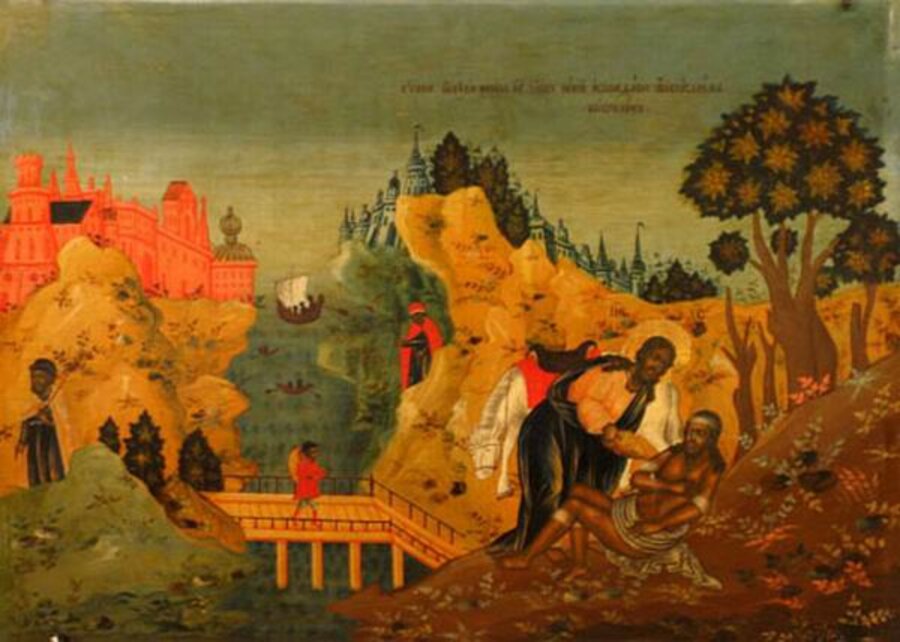
Russian Orthodox icon of the Parable of the Good Samaritan (ὁ Καλὸς Σαμαρείτης), late 18th century. A man fallen among thieves lies wounded on the road; the priest and Levite pass by, but the Samaritan dismounts, binds his wounds, and bears him to the inn. In the Lucan journey to Jerusalem, Christ sets this parable before those who would follow Him -- the incarnate Son Himself is the Samaritan who came down to heal the man left half dead and who promises to return.
Steadfast to Jerusalem
Luke 9:51
And it came to pass, when the time was come that he should be received up, he stedfastly set his face to go to Jerusalem.
Jesus turned toward the Holy City to accomplish the exodus spoken of on the mountain. He went willingly to the Passion that would fulfill the Law and the Prophets and open the way to salvation.
St. Cyril of Alexandria, Commentary on Luke
For when the days were fulfilled for His being taken up, He set His face to go to Jerusalem. By which is meant, that as the time had now come for Him to suffer, He went voluntarily to His Passion.
Cost of Following
Luke 9:57-62
And it came to pass, that, as they went in the way, a certain man said unto him, Lord, I will follow thee whithersoever thou goest. And Jesus said unto him, Foxes have holes, and birds of the air have nests; but the Son of man hath not where to lay his head.
And he said unto another, Follow me. But he said, Lord, suffer me first to go and bury my father. Jesus said unto him, Let the dead bury their dead: but go thou and preach the kingdom of God.
And another also said, Lord, I will follow thee; but let me first go bid them farewell, which are at home at my house. And Jesus said unto him, No man, having put his hand to the plough, and looking back, is fit for the kingdom of God.
Jesus here reveals the absolute cost of discipleship. In His kenosis the Son of Man has nowhere to lay His head. He demands complete detachment from every earthly comfort and natural bond.
St. Cyril of Alexandria, Commentary on Luke
For earnestly to follow Christ is confessedly profitable to salvation: but he who wishes to be counted worthy of so great glory must, I say, bear his cross. And what is it to bear the cross? It is to die unto the world, by denying its empty distractions, and manfully abandoning a carnal and pleasure-loving life.
St. Cyril of Alexandria, Commentary on Luke
For just as the husbandman, who has begun to break up his land by the plough, if he grow weary, and leave his labour half done, sees not his field thick set with ears, nor his threshing-floor full of sheaves, and suffers of course the loss which is the natural result of idleness; so he who wishes to cleave unto Christ, but does not bid farewell to the things of the world, and abandon all love of the flesh, and even deny his earthly relatives, is not fit for the kingdom of God.
The Seventy
Luke 10:1-3
After these things the Lord appointed other seventy also, and sent them two and two before his face into every city and place, whither he himself would come. Therefore said he unto them, The harvest truly is great, but the labourers are few: pray ye therefore the Lord of the harvest, that he would send forth labourers into his harvest. Go your ways: behold, I send you forth as lambs among wolves.
Jesus appointed seventy others and sent them to prepare the cities. Seventy (or seventy-two im some translations) is a reference to the table of nations after the flood, the very same seventy nations that were scattered after the fall of the Tower of Babel. At this moment, Jesus is extending His work unto all the nations of the world.
The Lord of the harvest sent forth laborers into a field that embraced both Jew and Gentile. As lambs among wolves they went in humility, prefiguring the apostolic mission of the Church, empowered by His authority.
St. Cyril of Alexandria, Commentary on Luke
An outline of this ordinance also was set forth in the words of Moses, who at the command of God chose out seventy, upon whom God poured out His Spirit.
St. Cyril of Alexandria, Commentary on Luke
For when we fly to spiritual refreshment, we shall find twelve fountains, namely, the holy Apostles, from whom we imbibe the knowledge of salvation as from the well-springs of the Saviour; and seventy palms, that is, those who were now appointed by Christ.
Good Samaritan
Luke 10:25-37
And, behold, a certain lawyer stood up, and tempted him, saying, Master, what shall I do to inherit eternal life? He said unto him, What is written in the law? how readest thou? And he answering said, Thou shalt love the Lord thy God with all thy heart, and with all thy soul, and with all thy strength, and with all thy mind; and thy neighbour as thyself. And he said unto him, Thou hast answered right: this do, and thou shalt live. But he, willing to justify himself, said unto Jesus, And who is my neighbour?
And Jesus answering said, A certain man went down from Jerusalem to Jericho, and fell among thieves, which stripped him of his raiment, and wounded him, and departed, leaving him half dead. And by chance there came down a certain priest that way: and when he saw him, he passed by on the other side. And likewise a Levite, when he was at the place, came and looked on him, and passed by on the other side. But a certain Samaritan, as he journeyed, came where he was: and when he saw him, he had compassion on him, And went to him, and bound up his wounds, pouring in oil and wine, and set him on his own beast, and brought him to an inn, and took care of him. And on the morrow when he departed, he took out two pence, and gave them to the host, and said unto him, Take care of him; and whatsoever thou spendest more, when I come again, I will repay thee. Which now of these three, thinkest thou, was neighbour unto him that fell among the thieves? And he said, He that shewed mercy on him. Then said Jesus unto him, Go, and do thou likewise.
Jesus is the Good Samaritan who came down from the heav to the man fallen among thieves. In His kenosis He bound the wounds of fallen humanity with oil and wine and carried him to the inn of the Church.
The priest and the Levite of the old covenant could not save; only the merciful Stranger who is God incarnate fulfills the Law of love. The Christian journey is one from death to life, paid in full by the Samaritan who promises to return.
St. Cyril of Alexandria, Commentary on Luke
Very skilfully therefore does the Saviour of all weave the parable of him who fell into the hands of thieves ... But one of another race, a Samaritan, fulfilled the law of love.
St. Cyril of Alexandria, Commentary on Luke
For the Saviour of all and Lord did not conclude this clause ... but commanded us to add, "For we also ourselves have forgiven every one who is indebted to us." But this is fitting only for those who have chosen a virtuous life.
Mary and Martha
Luke 10:38-42
Now it came to pass, as they went, that he entered into a certain village: and a certain woman named Martha received him into his house. And she had a sister called Mary, which also sat at Jesus' feet, and heard his word. But Martha was cumbered about much serving, and came to him, and said, Lord, dost thou not care that my sister hath left me to serve alone? bid her therefore that she help me. And Jesus answered and said unto her, Martha, Martha, thou art careful and troubled about many things: But one thing is needful: and Mary hath chosen that good part, which shall not be taken away from her.
Continuing His journey to Jerusalem, the Lord entered into a certain village and was received into the house of Martha. There, two sisters set before us two ways of receiving the Lord.
Martha was diligent and full of hospitality. She was cumbered about much serving. Though her labor sprang from love, it brought forth anxiety. In her distraction she asked the Lord to command her sister to rise and assist her.
Mary chose instead to sit at Jesus feet and hear His word. She fixed her whole attention upon the very Logos made flesh.
The Lord corrected Martha with tender authority. She was careful and troubled about many things, but only one thing is needful. Mary had chosen that good part which shall not be taken away from her.
On the road to Jerusalem, and to the Cross, Christ teaches every disciple the true order of the Christian life. All service and action must flow from contemplation and attentive listening to the Word. Without communion with Christ, even the finest works become burdensome and restless.
St. Augustine
Martha was troubled about many things, when but one thing was needful. Mary chose the better part, which shall not be taken away from her. She chose to be fed by the Lord, rather than to feed Him.
The example of Mary calls every soul toward the contemplative heart. In the Catholic Church the Lord sustains both the active and the contemplative life, yet always in right order: first to receive from Christ, then to serve in His name. As we continue this journey with Him toward Jerusalem, may we also choose that good part which alone endures forever.
Ask, Seek, Knock
Luke 11:9-13
And I say unto you, Ask, and it shall be given you; seek, and ye shall find; knock, and it shall be opened unto you. For every one that asketh receiveth; and he that seeketh findeth; and to him that knocketh it shall be opened. If a son shall ask bread of any of you that is a father, will he give him a stone? or if he ask a fish, will he for a fish give him a serpent? Or if he shall ask an egg, will he offer him a scorpion? If ye then, being evil, know how to give good gifts unto your children: how much more shall your heavenly Father give the Holy Spirit to them that ask him?
Continuing His journey to Jerusalem, the Lord instructs His disciples in confident and persistent prayer. Having taught them the words of the Our Father, He now urges them to ask, to seek, and to knock with the assurance of a loving Father who gives good gifts, above all the Holy Spirit.
The image is intimate and familial. Earthly fathers, though fallen, do not give stones for bread or serpents for fish. How much more will the heavenly Father respond to those who come to Him through the Son?
This teaching stands as a direct preparation for the trials that await in Jerusalem. The road ahead demands not self reliance but bold, continual dependence upon the Father. The very Logos who journeys toward the Cross reveals the heart of the Father.
Prayer is no mere formality. It is the living relationship that sustains every disciple. In the Catholic Church this same invitation remains open. The Lord preserves the grace of persistent prayer through the sacraments and the liturgy so that every soul may ask, seek, and knock until it receives the fullness of the Holy Spirit.
St. Cyril of Alexandria
He who asks receives, and he who seeks finds, and to him who knocks it shall be opened. For the heavenly Father gives the Holy Spirit to those who ask Him.
As the shadow of the Passion lengthens on the road to Jerusalem, the Lord calls every heart to this holy boldness in prayer. May we, like the disciples, learn to ask with faith, seek with perseverance, and knock with confidence, knowing that the Father who sent His Son will not refuse the Spirit to those who entreat Him.
Ten Lepers
Luke 17:11-19
And it came to pass, as he went to Jerusalem, that he passed through the midst of Samaria and Galilee. And as he entered into a certain village, there met him ten men that were lepers, which stood afar off: And they lifted up their voices, and said, Jesus, Master, have mercy on us. And when he saw them, he said unto them, Go shew yourselves unto the priests. And it came to pass, that, as they went, they were cleansed. And one of them, when he saw that he was healed, turned back, and with a loud voice glorified God, And fell down on his face at his feet, giving him thanks: and he was a Samaritan. And Jesus answering said, Were there not ten cleansed? but where are the nine? There are not found that returned to give glory to God, save this stranger. And he said unto him, Arise, go thy way: thy faith hath made thee whole.
Only one of the ten returned to give thanks and worship at the feet of Jesus. This act of gratitude marked the difference between external cleansing and full salvation. The Lord declared to the Samaritan stranger that his faith had made him whole.
The passage shows the mercy of God reaching beyond Israel. It reveals that true response to divine goodness is thankful adoration. Many receive benefits but few return to the Giver.
St. Cyril of Alexandria
The Saviour of all does not reject the stranger but receives him who gives glory to God.
In the Catholic Church the same Lord grants healing through the sacraments. He awaits the return of every soul in thanksgiving and worship.
Passion Predicted
Luke 18:31-34
Then he took unto him the twelve, and said unto them, Behold, we go up to Jerusalem, and all things that are written by the prophets concerning the Son of man shall be accomplished. For he shall be delivered unto the Gentiles, and shall be mocked, and spitefully entreated, and spitted on: And they shall scourge him, and put him to death: and the third day he shall rise again. And they understood none of these things: and this saying was hid from them, neither knew they the things which were spoken.
The Twelve understood none of these things. Christ here can do all things because He is the Author of all. As the incarmate Word through whom the Father created and sustains the universe, He sovereignly ordains the Passion to fulfill every prophecy written concerning the Son of man.
St. Cyril of Alexandria, Commentary on Luke
He foretells these things clearly, that when they came to pass the disciples might remember that He had foreknown them and had foretold them, and so might believe that He was God by nature.
In the Church the same Lord still leads His people along this road. The Passion is made present in the Holy Sacrifice of the Mass. By grace we embrace the path of obedient suffering, death, and resurrection into the freedom of the children of God.
Bartimaeus and Zacchaeus
Luke 18:35-43
And it came to pass, that as he was come nigh unto Jericho, a certain blind man sat by the way side begging: And hearing the multitude pass by, he asked what it meant. And they told him, that Jesus of Nazareth passeth by. And he cried, saying, Jesus, thou Son of David, have mercy on me. And they which went before rebuked him, that he should hold his peace: but he cried the more, Thou Son of David, have mercy on me. And Jesus stood, and commanded him to be brought unto him: and when he was come near, he asked him, Saying, What wilt thou that I shall do unto thee? And he said, Lord, that I may receive my sight. And Jesus said unto him, Receive thy sight: thy faith hath saved thee. And immediately he received his sight, and followed him, glorifying God: and all the people, when they saw it, gave praise unto God.
Luke 19:1-10
And Jesus entered and passed through Jericho. And, behold, there was a man named Zacchaeus, which was the chief among the publicans, and he was rich. And he sought to see Jesus who he was; and could not for the press, because he was little of stature. And he ran before, and climbed up into a sycomore tree to see him: for he was to pass that way. And when Jesus came to the place, he looked up, and saw him, and said unto him, Zacchaeus, make haste, and come down; for to day I must abide at thy house. And he made haste, and came down, and received him joyfully. And when they saw it, they all murmured, saying, That he was gone to be guest with a man that is a sinner. And Zacchaeus stood, and said unto the Lord; Behold, Lord, the half of my goods I give to the poor; and if I have taken any thing from any man by false accusation, I restore him fourfold. And Jesus said unto him, This day is salvation come to this house, forsomuch as he also is a son of Abraham. For the Son of man is come to seek and to save that which was lost.
Bartimaeus, though blind, sees who Jesus is and persists in crying for mercy. Zacchaeus, small and sinful, is called by name. Christ, the Author of all, grants sight by faith and brings salvation to the lost.
St. Cyril of Alexandria
Zacchaeus therefore, while he was in the crowd, saw not Christ, but having advanced beyond the vulgar ignorance, was thought worthy to entertain Him.
In the Church the same Lord calls sinners by name, grants mercy to persistent faith, and brings salvation to every house that receives Him.
Ten Minas
Luke 19:11-27
And as they heard these things, he added and spake a parable, because he was nigh to Jerusalem, and because they thought that the kingdom of God should immediately appear. He said therefore, A certain nobleman went into a far country to receive for himself a kingdom, and to return. And he called his ten servants, and delivered them ten pounds, and said unto them, Occupy till I come. But his citizens hated him, and sent a message after him, saying, We will not have this man to reign over us. And it came to pass, that when he was returned, having received the kingdom, then he commanded these servants to be called unto him, to whom he had given the money, that he might know how much every man had gained by trading. Then came the first, saying, Lord, thy pound hath gained ten pounds. And he said unto him, Well, thou good servant: because thou hast been faithful in a very little, have thou authority over ten cities. And the second came, saying, Lord, thy pound hath gained five pounds. And he said likewise to him, Be thou also over five cities. And another came, saying, Lord, behold, here is thy pound, which I have kept laid up in a napkin: For I feared thee, because thou art an austere man: thou takest up that thou layedst not down, and reapest that thou didst not sow. And he saith unto him, Out of thine own mouth will I judge thee, thou wicked servant. Thou knewest that I was an austere man, taking up that I laid not down, and reaping that I did not sow: Wherefore then gavest not thou my money into the bank, that at my coming I might have required mine own with usury? And he said unto them that stood by, Take from him the pound, and give it to him that hath ten pounds. (And they said unto him, Lord, he hath ten pounds.) For I say unto you, That unto every one which hath shall be given; and from him that hath not, even that he hath shall be taken away from him. But those mine enemies, which would not that I should reign over them, bring hither, and slay them before me.
The people supposed the kingdom of God would immediately appear. Christ, the Author of all, is the nobleman who ascends to receive the kingdom and will return to reward faithful servants and judge the unfaithful.
St. Cyril of Alexandria, Commentary on Luke
He speaks this parable because they thought that the kingdom of God was to appear immediately; but He shows that it was necessary for Him first to go to the Father and then to return.
In the Church the same Lord entrusts us with His gifts and will return to reward faithful stewardship.
The New Exodus
Jesus has led the disciples on this journey from Galilee to Jerusalem. Every teaching, healing, and encounter has prepared them for what He will accomplish in the holy city: the fulfillment of all that the prophets wrote concerning the Son of man through His Passion, death, and resurrection.