Ascension
Forty days after He rose from the dead, the Lord Jesus leads His disciples out from Jerusalem to the place where heaven and earth meet. What began in the empty tomb and was confirmed in Galilee and on the road to Emmaus now reaches its crown. The same body that was crucified, buried, and raised walks the earth once more -- and then ascends bodily into heaven.
The Ascension is twofold mystery. It completes the Paschal victory: Christ does not vanish into absence but enters glory while remaining present to His Church. It is also His enthronement: the man Jesus takes His seat at the right hand of the Father as King and eternal High Priest. In one movement the Son who descended for our salvation is lifted up, and human nature with Him.
Ascension of Christ
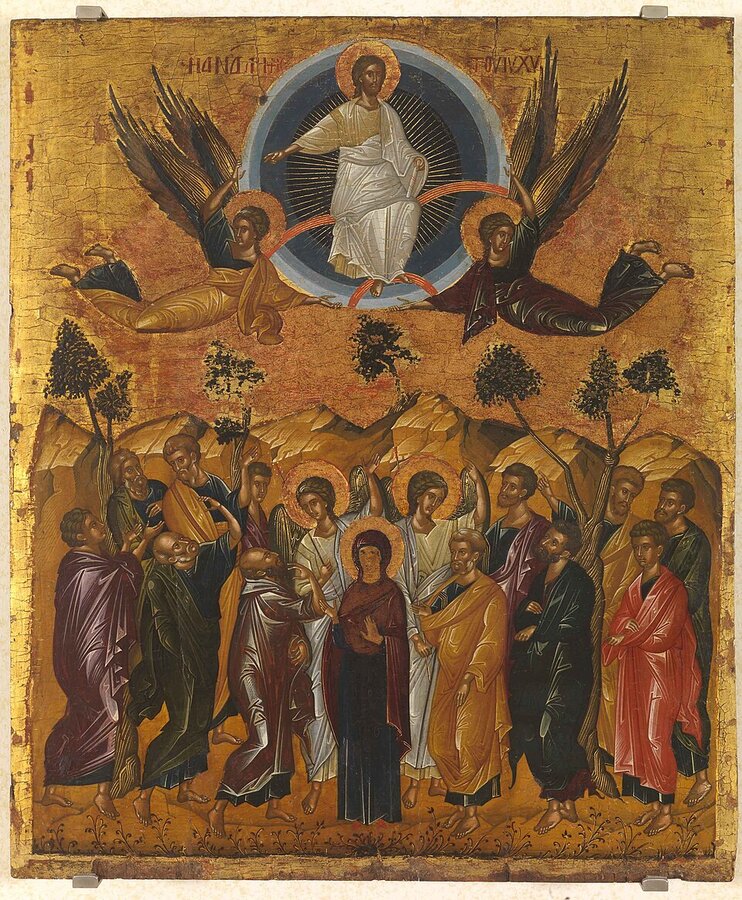
Byzantine icon of the Ascension (Ἡ Ανάληψις). Unknown painter of Candia (Crete), second half of the 15th century. Christ rises in garments of uncreated light within a circular mandorla borne by two angels; below, the apostles stand in two groups around the Theotokos, flanked by angels in white. In the background, the Mount of Olives marks the place from which the Lord ascended to the right hand of the Father.
Death has been defeated. Hades has been harrowed. The risen Lord has eaten with His disciples, shown them His wounds, and breathed peace upon the apostolic college. The forty days between Easter and Ascension are not an epilogue to the Resurrection but its necessary unfolding. The apostles must learn that the body raised in incorruption is the same body that will be glorified at the Father's right hand. The Ascension is the visible seal upon everything the Resurrection proclaimed.
The Church Fathers of East and West behold in this event the fulfillment of prophecy, the opening of heaven to mankind, and the pledge that the same Lord who departed in the flesh will return. What the apostles witnessed on the Mount of Olives remains the living faith of the one, holy, catholic, and apostolic Church until He comes again.
To contemplate the Ascension is to contemplate the destiny of the human race in Christ. The flesh taken from the Virgin is the flesh that enters the sanctuary of heaven. The wounds that Thomas touched are the wounds of the enthroned High Priest. The blessing spoken on the mount is the blessing that still descends upon the Church in every liturgy. Here the Paschal Mystery reaches the throne; here the Kingdom proclaimed in Galilee is seated in glory.
Mount of Olives
The risen Lord had appeared to the apostles over forty days, speaking of the kingdom of God and opening the Scriptures concerning Himself. He proved Himself alive by many infallible proofs. He ate and drank with them. He spoke of the promise of the Father. At the end He leads them out as far as Bethany, on the slope of the Mount of Olives -- the same ridge from which He had wept over Jerusalem and from which He will one day return.
Luke 24:50-53
And he led them out as far as to Bethany, and he lifted up his hands, and blessed them. And it came to pass, while he blessed them, he was parted from them, and carried up into heaven. And they worshipped him, and returned to Jerusalem with great joy: and were continually in the temple, praising and blessing God. Amen.
He lifts His hands in blessing. While the blessing is still upon them, He is parted from their sight and carried up into heaven. The last gesture of the incarnate Son upon the earth is benediction. He departs as He lived: bestowing grace.
The apostles do not flee in grief. They worship, return to Jerusalem with great joy, and remain in the temple praising God. The departure of the Lord in the flesh is not abandonment but the consummation of His victory. Joy, not sorrow, is the apostolic response, because they have seen where He has gone and know that the blessing He spoke still rests upon them.
Acts 1:9-11
And when he had spoken these things, while they beheld, he was taken up; and a cloud received him out of their sight. And while they looked stedfastly toward heaven as he went up, behold, two men stood by them in white apparel; Which also said, Ye men of Galilee, why stand ye gazing up into heaven? this same Jesus, which is taken up from you into heaven, shall so come in like manner as ye have seen him go into heaven.
A cloud receives Him -- not to hide defeat but to reveal divine glory, as the prophets spoke of the Lord who makes the clouds His chariot. Two men in white apparel stand beside the apostles. They name Him explicitly: this same Jesus. The Ascension confirms what the empty tomb already proclaimed: the same body that suffered and rose has been taken up into heaven.
The Byzantine icon of the feast makes the mystery visible. Christ ascends within the mandorla of uncreated light, His hands outstretched in blessing even as He departs. Below, the apostles stand in two groups, their faces lifted toward heaven. At the center stands the Theotokos, her hands raised in prayer, the Mother of the Lord who ascends. She does not gaze upward like the apostles; in the tradition of the Church she already participates in the mystery she bore in her womb. The first of the redeemed, she stands at the heart of the icon as humanity's representative before the throne. Angels in white flank the assembly. The Mount of Olives rises in the background, marking the sacred geography where the feet of the incarnate Son last touched the earth.
St. John Chrysostom, preaching on the Acts of the Apostles, teaches that the Ascension was ordered for the strengthening of faith. The disciples saw the beginning of the Ascension while they beheld; the angels bore witness to its end, lest anyone imagine that Christ had merely seemed to depart or that His body had been left behind on earth.
St. John Chrysostom, Homily 2 on the Acts of the Apostles
While they beheld, He was taken up. Not while they beheld did He rise from the dead, but while they beheld, He was taken up. Inasmuch, however, as the sight of their eyes even here was not all-sufficient; for in the Resurrection they saw the end, but not the beginning, and in the Ascension they saw the beginning, but not the end: because in the former it had been superfluous to have seen the beginning, the Lord Himself Who spoke these things being present, and the sepulchre showing clearly that He is not there; but in the latter, they needed to be informed of the sequel by word of others.
St. John Chrysostom further insists that the Ascension is a confirmation of the Resurrection. If He was taken up with a body, much rather must He have risen again with a body. The cloud, the angels, and the mount together bear witness that the Paschal victory is bodily and complete.
The Ascension is therefore the visible completion of the Paschal Mystery. The tomb is empty; the body is glorified; the Lord goes up in the flesh He received from Mary. Heaven, which no human foot had trodden, now receives the first-fruits of our race. The gates lift up their heads; the everlasting doors open wide; the King of glory enters in.
St. Cyril of Alexandria teaches that before the Ascension, heaven was in a certain sense closed to human nature. No human foot had trodden that pure country of the angels. Christ first prepared the way for our ascent by offering Himself to the Father as the first-fruits of the dead, and the inhabitants of heaven beheld in wonder the man whom the Spirit commanded them to receive as King of glory.
St. Cyril of Alexandria, Commentary on the Gospel of John
For heaven was then completely inaccessible to us -- human foot had never trodden that pure and holy country of the angels. It was Christ who first prepared the way for our ascent there. By offering himself to God the Father as the first fruits of all who are dead and buried, he gave us a way of entry into heaven and was himself the first human being the inhabitants of heaven ever saw.
The Mother of God, who gave Him that flesh, stands beneath the ascending mandorla as the icon of the Church on earth: prayerful, steadfast, already drawn into the mystery she carried. The apostles gaze upward; she unites both groups in one hope. From this mountain the Lord departs; to this mountain He will return.
Promise and Commission
Before He ascends, the apostles ask whether He will at this time restore the kingdom to Israel. The question arises from love and from the hope kindled by His resurrection appearances. They have seen the risen King; they long for the restoration of all things. The Lord redirects their gaze from political expectation to the mission that will found the Church.
Acts 1:6-8
When they therefore were come together, they asked of him, saying, Lord, wilt thou at this time restore again the kingdom to Israel? And he said unto them, It is not for you to know the times or the seasons, which the Father hath put in his own power. But ye shall receive power, after that the Holy Ghost is come upon you: and ye shall be witnesses unto me both in Jerusalem, and in all Judaea, and in Samaria, and unto the uttermost part of the earth.
The kingdom is not withheld; it is entrusted. The apostles will receive power when the Holy Spirit comes upon them. They will be witnesses in Jerusalem, in all Judaea and Samaria, and to the uttermost part of the earth. The Ascension does not postpone the Kingdom. It launches the Kingdom into history through the apostolic body that will carry the Gospel to every nation.
The charge to teach and baptize all nations had already been spoken in Galilee. The Ascension crowns that commission with the promise of abiding presence.
Matthew 28:18-20
And Jesus came and spake unto them, saying, All power is given unto me in heaven and in earth. Go ye therefore, and teach all nations, baptizing them in the name of the Father, and of the Son, and of the Holy Ghost: Teaching them to observe all things whatsoever I have commanded you: and, lo, I am with you alway, even unto the end of the world. Amen.
All power in heaven and on earth belongs to the risen Lord who now ascends. The apostles go forth under His authority, not their own. The promise that He will be with them always, even unto the end of the world, is spoken before the Ascension and confirmed by it. He goes up to the Father so that He may be with them more truly through the Spirit and the sacraments of the Church.
The Lord had also spoken of this departure as necessary for the gift that would follow.
John 16:7
Nevertheless I tell you the truth; It is expedient for you that I go away: for if I go not away, the Comforter will not come unto you; but if I depart, I will send him unto you.
His going away is not loss but the condition of a greater presence. The Comforter, the Spirit of Truth, will come because the Son ascends to the Father. What the apostles cannot yet grasp on the Mount of Olives will be unveiled ten days later in the upper room, when the promise of Pentecost is fulfilled in the Descent of the Holy Spirit.
St. John Chrysostom observes that the Lord spoke these words of the Spirit immediately before He was taken up, so that the disciples would not grieve as though left orphans, but would look forward to the power that would equip them for the world-wide mission.
St. John Chrysostom, Homily 2 on the Acts of the Apostles
And He did not merely say, I go, lest they should again grieve, but He said, I send the Spirit; and that He was going away into heaven they saw with their eyes. O what a sight they were granted! And while they looked stedfastly, it is said, toward heaven, as he went up, behold, two men stood by them in white apparel.
The Ascension and Pentecost belong to one design. Christ ascends as King; the Spirit descends to constitute the Church as His Body. The apostles who watched Him depart will soon speak in tongues of fire and baptize nations in the name of the Father, and of the Son, and of the Holy Ghost. The commission spoken on the mountain is the same commission the Catholic Church carries still: to make disciples of all nations, teaching them to observe all things whatsoever He commanded.
St. Leo the Great teaches that the forty days between Resurrection and Ascension were not idle. In that period great mysteries were ratified and deep truths revealed: the fear of death was removed, the immortality of the flesh was established, the keys of the kingdom were entrusted to Peter, and the Lord opened the Scriptures on the road to Emmaus until the breaking of bread unveiled His presence. The Ascension is the capstone of that instruction.
St. Leo the Great, Sermon 73
Those days, therefore, dearly-beloved, which intervened between the Lord's Resurrection and Ascension did not pass by in uneventful leisure, but great mysteries were ratified in them, deep truths revealed. In them the fear of awful death was removed, and the immortality not only of the soul but also of the flesh established.
The apostles who had fled the Cross now receive the world as their field of witness. The Ascension sends them not into comfortable triumph but into the labor of the Kingdom, armed with a promise greater than any earthly restoration of Israel.
Right Hand of the Father
To ascend is not merely to leave. It is to be enthroned. The man Christ Jesus, who walked the roads of Galilee and hung upon the Cross, is exalted to the right hand of the Majesty on high. The Fathers proclaim this as the supreme revelation of what humanity was created to become.
Mark 16:19
So then after the Lord had spoken unto them, he was received up into heaven, and sat on the right hand of God.
Hebrews 1:3
Who being the brightness of his glory, and the express image of his person, and upholding all things by the word of his power, when he had by himself purged our sins, sat down on the right hand of the Majesty on high.
The seat at the Father's right hand is the seat of eternal priesthood and kingly authority. Having offered one sacrifice for sins forever, the incarnate Son sits down. The work of redemption is complete; the reign has begun. What the prophets foretold in figure now stands revealed in the Person of Christ.
Psalm 110:1
The LORD said unto my Lord, Sit thou at my right hand, until I make thine enemies thy footstool.
Daniel 7:13-14
I saw in the night visions, and, behold, one like the Son of man came with the clouds of heaven, and came to the Ancient of days, and they brought him near before him. And there was given him dominion, and glory, and a kingdom, that all people, nations, and languages, should serve him: his dominion is an everlasting dominion, which shall not pass away, and his kingdom that which shall not be destroyed.
The Son of Man who came with the clouds of heaven at the Ascension is the same Lord who gave Himself for the life of the world. Dominion, glory, and an everlasting kingdom are His by right of the Cross and the empty tomb. Every knee in heaven and on earth will bow before the name that is above every name.
Ephesians 4:8-10
Wherefore he saith, When he ascended up on high, he led captivity captive, and gave gifts unto men. (Now that he ascended, what is it but that he also descended first into the lower parts of the earth? He that descended is the same also that ascended up far above all heavens, that he might fill all things.)
He who descended into the lower parts of the earth -- into death and Hades itself -- is the same who ascended far above all heavens. The Harrowing and the Ascension are one victory viewed from two directions. Captivity itself is taken captive; gifts are poured out upon men. The enthroned Christ fills all things, from the depths of the grave to the heights of the Father's glory.
St. Leo the Great, preaching to the Church at Rome, beholds in the Ascension the exaltation not of Christ alone but of the human nature He assumed. What the first Adam lost through disobedience, the New Adam restores through obedience unto death and glory at the Father's right hand.
St. Leo the Great, Sermon 73
Since then Christ's Ascension is our uplifting, and the hope of the Body is raised, whither the glory of the Head has gone before, let us exult, dearly-beloved, with worthy joy and delight in the loyal paying of thanks. For today not only are we confirmed as possessors of paradise, but have also in Christ penetrated the heights of heaven, and have gained still greater things through Christ's unspeakable grace than we had lost through the devil's malice.
St. Cyril of Alexandria teaches that the Lord ascended as man to appear before the Father on our behalf, transmitting to the whole human race the glory of being children of God. He sits at the right hand not in departure from us but as the pioneer of our entry into heaven.
St. Cyril of Alexandria, Commentary on the Gospel of John
As man then he appeared before the Father on our behalf, to enable us whom the ancient transgression had excluded from his presence once more to see the Father's face. As the Son he took his seat to enable us as sons and daughters through him to be called children of God. So Paul, who claims to speak for Christ, teaching that the whole human race has a share in the events of Christ's life, says that God has raised us up with him and enthroned us with him in heaven.
The Ascension is therefore enthronement in the fullest sense. Christ reigns as King. He intercedes as High Priest. And because Head and Body are one, the Church already shares in His exaltation by grace, awaiting the day when faith shall give way to sight.
From the throne He pours out the gifts that build up His Body. The ascended Lord is not idle in heaven. He governs the nations. He pleads for His own. He sends His Spirit upon the Church He purchased with His blood. The right hand of the Father is the place from which He rules the sacramental life of the world, until every enemy is made His footstool and He delivers the kingdom to the Father at the end.
St. Augustine reminds the faithful that Christ who is exalted above the heavens still suffers on earth in the members of His Body. The Head is in glory; the Body still walks the way of the Cross. Yet the two are never divided.
St. Augustine, Sermon on the Ascension of the Lord
Christ is now exalted above the heavens, but he still suffers on earth all the pain that we, the members of his body, have to bear. He showed this when he cried out from above: Saul, Saul, why do you persecute me? and when he said: I was hungry and you gave me food.
Christ Present in His Church
A careless reading might imagine that the Ascension marks the end of Christ's presence on earth -- that the disciples were left behind to remember a Lord who had gone far away. The apostolic faith proclaims the opposite. The Lord who ascended remains with His Church until the end of the age. His departure in the flesh opens the way for a presence more universal, not more remote.
St. Leo the Great teaches that what was visible in Christ's earthly ministry was changed at the Ascension into a sacramental presence, so that faith might become more excellent and sight give way to the authority of divine doctrine.
St. Leo the Great, Sermon 74
And so that which till then was visible of our Redeemer was changed into a sacramental presence, and that faith might be more excellent and stronger, sight gave way to doctrine, the authority of which was to be accepted by believing hearts enlightened with rays from above.
St. Augustine, preaching on the feast of the Ascension, calls the faithful to ascend with Christ in heart even while He remains on earth with them through love.
St. Augustine, Sermon on the Ascension of the Lord
Today our Lord Jesus Christ ascended into heaven; let our hearts ascend with him. Listen to the words of the Apostle: If you have risen with Christ, set your hearts on the things that are above where Christ is, seated at the right hand of God; seek the things that are above, not the things that are on earth. For just as he remained with us even after his ascension, so we too are already in heaven with him, even though what is promised us has not yet been fulfilled in our bodies.
The Lord who ascended did not leave heaven when He came down to earth, nor did He withdraw from His disciples when He was taken up. He is here with us by His divinity, His power, and His love. While in heaven He is also with us; and we while on earth are with Him. The members of His Body ascend in Him because they are in Him by grace.
St. Augustine, Sermon on the Ascension of the Lord
Out of compassion for us he descended from heaven, and although he ascended alone, we also ascend, because we are in him by grace. Thus, no one but Christ descended and no one but Christ ascended; not because there is no distinction between the head and the body, but because the body as a unity cannot be separated from the head.
This is the faith of the Catholic Church. The same Christ who blessed the apostles on the Mount of Olives and was received into the cloud is objectively and fully present in the sacraments He entrusted to His apostles. In the Holy Eucharist He is not remembered as absent but received as living. In the apostolic ministry of forgiveness He continues the peace He spoke in the upper room. In the teaching of the bishops in union with the See of Peter, the doctrine He commanded is guarded and proclaimed without corruption.
The Theotokos, who stood at the center of the apostolic company as her Son ascended, remains in the midst of the Church as mother of the living and model of faith. She who bore the bodily Christ on earth now intercedes before the enthroned Christ in heaven, and the pilgrim Church on earth walks in her company toward the glory that has already opened its gates.
Where the risen Lord was seen in Galilee for forty days, He is now seen in the breaking of the bread and the assembly of the faithful. The Ascension completes the Paschal victory by transforming visible companionship into the enduring presence of Christ in His one, holy, catholic, and apostolic Church.
This is why the Church does not mourn a Lord who has gone away. She worships a Lord who has gone up for her sake. The Eucharistic altar is the place where heaven and earth remain joined. The ascended Christ is the Christ who gives His Body and Blood to the faithful. The same hands lifted in blessing on the Mount of Olives are the hands that break the bread in every age. What the apostles received in the upper room after the Resurrection continues wherever the apostolic ministry endures in hierarchical unity.
The pre-schism Fathers of East and West are at one in this confession. The Ascension does not thin Christ's presence into memory or sentiment. It intensifies His presence into the sacramental economy by which the Catholic Church lives until the end of the age.
Until He Comes Again
The two men in white apparel do not permit the apostles to stand forever gazing into heaven. They redirect hope toward the future while anchoring it in what was seen. The same Jesus who was taken up will return in like manner.
The Ascension is therefore an eschatological sign. The clouds that received Him conceal Him only for a time. The Kingdom He proclaimed is already present in the Church and not yet fully manifest to the world. The Lord who sits at the right hand of the Father will come again to judge the living and the dead in the same flesh in which He ascended, as the Church confesses in awaiting the Second Coming.
Colossians 3:1
If ye then be risen with Christ, seek those things which are above, where Christ sitteth on the right hand of God.
The apostolic exhortation follows from the mystery the apostles witnessed. Those who are united to the risen and ascended Christ must set their minds on things above, not on things on the earth. The same Lord who reigns in heaven governs the conscience of every believer and every nation. His return is not an open question for those who received the testimony of the angels.
St. John Chrysostom draws out the consolation hidden in the angels' words. If Christ shall come again in the same manner, then those who live an admirable life in union with Him shall see Him and shall not be disappointed.
St. John Chrysostom, Homily 2 on the Acts of the Apostles
If any therefore desires to see Christ; if any grieves that he has not seen Him: having this heard, let him show forth an admirable life, and certainly he shall see Him, and shall not be disappointed. For Christ will come with greater glory, though thus, in this manner, with a body.
Between the Ascension and the final Parousia stands the outpouring of the Holy Spirit. The Lord ascended so that the Comforter might descend. The ten days the apostles waited between heaven's opening and Pentecost's fire are the threshold of the Church's public mission. What was promised on the Mount of Olives is fulfilled when the Spirit descends upon the assembly gathered in prayer with Mary the Mother of Jesus at their center.
The Paschal Mystery thus moves from death to resurrection, from resurrection to ascension, from ascension to the gift of the Spirit. The enthroned Christ sends His own Spirit upon the Body that shares His life. The apostles who watched Him go up will preach Him as Lord to the ends of the earth until He comes again in glory.
The one who descended from heaven has ascended far above all heavens. The one who will return is this same Jesus -- King, High Priest, and Son of Man upon the clouds. The Church lives in the interval not as an orphan community but as the Bride awaiting the Bridegroom, already joined to Him in the sacraments, already raised with Him in hope, and already commissioned to bear witness until the day when every eye shall see what the apostles saw by faith on the Mount of Olives.
St. Leo the Great teaches that the angels who announced His birth, attested His Resurrection, and foretold His return in the same Flesh show the continuity of the one divine plan. The Ascension refines faith so that what was once grasped by the hand of flesh is now grasped by the spiritual understanding of the heart, until the Lord comes again visibly upon the clouds.
St. Leo the Great, Sermon 74
As messengers from above were the first to attest His having risen from the dead, so the service of angels was employed to foretell His coming in very Flesh to judge the world, that we might understand what great powers will come with Him as Judge, when such great ones ministered to Him even in being judged.
Watch, then, in the Spirit the Lord has promised. The days between Ascension and Pentecost are the pattern of the Church's whole life: waiting in prayer, gathered around the apostles and the Mother of God, until the fire descends and the Gospel goes forth. The troparion of the feast names the joy the disciples received: the promise of the Spirit, the blessing that confirms the Sonship of Christ, the Redeemer whose ascent is our hope.
He has ascended in glory. He will return in glory. Until that day, He is not absent. He is enthroned -- and present -- in the Church He founded.
The apostles returned to Jerusalem not because the story had ended, but because the story had entered its apostolic phase. The blessing was still upon them. The Spirit was still promised. The King was already on His throne. And the world, from Jerusalem to the uttermost part of the earth, awaited the witness of those who had seen Him go up.
Thou hast ascended in glory
Thou hast ascended in glory, O Christ our God, and gladdened Thy disciples with the promise of the Holy Spirit; and they were assured by the blessing that Thou art the Son of God, the Redeemer of the world.