Temptations of Christ
Immediately after His Baptism in the Jordan, the Spirit led our Lord Jesus Christ into the wilderness to be tempted by the devil (Matthew 4:1; Mark 1:12; Luke 4:1). The New Adam confronted the same threefold concupiscence that had conquered the first Adam in Eden (Genesis 3:6; 1 John 2:16). In this combat Jesus triumphed completely, giving us both the model and the grace to overcome.
Temptations of Christ
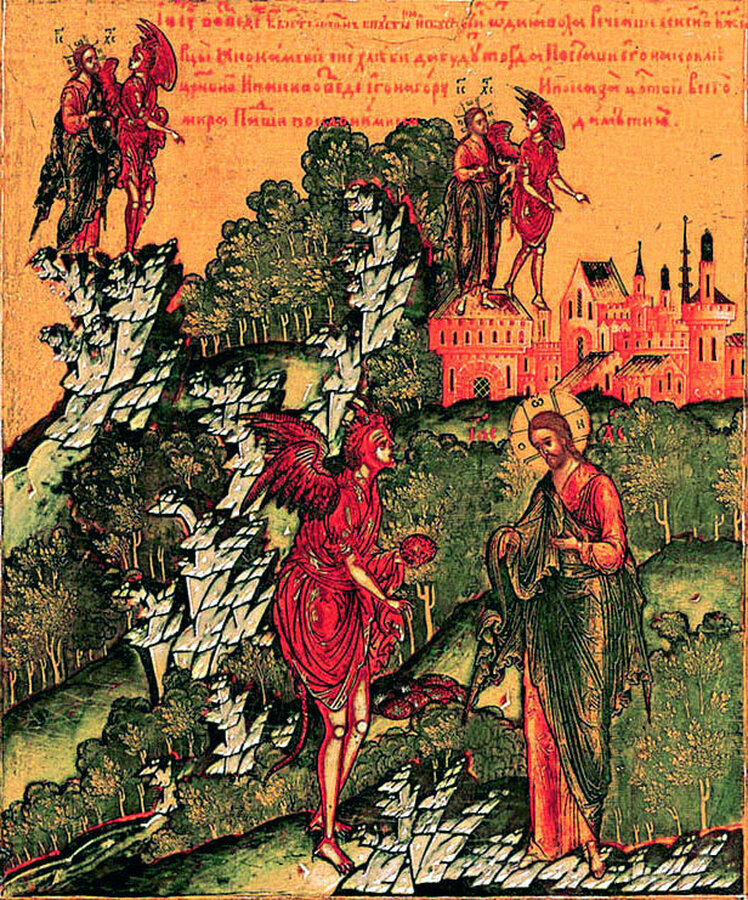
Byzantine icon of the Temptations (Οἱ Πειρασμοὶ). Christ stands fasting in the wilderness while the devil appears in three scenes: offering stones turned to bread, displaying the kingdoms of the world from a high mountain, and tempting Him to cast Himself from the temple pinnacle. In iconographic tradition the forty days of fasting precede the combat, and Christ's victory over the threefold concupiscence supplies the pattern for every Christian struggle.
Dostoevsky’s Grand Inquisitor
In The Brothers Karamazov the Grand Inquisitor accuses Christ: "Thou didst reject the three powers ... miracle, mystery and authority ... Thou wouldst not enslave man by a miracle ... Thou didst crave for free love and not the base raptures of the slave before the might that has overawed him for ever." The world still hungers for these three more than for the living God.
Wilderness
The wilderness into which the Spirit drove Christ is the desolate region west of the Jordan and the Dead Sea (the same arid wasteland where Israel wandered forty years (Deuteronomy 8:2-4), where Moses and Elijah fasted forty days (Exodus 34:28; 1 Kings 19:8), and where John the Baptist had preached repentance (Matthew 3:1)). Mark’s Gospel states the Spirit “drove” (ekballō) Him there (Mark 1:12), the same forceful verb used for casting out demons. Christ fasted forty days and forty nights, becoming genuinely hungry (Matthew 4:2; Luke 4:2).
This was no mere symbolic retreat. Church Fathers see it as deliberate recapitulation:
St. John Chrysostom, Homily on Matthew 13.1
"Christ goes into the wilderness to overthrow the tyranny of the devil, who had held sway over the earth since Adam's fall ... He fasts forty days to teach us that fasting is the mother of all virtue and the strongest weapon against the devil."
St. Augustine adds that the New Adam must conquer precisely where the old Adam was conquered -- through hunger, presumption, and ambition -- so that every temptation we face might be overcome in Him (De Trinitate 4.13; Sermon 341). The wilderness therefore becomes the battlefield of salvation history, the place where the Logos who created the world now reclaims it from the ancient serpent by the same free obedience Adam refused.
Stones into Bread
Matthew 4:3-4
And the tempter came and said to him, "If you are the Son of God, command these stones to become loaves of bread." But he answered, "It is written, 'Man shall not live by bread alone, but by every word that proceeds from the mouth of God.'"
This first temptation corresponds to the lust of the flesh in the threefold concupiscence (1 John 2:16), the very point at which the first Adam fell when he saw that the tree was good for food (Genesis 3:6).
St. John Chrysostom, Homily on Matthew 13.2
"Why does the devil begin with this temptation? Because he knew that the belly is a great tyrant and that when it gains the mastery it drives even those who are unwilling. ... He therefore attacks Christ first with that whereby he had conquered Adam, thinking that he would easily prevail in like manner against the second Adam. But Christ shows him that He is not overcome by the belly, but that He rules over it."
St. Augustine, Sermon 341
"The first Adam was conquered by the desire for food; the second Adam conquered by the refusal of food. In the first man the flesh lusted against the spirit; in the second the spirit ruled the flesh perfectly. Here the New Adam gives us the pattern: hunger itself must be subjected to the word of God."
St. Gregory the Great summarizes the patristic consensus when he writes that Christ, by fasting forty days and then refusing the bread offered on the devil's terms, "taught us that the soul is more important than the body and that the word of God is the true nourishment of the rational creature" (Homily on the Gospels 16).
Jesus, who is Himself the Bread of Life (John 6:35), would not turn stones into bread at the devil's command. In this refusal He reclaims the ground lost in Eden and supplies the grace by which every Christian can subject the desires of the flesh to the will of the Father.
Temple Pinnacle
Matthew 4:5-7
Then the devil took him to the holy city and set him on the pinnacle of the temple and said to him, "If you are the Son of God, throw yourself down, for it is written, 'He will command his angels concerning you,' and 'On their hands they will bear you up, lest you strike your foot against a stone.'" Jesus said to him, "Again it is written, 'You shall not put the Lord your God to the test.'"
This second temptation corresponds to presumption and vainglory -- the desire to force God to act on our terms and to display divine power before men.
St. John Chrysostom, Homily on Matthew 13.3
"The devil now shifts to the opposite extreme. Having failed with the belly, he attacks through vainglory. He brings Christ to the pinnacle of the temple and urges Him to cast Himself down, not that he might kill Him, but that he might persuade Him to perform a miracle before the people and thus win their admiration. But Christ refuses, teaching us never to tempt God or to seek to prove our sonship by forcing His hand."
St. Augustine, Sermon 341
"The first man fell through pride, wishing to be like God on his own terms. The second Adam conquers by refusing to tempt the Father. Where Adam sought to seize equality with God by grasping, Christ submits in perfect humility and obedience, even to the point of refusing a spectacular sign."
St. Gregory the Great echoes the consensus of the Fathers when he explains that this temptation is the assault of pride: the devil tempts us to demand visible proofs of God's protection rather than to walk by faith and trust in His word (Homily on the Gospels 16).
Jesus, who is Himself the Temple (John 2:21), would not cast Himself down to prove His identity on the devil's terms. In this refusal He reclaims the ground lost in Eden and supplies the grace by which every Christian can reject presumption and walk in humble obedience to the Father.
Kingdoms of the World
Matthew 4:8-10
Again, the devil took him to a very high mountain and showed him all the kingdoms of the world and their glory. And he said to him, "All these I will give you, if you will fall down and worship me." Then Jesus said to him, "Be gone, Satan! For it is written, 'You shall worship the Lord your God and him only shall you serve.'"
This third temptation corresponds to the lust of the eyes and ambition in the threefold concupiscence (1 John 2:16), the very point at which the first Adam fell when he saw that the tree was desirable to make one wise and to be like God (Genesis 3:6).
St. John Chrysostom, Homily on Matthew 13.4
"Having failed with the belly and with vainglory, the devil now attacks through the desire for power and dominion. He offers all the kingdoms of the world, not that he possesses them, but that he might seduce Christ into idolatry. But the Lord repels him with the command of Scripture, teaching us that we must worship God alone and refuse every earthly kingdom offered at the price of apostasy."
St. Augustine, Sermon 341
"The first man fell through the desire to seize dominion on his own terms. The second Adam conquers by refusing every kingdom that does not come from the Father. Where Adam grasped at equality with God through pride, Christ submits in perfect obedience and receives the true kingdom through the cross."
St. Gregory the Great summarizes the patristic consensus when he writes that Christ, by rejecting the offer of all earthly power, "taught us that the soul must never barter its eternal inheritance for temporal glory and that true authority belongs only to those who serve God alone" (Homily on the Gospels 16).
Jesus, who is Himself the King of kings (Revelation 19:16), would not fall down and worship the devil to gain the kingdoms of the world. In this refusal He reclaims the ground lost in Eden and supplies the grace by which every Christian can reject ambition and serve the Father alone.
Threefold Concupiscence
1 John 2:16
For all that is in the world, the lust of the flesh and the lust of the eyes and the pride of life, is not of the Father but is of the world.
The three temptations correspond precisely to this threefold concupiscence that conquered the first Adam in Eden (Genesis 3:6) and still assaults every soul.
St. John Chrysostom, Homily on Matthew 13.4
"See how the devil attacks in the very order of the three passions by which he conquered Adam. First he tempts with the belly, then with vainglory, and finally with the desire for power. Christ, however, overcomes each in turn, showing us the way to conquer the world, the flesh, and the devil."
St. Augustine, Sermon 341
"In the first temptation the lust of the flesh was repelled; in the second the pride of life; in the third the lust of the eyes. Thus the Lord Jesus Christ, our Head, triumphed over the three roots of all sin, so that His members might conquer in Him."
St. Gregory the Great, Homily on the Gospels 16
"These three temptations contain the whole of the enemy's art. Whatever he suggests to us comes under one of these three heads: the lust of the flesh, the lust of the eyes, or the pride of life. Christ our Lord, by refusing each in order, has broken the power of all three and given us the pattern and the grace of victory."
In Christ Jesus the old Adam is perfectly recapitulated and healed. Where the first man fell by yielding to concupiscence, the New Adam stands firm in perfect obedience, supplying every Christian with the grace to overcome the same threefold assault.
Victory
Matthew 4:11
Then the devil left him, and behold, angels came and ministered to him.
With the threefold concupiscence decisively conquered, Jesus stands victorious where the first Adam had fallen. The ancient serpent is repelled, and the angels who had been absent since Eden now return to serve the New Adam.
St. John Chrysostom, Homily on Matthew 13.4
"Christ has overcome the devil completely, not by force or by angelic aid at the beginning, but by the power of His own obedience. In this victory He has given us the model of spiritual combat: we too must answer every temptation with the word of God and never depart from the Father's will."
St. Augustine, Sermon 341
"Our Head has triumphed; now His members must fight in His strength. The Lord Jesus Christ conquered the three roots of all sin so that every Christian, united to Him, might overcome the same temptations in daily life. Where Adam fell, Christ stood firm, and in Him we stand firm."
St. Gregory the Great, Homily on the Gospels 16
"By this threefold victory the Lord has taught us the whole art of spiritual warfare. Let no one despair when tempted, for the Captain of our salvation has already broken the enemy's power. In Christ the New Adam the old Adam is healed, and grace is now supplied to every soul that fights by the same obedience."
In the temptations of Christ the battlefield of the wilderness becomes the pattern of every Christian life. Where the first man yielded, the Second has conquered, supplying the grace by which we too can subject the flesh, reject presumption, refuse false authority, and worship the Father alone.