Coronation of the Theotokos
The Glorious Mysteries reach their final crown in the Coronation of the Theotokos. What the Resurrection accomplished for human nature, what the Ascension displayed in the flesh of the incarnate Son, and what the Dormition granted to the Mother who bore Him now unfolds in the glory that was promised from the beginning. Mary is crowned Queen of Heaven because she bore the King. Her queenship is not a human invention nor a rival throne set against the throne of Christ. It is the fruit of her Fiat at the Annunciation, the fulfillment of the word spoken by Gabriel, and the radiant consequence of the divine promise that the handmaiden who said yes to the Word would be exalted by the Word she received.
The Church does not separate the crown from the womb. The same Virgin who conceived the Son of the Most High by the overshadowing of the Holy Spirit is the woman whom heaven crowns because the King took His human nature from her. Her glory is entirely derivative, and therefore entirely secure: she reigns with Christ, not beside Him; through Christ, not apart from Him; as mother of the King, not as a sovereign who displaces the King. To contemplate the Coronation is to behold the last movement of the logos arc: the objective Truth who entered history in Mary's flesh has ascended, has assumed His mother into glory, and now places upon her brow the diadem that Scripture foretold and the Fathers confessed from the earliest ages.
Coronation of the Theotokos
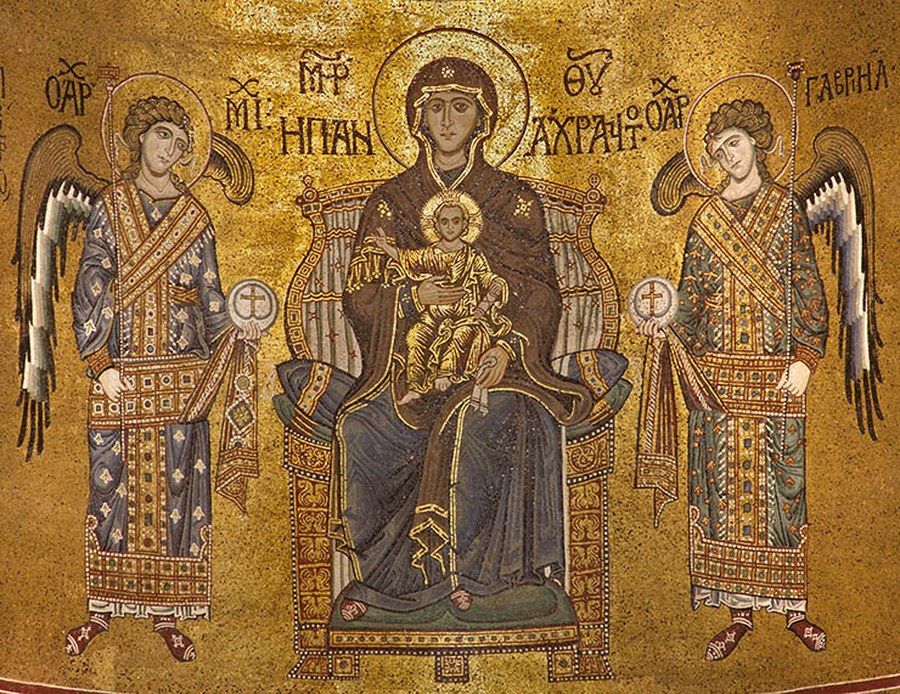
Byzantine mosaic of the Coronation of the Theotokos (Ἡ Κορώνωσις τῆς Θεοτόκου). Cathedral of Monreale, Palermo, Sicily, 12th century. The Virgin Mary enthroned as Queen of Heaven holds the incarnate Christ upon her lap; the Archangels Michael and Gabriel stand at either side bearing the globes of sovereignty. The Mother of God receives the glory promised to her who bore the eternal Logos.
The mosaic at Monreale preserves this faith in gold and glass. Mary enthroned, Christ upon her lap, the Father and the Son crowning the Mother, Michael and Gabriel bearing the globes of rule: every detail teaches that the Queen of heaven is the Theotokos, and the Theotokos is queen because she gave the world its King. The icon does not depict a pious legend. It confesses what the apostolic Church has always believed about the woman in whom the Word became flesh.
The Coronation is the Magnificat fulfilled in heaven. The lowly handmaiden whom all generations call blessed is raised to the throne of her Son. He hath put down the mighty from their seats, and exalted them of low degree; and the handmaiden who consented to bear the Word is exalted above every creature not by human ambition but by the will of the God she magnified. The proud are scattered, the mighty are put down, and she who emptied herself in obedience is exalted by God to a dignity above every creature. What was sung in Nazareth at the Annunciation is now visible in the courts of heaven. The Kingdom her Son brought has found its queenly icon in the mother who bore the King.
Promised in Scripture
The queenship of the Theotokos is not read into Scripture as an afterthought. It is drawn from the same prophecies that announced the coming of the Messiah and from the same Gospel that records the Virgin's consent to bear Him. When Gabriel was sent to Nazareth, he did not speak only of a birth. He proclaimed a reign.
Luke 1:26-33
And in the sixth month the angel Gabriel was sent from God unto a city of Galilee, named Nazareth, to a virgin espoused to a man whose name was Joseph, of the house of David; and the virgin's name was Mary. And the angel came in unto her, and said, Hail, thou that art highly favoured, the Lord is with thee: blessed art thou among women. And when she saw him, she was troubled at his saying, and cast in her mind what manner of salutation this should be. And the angel said unto her, Fear not, Mary: for thou hast found favour with God. And, behold, thou shalt conceive in thy womb, and bring forth a son, and shalt call his name JESUS. He shall be great, and shall be called the Son of the Highest: and the Lord God shall give unto him the throne of his father David: and he shall reign over the house of Jacob for ever; and of his kingdom there shall be no end.
The throne belongs to Christ. Yet the angel's message already binds the Mother to the Kingdom. She who is to bear the eternal King stands at the threshold of a mystery in which motherhood and sovereignty will be inseparable. The Church has never heard these words in isolation. When Elizabeth greeted the Virgin, the Spirit revealed the dignity that Gabriel's greeting implied.
Luke 1:41-43
And it came to pass, that, when Elisabeth heard the salutation of Mary, the babe leaped in her womb; and Elisabeth was filled with the Holy Ghost: and she spake out with a loud voice, and said, Blessed art thou among women, and blessed is the fruit of thy womb. And whence is this to me, that the mother of my Lord should come to me?
Elizabeth does not call Mary the mother of a future prophet or a merely human messiah. She calls her the mother of her Lord. St. John Chrysostom, preaching on the honor given the Virgin in this encounter, teaches that the Spirit who filled Elizabeth disclosed the exalted station of her who bore the Lord of all.
St. John Chrysostom, Homily on the Gospel of Luke
For the Virgin did not merely bear a child, but she bore the Lord Himself. And therefore Elizabeth, filled with the Holy Ghost, did not say, Blessed is the mother of my kinswoman, but, Blessed is she who bore my Lord.
The Old Testament had already prepared the faithful to understand what such a motherhood would mean. In the kingdom of David, the mother of the king possessed a dignity recognized by all Israel. She was the Gebirah, the Queen Mother, seated at the right hand of her son's throne, interceding for the people and honored in the royal court.
1 Kings 2:19
And Bathsheba went unto king Solomon, to speak unto him for Adonijah. And the king rose up to meet her, and bowed himself unto her, and sat down on his throne, and caused a seat to be set for the king's mother; and she sat on his right hand.
Solomon the wise king rises to honor his mother and sets a throne beside his own. The Church, reading the Gospel in light of the Law and the Prophets, has always seen in this pattern a foreshadowing of the Theotokos. Christ is the Son of David whose kingdom shall have no end. Mary is the mother of the King. It is fitting that she who bore the heir to David's throne should herself be honored with the seat at the King's right hand, not as an equal in authority, but as mother of the sovereign who reigns forever.
The psalms sing of the King's bride adorned in gold, standing at His right hand.
Psalm 45:6-9
Thy throne, O God, is for ever and ever: the sceptre of thy kingdom is a right sceptre. Thou lovest righteousness, and hatest wickedness: therefore God, thy God, hath anointed thee with the oil of gladness above thy fellows. All thy garments smell of myrrh, and aloes, and cassia, out of the ivory palaces, whereby they have made thee glad. Kings' daughters were among thy honourable women: upon thy right hand did stand the queen in gold of Ophir.
The Fathers read this psalm as a nuptial hymn of the Messiah and His people, and in the queen who stands at the right hand of the King they discern the glory of the Virgin Mother. She who gave the King His human beauty, the flesh anointed for the salvation of the world, is herself adorned with the gold of heaven. St. Leo the Great, preaching on the exaltation of Christ and those united to Him, teaches that the glory of the Head extends to the members whom grace joins to His Body.
St. Leo the Great, Sermon 73
Since then Christ's Ascension is our uplifting, and the hope of the Body is raised, whither the glory of the Head has gone before, let us exult, dearly-beloved, with worthy joy and delight in the loyal paying of thanks.
Mary is the first of those members. The Head has ascended; the Mother follows. The queen who stands at the right hand in the psalm is not a rival to the King but the honored companion of His reign, crowned because she belongs to the King and shares in the glory that surrounds His throne.
John on Patmos beholds the same glory in apocalyptic vision. A woman clothed with the sun, with the moon beneath her feet and a crown of twelve stars upon her head.
Revelation 12:1
And there appeared a great wonder in heaven; a woman clothed with the sun, and the moon under her feet, and upon her head a crown of twelve stars.
The Apocalypse does not name Mary by name, yet the Church has consistently heard in this crowned woman both the Mother of the Messiah and the figure of Israel and the Church in travail and triumph. At the Coronation the crown of twelve stars is no longer seen from afar. The woman who bore the male child who is to rule all nations with a rod of iron now wears upon her brow the diadem that prophecy promised. The moon beneath her feet is the old order subdued beneath the feet of her who passes into the unending day of heaven.
St. Cyril of Alexandria, defending the title Theotokos against those who would divide the person of Christ, insists that the Virgin's dignity flows from the unity of the one Son who is God and man.
St. Cyril of Alexandria, On the Unity of Christ
The Word was made flesh and dwelt among us, not by undergoing change into flesh, but by taking flesh to Himself from the holy Virgin. She is therefore the true Mother of God, not mother of His divinity apart from the flesh, but mother of the one Son who is at once God and man.
The prophet Isaiah had foretold the royal birth long before Gabriel descended to Nazareth.
Isaiah 9:6-7
For unto us a child is born, unto us a son is given: and the government shall be upon his shoulder: and his name shall be called Wonderful, Counsellor, The mighty God, The everlasting Father, The Prince of Peace. Of the increase of his government and peace there shall be no end, upon the throne of David, and upon his kingdom, to order it, and to establish it with judgment and with justice from henceforth even for ever. The zeal of the Lord of hosts will perform this.
The government is upon His shoulder, yet the Child is born of the Virgin. The Coronation confesses that the mother of the Prince of Peace shares in the peace of His reign because she gave Him the humanity in which He rules. When Mary answered Gabriel, she bound her own destiny to the Kingdom her Son would establish.
Luke 1:38
And Mary said, Behold the handmaid of the Lord; be it unto me according to thy word. And the angel departed from her.
The Fiat is the root of the crown. Obedience precedes exaltation. The handmaiden who consented to bear the King consented also to every consequence of that bearing, including the glory that God would bestow upon her when the Kingdom was won. Because she is mother of the one Person who is King by nature and by redemption, her queenship is rooted in the hypostatic union itself. She bore not a prophet crowned by men but the incarnate God whose kingdom shall have no end. The Scriptures promised a King. They promised, in figure and in type, the glory of the King's mother. The Coronation is the unveiling of what was already spoken when Gabriel knelt before the Virgin of Nazareth and called her blessed among women.
Assumed into Glory
The crown presupposes the throne, and the throne presupposes the ascent. Mary is crowned in heaven because she was first assumed into heaven. The Dormition and the Coronation are not two unrelated honors. They are consecutive movements of one mystery. The Virgin who fell asleep in Christ was received body and soul into glory; the Virgin who reigns in Christ receives the diadem that belongs to the mother of the King.
The Church does not imagine Mary crowned while her body yet saw corruption. The tabernacle of the Word must not know decay. Pope Pius XII, defining the Assumption in 1950, taught that the glorification of her virginal body was the final sign of the victory she shared with her divine Son over sin and death. What the empty tomb proclaimed for Christ, the empty tomb in Gethsemane proclaimed for His mother. Heaven received her wholly, and the court of the angels prepared her place at the right hand of the Son.
The psalmist's queen in gold of Ophir and John's woman crowned with stars are not fulfilled in a soul alone. The Coronation iconography of East and West presupposes the Assumption. Mary is enthroned as Queen because she stands before the face of God in the integrity of the person: body and soul, the same flesh that nourished the incarnate Christ, the same voice that sang the Magnificat, the same hands that swaddled the King of kings.
St. Cyril of Alexandria teaches that Christ opened heaven to human nature by ascending in the flesh He received from Mary. It is fitting that the flesh from which His body was taken should follow where He has gone before.
St. Cyril of Alexandria, Commentary on the Gospel of John
For heaven was then completely inaccessible to us -- human foot had never trodden that pure and holy country of the angels. It was Christ who first prepared the way for our ascent there. By offering himself to God the Father as the first fruits of all who are dead and buried, he gave us a way of entry into heaven and was himself the first human being the inhabitants of heaven ever saw.
If the first human being heaven saw was Christ, the second is she from whom He took that humanity. Her assumption is the proof that the way Christ opened is real. The Coronation rests upon that proof. One cannot crown a queen who has not entered the kingdom. Mary enters first among the redeemed, and the kingdom receives her as the Mother of its King.
St. Augustine, meditating on the union of believers with the risen and ascended Christ, teaches that the members of Christ are already with Him by grace, though the fullness of bodily glory awaits the resurrection of the dead.
St. Augustine, Sermon on the Ascension of the Lord
For just as he remained with us even after his ascension, so we too are already in heaven with him, even though what is promised us has not yet been fulfilled in our bodies.
Mary's assumption is the moment when promise and fulfillment coincide in one member of the Body before the general resurrection. She is in heaven not only in soul but in body, the first complete harvest of the Paschal victory. The crown placed upon her brow belongs to a person fully glorified, not to a memory or a spirit alone. The Church contemplates this and learns that the dignity promised to the redeemed is not a mere spiritual abstraction. It is bodily glory in the presence of God.
The Byzantine liturgy sings of the Assumption as a royal entrance. The Mother of God is borne to heaven on the chariots of the cherubim, and the hosts of angels bow before her. The Western Church celebrates the same truth under the title of the Assumption and crowns her images in recognition of the queenship that flows from her divine motherhood. East and West do not tell two stories. They contemplate one woman taken up into the glory of her Son, prepared to reign with Him who reigns forever.
The empty tomb in Gethsemane and the throne in heaven belong to the same mystery. Earth testifies that she was taken up; heaven testifies that she was crowned. The Church on pilgrimage holds both testimonies in one faith, refusing to separate the Assumption from the Coronation just as she refuses to separate the Cross from the Resurrection. What was won upon the Cross and revealed at the empty tomb reaches its maternal fulfillment in the crowned Virgin who reigns with the risen King.
St. Leo the Great teaches that the Ascension of Christ establishes the hope of the whole Body, because where the Head has gone the members are destined to follow.
St. Leo the Great, Sermon 74
For today our Lord Jesus Christ ascended into heaven; not that the benefits of His Presence were thereby withdrawn from us, but that He might transfer our hope to that place whither the nature of our humility had already been transferred in Him.
Mary's assumption is the first fulfillment of that transfer in a member of the Body. The Coronation follows as the public recognition of what heaven already knows. She who was assumed is acclaimed as Queen. The angels who received her at the dormition now stand as courtiers at her enthronement. Michael and Gabriel, who announced the coming of the King, bear the globes of sovereignty beside the Mother of the King.
At Pentecost the Theotokos stood at the center of the apostolic assembly, already mother of the Church by the word spoken from the Cross. The Spirit who had overshadowed her at the conception of the Lord now descended upon the disciples she had taught to pray. From that upper room the Gospel went forth to the nations. From the throne of heaven the crowned Virgin continues the same maternal office on a universal scale. She who nurtured the infant Church in Jerusalem now nurtures the Church catholic from the kingdom that cannot be shaken.
The Glorious Mysteries move in order. Christ rises. Christ ascends. Christ pours forth His Spirit. The Theotokos is assumed. Now she is crowned. To skip the Assumption would be to place a diadem upon a promise not yet fulfilled. The Church does not make that mistake. She confesses the whole sequence, from the sleep of the Mother of Life to her enthronement as Queen of Life, because each mystery unfolds from the one who said yes at the Annunciation and bore the King in her womb. The Descent of the Holy Spirit and the Dormition are not bypassed on the way to the crown. They are the steps by which the handmaiden becomes the Queen.
Crowned in Heaven
The Coronation is the revelation of what the Assumption concealed in glory. In the dormition the Church beheld the empty tomb and the fragrance of paradise. In the Coronation she beholds the Mother of God upon a throne, crowned by the hands of her Son and of the Father, adored by the heavenly host as Queen of the angels and Queen of all the saints.
The Monreale mosaic places Christ upon her lap even as He crowns her. The image is theologically precise. Mary is queen because she is Theotokos, and she remains Theotokos forever. Her queenship does not remove her from her Son. It binds her to Him more visibly. The incarnate Christ seated upon the lap of the crowned Virgin is the same Christ who took flesh from her womb. The crown upon her head is the crown of the mother of the King, not of a creature who has forgotten the origin of her dignity.
St. John Chrysostom, reflecting on the honor shown the Virgin throughout the Gospel, teaches that every act of reverence toward Mary returns ultimately to the mystery of Christ Himself, for her greatness is the greatness of her Son made manifest in His mother.
St. John Chrysostom, Homily 4 on the Gospel of Matthew
For the honor given to the Mother redounds to the Son; and the Son, being honored, glorifies His Mother. He who is the source of all blessing blesses her who bore Him, and through her blesses all who call upon His name.
The Coronation is the supreme instance of this mutual glory. Christ crowns His mother because she bore Him. The Father crowns her because the Son wills to honor the woman from whom He received His humanity. The angels bear the instruments of sovereignty because the court of heaven acknowledges the one through whom the King entered the world. Every line of the mosaic leads back to the Annunciation. The crown is the fruit of the Fiat.
Christian art has confessed this faith from antiquity. Icons and mosaics across the Byzantine world depict the Theotokos enthroned, crowned, robed in royal vesture, surrounded by the host of heaven. The Western Church preserved the same tradition in stained glass, panel painting, and the coronation of sacred images at pilgrimage shrines. When the Roman Pontiffs placed crowns upon icons of the Virgin, they did not invent a new devotion. They recognized publicly what the faithful had long professed in prayer: Mary is Queen because she is Mother of God.
The liturgy of East and West sings the same acclamation. Hymns of the Assumption proclaim that the Virgin reigns with Christ forever. The Salve Regina addresses her as Queen and Mother of mercy. The Litany of Loreto invokes her under the title Queen repeatedly, as though the Church could not pray without acknowledging the sovereignty of her who stands at the right hand of the Son.
Psalm 45:13-15
The king's daughter is all glorious within: her clothing is of wrought gold. She shall be brought unto the king in raiment of needlework: the virgins her companions that follow her shall be brought unto thee. With gladness and rejoicing shall they be brought: they shall enter into the king's palace.
The Church hears these verses at the Coronation. The Virgin is brought to the King in gold and gladness, not as a bride in the romantic sense alone, but as the one in whom the covenant between God and humanity was sealed by the conception of the eternal Word. She enters the king's palace because the King first entered her. The throne she receives is the throne of the King's mother, prepared from before the ages for her who was chosen among all women to bear the ruler of the nations.
St. Cyril of Alexandria, expounding the divine motherhood, teaches that the honor given to Mary is inseparable from the confession that her Son is God.
St. Cyril of Alexandria, Commentary on the Gospel of Luke
The Archangel Gabriel was sent to announce to the holy Virgin the birth of a Son who would be great and would be called the Son of the Most High. If the child born of her is God, then she who bore Him is rightly honored above all creation, for she gave flesh to the One through whom all things were made.
The Coronation makes that honor visible to the eyes of faith. What Cyril defended at Ephesus against those who would deny the unity of Christ, the icon of the Coronation proclaims in color and gold. The crowned Virgin is the Theotokos, and the Theotokos is queen because the one she bore is Lord of all.
St. Augustine warns the faithful never to love any creature more than the Creator, yet he also teaches that the honor shown to the saints and to the Mother of God is honor that returns to the glory of Christ, through whom alone any creature is worthy of veneration.
St. Augustine, On Christian Doctrine
The true Mediator, by whom we are reconciled to God, deigned to take flesh from the Virgin Mary, that He might offer sacrifice for our sins. Whatever honor we render to her, we render in Him and through Him, for she is blessed because she believed, and she is exalted because she bore the Word made flesh.
The Coronation is therefore not Mariolatry but Christology seen from the side of the mother. To crown Mary is to confess that the child she bore is King of heaven and earth. To enthrone the Theotokos is to declare that the flesh taken from her has ascended to the right hand of the Father and has carried her with it into glory.
The Archangels Michael and Gabriel in the Monreale mosaic bear the globes of sovereignty because the Queen of heaven shares in the reign of her Son by maternal right. She does not grasp at equality with God. She receives from the hand of God and of her Son the crown that belongs to the mother of the King. Her hands hold Christ upon her lap as though to remind every generation: this Queen is queen because of that Child. Remove the Child, and the crown has no meaning. Remove the crown, and the Gospel's promise remains incomplete. The Church holds both together, as the mosaic does, in one undivided confession of faith.
The fifth decade of the Rosary contemplates this mystery as the crown of the Glorious Mysteries. The faithful who meditate upon the Coronation are not escaping from the Cross to a sentimental paradise. They are following the path of the Theotokos from sorrow to glory, from the sword that pierced her soul to the diadem that heaven placed upon her brow. Each Hail Mary along that path repeats the greeting of the archangel who first proclaimed that the child born of her would reign forever. The Rosary ends its Glorious sequence here because the Church has nowhere higher to look except to Christ Himself, who crowns His mother and invites the faithful to share in the Kingdom won by His blood.
Queen of the Church
The Coronation is not a mystery sealed in heaven, remote from the pilgrim Church on earth. Mary is crowned Queen of heaven precisely so that she may be Mother and Queen to the Church that journeys below. Her throne is not a departure from the maternal office entrusted at the Cross. It is the perfection of that office. She who was given to the beloved disciple as mother now intercedes for all who are grafted into Christ through baptism and the apostolic faith.
At the Cross Christ commended His mother to John and John to His mother. From that hour the disciple took her to his own home, and in the disciple the whole Church received its mother. At the Coronation the same Christ who hung upon the Cross and who now reigns in glory confirms that gift from the throne. The Queen of heaven is the Mother of the Church on earth. The pilgrim people do not journey alone. They walk under the sovereignty of her who has already arrived where they are bound.
Pope Pius XII, in the encyclical Ad Caeli Reginam, proclaimed the Queenship of Mary to the universal Church in 1954, gathering into one solemn proclamation what the liturgy, the Fathers, the art of the faithful, and the devotion of centuries had already confessed.
Pope Pius XII, Ad Caeli Reginam
From the earliest ages of the catholic church a Christian people, whether in time of triumph or more especially in time of crisis, has addressed prayers of petition and hymns of praise and veneration to the Queen of Heaven. And never has that hope wavered which they placed in the Mother of the Divine King, Jesus Christ; nor has that faith ever failed by which we are taught that Mary, the Virgin Mother of God, reigns with a mother's solicitude over the entire world, just as she is crowned in heavenly blessedness with the glory of a Queen.
The encyclical does not propose a new doctrine. It states clearly what the Church has always believed: Mary's queenship rests upon her divine motherhood and upon her unique cooperation in the work of redemption. She bore the Redeemer. She stood beneath His Cross. She offered herself with Him in the sorrow that pierced her soul. She is therefore queen not only because she is Mother of God, but because, as the new Eve associated with the new Adam, she shared in the struggle against sin and death and now shares, in a manner proper to a creature, in the victory of her Son.
Pope Pius XII, Ad Caeli Reginam
Certainly, in the full and strict meaning of the term, only Jesus Christ, the God-Man, is King; but Mary, too, as Mother of the divine Christ, as His associate in the redemption, in his struggle with His enemies and His final victory over them, has a share, though in a limited and analogous way, in His royal dignity. For from her union with Christ she attains a radiant eminence transcending that of any other creature; from her union with Christ she receives the royal right to dispose of the treasures of the Divine Redeemer's Kingdom; from her union with Christ finally is derived the inexhaustible efficacy of her maternal intercession before the Son and His Father.
This is the Catholic faith in its fullness. Christ alone is King in the strict sense. Mary is Queen because she is His mother and because she cooperated in His saving work as no other creature could. Her intercession is not a bypass around the one Mediator. It is the maternal voice of the woman whose soul magnified the Lord, now lifted before the throne of the same Lord on behalf of those who still walk in the valley of tears. She distributes the treasures of the Kingdom because the King has willed to honor His mother by hearing her prayers.
St. John Chrysostom, teaching on the power of prayer offered in union with Christ, shows that those who belong to the Savior share in His life and therefore approach the Father with confidence. The Theotokos possesses that confidence in its supreme form, for she is mother of the Son and remains forever in His presence.
St. John Chrysostom, Homily 2 on the Acts of the Apostles
If any therefore desires to see Christ; if any grieves that he has not seen Him: having this heard, let him show forth an admirable life, and certainly he shall see Him, and shall not be disappointed. For Christ will come with greater glory, though thus, in this manner, with a body.
Mary has already seen Him in that glory. She who waited beneath the Cross now stands crowned at His right hand. The Church on earth, which has not yet seen Him in the fullness of His parousia, turns to her as the Queen who can obtain from her Son what the children of Eve need: mercy, protection, and the grace to persevere until He comes again.
St. Augustine teaches that the members of Christ are never separated from the Head, and that what belongs to the Head belongs by grace to the Body.
St. Augustine, Sermon on the Ascension of the Lord
Out of compassion for us he descended from heaven, and although he ascended alone, we also ascend, because we are in him by grace. Thus, no one but Christ descended and no one but Christ ascended; not because there is no distinction between the head and the body, but because the body as a unity cannot be separated from the head.
Mary's queenship confirms that unity in the first of the redeemed. She is in heaven as the first-fruits of the Church, not as an exception to it. When the faithful invoke her as Queen, they confess that the Head has already exalted a member of the Body and that the same exaltation awaits all who persevere in Him. The crown upon her brow is a pledge upon the brow of the Church.
The one, holy, catholic, and apostolic Church, in hierarchical communion with the See of Peter, proclaims the Coronation as the completion of the Glorious Mysteries. Christ is risen. Christ is ascended. Christ has poured out His Spirit. The Theotokos has been assumed. The Theotokos is crowned. From this throne she accompanies the pilgrim people through every trial, as she accompanied the apostles from the upper room to Pentecost and from the foot of the Cross to the empty tomb in Gethsemane.
To honor Mary as Queen is to honor the divine plan by which the Word became flesh in her womb and the redemption of the world passed through her consent. The Catholic Church does not obscure Christ when she crowns His mother. She proclaims Christ more clearly, because the crown upon Mary's brow is the crown of the Theotokos, and there is no Theotokos apart from the incarnate God whose Body and Blood remain the source of life for the faithful upon the altars of His Church.
The logos arc does not end in passive glory. It ends in a reign that reaches down to earth. The Queen of heaven hears the prayers of the Church militant because she was once the handmaiden of Nazareth who prayed in the temple, stood at the Cross, and gathered with the apostles in expectation of the Spirit. Her sovereignty is maternal. Her crown is the crown of the Mother of Mercy. She reigns by bringing the needs of her children before the King who is her Son.
Pius XII further taught that the principal foundation of Mary's royal dignity is her divine motherhood, and that the voice of Gabriel was the first to proclaim her royal office when he announced the Son who would reign without end.
Pope Pius XII, Ad Caeli Reginam
In Holy Writ, concerning the Son whom Mary will conceive, We read this sentence: He shall be called the Son of the most High, and the Lord God shall give unto him the throne of David his father, and he shall reign in the house of Jacob forever, and of his kingdom there will be no end, and in addition Mary is called Mother of the Lord; from this it is easily concluded that she is a Queen, since she bore a son who, at the very moment of His conception, because of the hypostatic union of the human nature with the Word, was also as man King and Lord of all things.
The Magisterium thus reads the same Scriptures the Fathers read and arrives at the same confession the icons proclaim. Mary is Queen because she bore the King. The Coronation is the liturgical and visual expression of a truth already embedded in the angel's message at Nazareth.
Until the Second Coming, the faithful look to the crowned Theotokos as the sign that Christ's Kingdom is already established in heaven and advancing on earth through grace. She is the rainbow in the clouds, the pledge that the covenant of peace will reach its fulfillment when the King returns in glory. The Church does not worship the Queen instead of the King. She runs to the Queen because the King gave her to the Church as mother, crowned her as honor to His own flesh, and wills that His members seek mercy at the throne where a mother's solicitude never fails.
The Glorious Mysteries are complete. The handmaiden who said yes to the Word at the Annunciation, who bore the King in Bethlehem, who stood at the Cross, who slept in Christ, and who was assumed into heaven now reigns with Christ as Queen. Her glory is the fruit of her Fiat and of God's promise. Every Hail Mary confessed on earth ascends to the Queen of heaven. Every petition offered through her returns to the King who is the objective Truth, fully present in His Church, and who will come again to judge the living and the dead. Until that day, the Church prays as children of the crowned Mother, confident that the blessed fruit of her womb, Jesus, will show Himself to those who cry to her from this valley of tears.
Mary is crowned. The Church rejoices. The Glorious Mysteries are fulfilled in her who bore the King, and the pilgrim people lift their eyes to the throne where the Mother of Christ reigns in the glory of her Son until He comes again.
Hail, Holy Queen
Hail, holy Queen, Mother of Mercy, our life, our sweetness and our hope. To thee do we cry, poor banished children of Eve. To thee do we send up our sighs, mourning and weeping in this valley of tears. Turn then, most gracious advocate, thine eyes of mercy toward us, and after this our exile, show unto us the blessed fruit of thy womb, Jesus. O clement, O loving, O sweet Virgin Mary.