Proclamation of the Kingdom
The eternal Logos, having sanctified the waters of the Jordan and triumphed over the devil in the wilderness, now advances into public ministry. The New Adam proclaims the arrival of the Kingdom. In His own Person He brings to its divinely appointed fulfillment the long expectation of the ages. What was promised from Adam through the Law and the Prophets now stands present and active. The same royal proclamation and grace are offered to every soul in the Church today.
Proclamation of the Kingdom
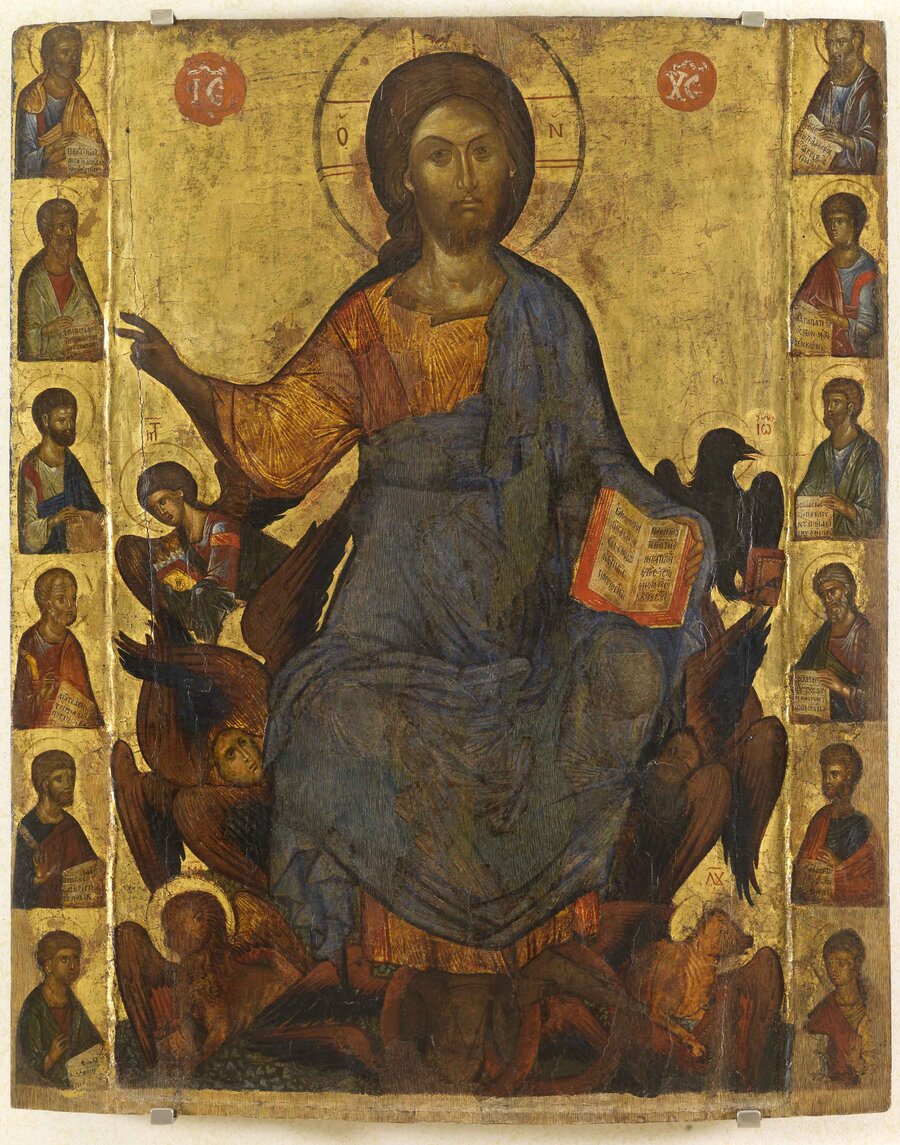
Byzantine icon of Christ in glory with the twelve apostles (mid-14th century, Constantinople). Christ is enthroned upon a throne borne by seraphim, blessing with His right hand and holding open the Gospel in His left. The text in the Gospel records His royal commission: All authority in heaven and on earth has been given to Me; go therefore and make disciples of all nations. The twelve apostles stand in busts at left and right, receiving the proclamation of the Kingdom.
Fulfillment of Time
Mark 1:14-15
Now after John was arrested, Jesus came into Galilee, proclaiming the gospel of God, and saying, “The time is fulfilled, and the kingdom of God is at hand; repent and believe in the gospel.”
Matthew 4:17
From that time Jesus began to preach, saying, “Repent, for the kingdom of heaven is at hand.”
Galatians 4:4
But when the fullness of time had come, God sent forth his Son.
This announcement is the decisive turning point in the divine economy. The preparatory age of the Law and the Prophets reaches its completion. The Logos made flesh stands before humanity as the very fulfillment of all that was promised from Adam onward.
St. Augustine declares that the times are fulfilled because the One for whom the times waited has now come. In Christ the entire plan of God is recapitulated. The ancient promises, the shadows of the old covenant, and the longing of the ages all converge in the Person of the King.
St. John Chrysostom teaches that with this proclamation a new order breaks into history: the Kingdom is no longer merely foretold from afar but is present and active in the King Himself. The Fathers of East and West see in this moment the hinge of all salvation history -- the closing of the old dispensation and the inauguration of the New Covenant in the incarnate Logos.
In this fulfillment the New Adam restores what the first Adam lost. Where humanity had been exiled from the presence of God, the King now brings the Kingdom near. The same grace that was manifested in Galilee continues in the Church, where the eternal Logos still proclaims the Kingdom and calls every generation to enter it through repentance and faith.
Kingdom
Luke 17:21
“Behold, the kingdom of God is in the midst of you.”
Matthew 12:28
“But if it is by the Spirit of God that I cast out demons, then the kingdom of God has come upon you.”
Luke 11:20
“But if it is by the finger of God that I cast out demons, then the kingdom of God has come upon you.”
The Kingdom announced by the eternal Logos is not a distant hope or an earthly political realm. It is the sovereign reign of God breaking into history in the very Person of Christ the King. Where the first Adam lost dominion through disobedience, the New Adam reclaims all things through perfect obedience. In Him the Kingdom is both present and powerfully active -- the rule of God tabernacling among men.
St. Augustine teaches that the Kingdom of God is Christ Himself. Wherever the King is present, there the Kingdom has arrived in its fullness. The pre-schism Fathers of East and West proclaim that this Kingdom restores the original order of creation under its rightful Lord. It overcomes the disorder introduced by sin, casts down the tyranny of demons, and begins the defeat of death itself.
St. John Chrysostom declares that the arrival of the King brings the arrival of the Kingdom with divine power. What prophets glimpsed from afar now stands visibly in their midst. The eternal Logos made flesh does not merely speak of a future age -- He embodies and inaugurates the Kingdom here and now. This same Kingdom, present and active in Christ, continues in the Catholic Church, where the King rules through the sacraments and extends the identical grace to every soul that will receive Him.
Repent
Luke 5:32
“I have not come to call the righteous but sinners to repentance.”
Matthew 11:20
Then he began to denounce the cities where most of his mighty works had been done, because they did not repent.
The eternal Logos issues a radical summons. This is no mere moral reform. It is the total conversion of heart and mind -- the decisive turning away from the old Adam and the old order of sin into the life of the Kingdom. Repentance is the narrow gate through which souls enter the reign of the King.
St. Augustine teaches that true repentance is a gift of grace, the soul’s return from exile to its true homeland in God. It is the reversal of Adam’s fall, made possible only because the New Adam has come. The pre-schism Fathers of East and West are unanimous: this metanoia is the essential first response to the presence of the Kingdom. It is the renunciation of self-rule and the joyful submission to the sovereign Logos incarnate.
St. John Chrysostom stresses the urgency born of the King’s arrival. Where the Kingdom has come in power, continued rebellion brings greater judgment. The same call that went forth in Galilee now sounds in the Church. Through the sacrament of penance the eternal Logos continues to bestow this grace, raising the dead to life and restoring souls to the Kingdom won by His Cross.
Authority
Mark 1:27
And they were all amazed, so that they questioned among themselves, saying, “What is this? A new teaching with authority! He commands even the unclean spirits, and they obey him.”
Matthew 7:29
For he was teaching them as one who had authority, and not as their scribes.
Mark 2:10
“But that you may know that the Son of Man has authority on earth to forgive sins” -- he said to the paralytic.
The eternal Logos speaks and acts with immediate, intrinsic authority. Unlike the scribes who cite tradition or the prophets who say “thus says the Lord,” Christ commands in His own name. Demons obey. Sins are forgiven on earth. Nature and disease submit instantly. This is the royal authority of the King who possesses in Himself what He bestows.
St. John Chrysostom explains that the astonishment of the crowds arose precisely because this teaching and power belonged to no human office. The unclean spirits recognized their Creator and submitted without delay. The pre-schism Fathers of East and West affirm that such authority over spirits and sin belongs to God alone. When the incarnate Logos exercises it as man, He reveals the restoration of humanity’s true dignity and dominion.
St. Augustine underscores that the authority to forgive sins on earth is the clearest sign that God Himself has visited His people. Only the divine King can remit offenses committed against the divine Majesty. This authority remains fully active in the Catholic Church through the apostolic priesthood, where the same King continues to teach, absolve, and command the powers of darkness.
Signs
Matthew 11:4-5
“Go and tell John what you hear and see: the blind receive their sight and the lame walk, lepers are cleansed and the deaf hear, and the dead are raised up, and the poor have good news preached to them.”
John 2:11
This, the first of his signs, Jesus did at Cana in Galilee, and manifested his glory. And his disciples believed in him.
These visible signs are not incidental wonders. They are the concrete proof that the Kingdom has arrived in power. The eternal Logos reverses the effects of the Fall: sight restored to the blind, mobility to the lame, cleanness to the unclean, hearing to the deaf, life to the dead. Each miracle declares that the reign of sin and death is broken in the New Adam.
St. John Chrysostom teaches that these signs were performed openly so that no one could deny the arrival of the King. They fulfill the ancient prophecies and demonstrate that the Creator has entered His creation to heal and renew it from within. The pre-schism Fathers of East and West see in every miracle the restoration of humanity’s original state and a foretaste of the final renewal of all things.
St. Augustine explains that the signs were works of mercy and power that revealed the identity of the Worker. When the dead rise and the afflicted are healed, it is the Kingdom itself breaking the chains forged by Adam’s transgression. These same signs continue in the Catholic Church through the sacraments and the ongoing miracles granted to the saints. The eternal Logos still heals souls in confession, feeds multitudes in the Eucharist, and raises the spiritually dead to life, manifesting the identical Kingdom that was proclaimed in Galilee.
Maranatha
Gloria Patri, et Filio, et Spiritui Sancto. Sicut erat in principio, et nunc, et semper, et in saecula saeculorum. Amen.
Maranatha. Come, Lord Jesus.