Dormition of the Theotokos
The Glorious Mysteries reach their penultimate crown in the Dormition of the Theotokos. What the Resurrection won for the human race and the Ascension displayed in the flesh of the incarnate Son now unfolds in the Mother who bore Him. She who gave her body to God receives from God the first complete fruit of the Paschal victory: passage body and soul into heavenly glory.
The Dormition is twofold mystery. It is Mary's own exaltation. The woman in whom the Word became flesh is the first of the redeemed to follow her Son where He has gone before, not in figure alone but in the integrity of body and soul. It is also revelation for the Church. In her falling asleep the pilgrim people behold what awaits every member of Christ's Body: death is not annihilation, the grave is not the final word, and the Lord who harrowed Hades receives the soul of His mother as He anticipates the resurrection of all who die in Him.
Dormition of the Theotokos
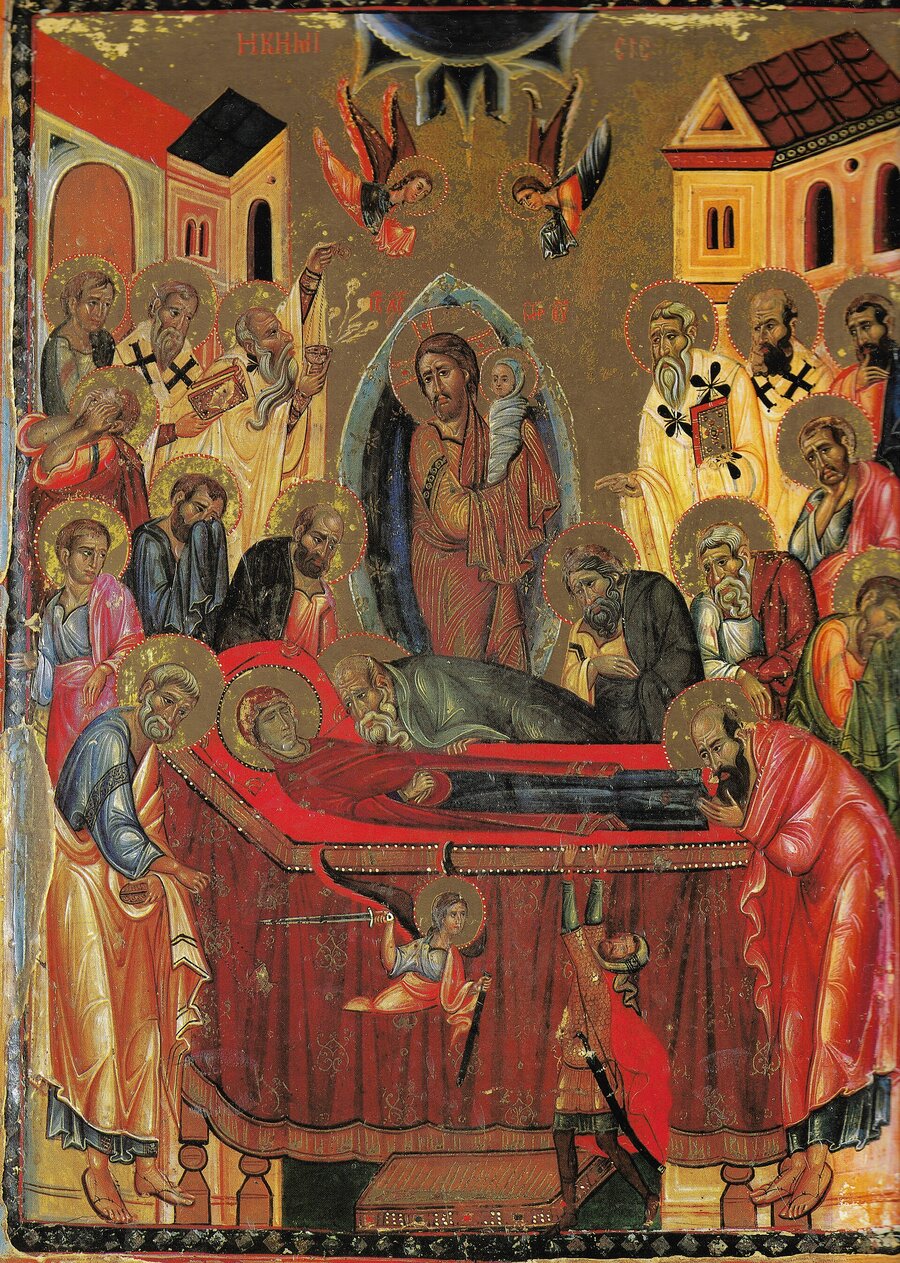
Byzantine icon of the Dormition (Ἡ Κοίμησις τῆς Θεοτόκου). From Saint Catherine's Monastery, Mount Sinai, c. 1250. The Theotokos lies upon her deathbed surrounded by the apostles; Christ stands at her center to receive her soul in the arms of angels, while Peter swings a censer and Paul kneels at her feet.
The Byzantine Church names the feast Koimesis -- the Falling Asleep -- because Christian death is sleep in Christ, a rest from which the voice of the Son will awaken the dead. The Catholic Church confesses the same mystery under the title of the Assumption: Mary, having completed the course of her earthly life, was taken up body and soul into heaven. East and West do not tell two stories. They contemplate one gift from different angles of the same apostolic faith. The Mother of Life passes over into life, and the Church that gathers at her bier learns how to die and how to hope.
To contemplate the Dormition is to stand where the apostles stood: around the deathbed of her who is already the icon of the Church's destiny. Here the flesh that nourished God becomes the flesh that heaven receives. Here the sword that pierced her heart at the Cross gives way to the joy of reunion with the Son she had buried. Here the promise spoken over the empty tomb and confirmed on the Mount of Olives descends upon one human person in its fullness, so that every believer may say with confidence: where Mary has gone in Christ, the Church will follow.
The icon from Mount Sinai preserves this faith in color and line. The Theotokos upon her bier, the apostles in their grief, Christ in the mandorla receiving her soul, Peter with the censer, Paul at her feet: every detail teaches what the Church professes.
The feast is not legend appended to the Gospel. It is the Gospel's fruit borne in the life of her who said yes to the Word from the beginning.
Mary's Final Days
After the Lord ascended from the Mount of Olives, the Theotokos remained in Jerusalem as the heart of the apostolic community. She who had stood beneath the Cross, who had received the beloved disciple as her son, who had persevered in prayer with the apostles between Ascension and Pentecost, now completed her earthly pilgrimage in the city where redemption was accomplished. The tradition of the Church, received in East and West and celebrated in the liturgical books from antiquity, teaches that angels announced to her the approach of death so that she might prepare her soul in peace.
Simeon had foretold this hour in the temple. When the Virgin brought the infant Christ to be presented according to the Law, the righteous man took Him up in his arms and prophesied both the fall and rising of many in Israel and a sword that would pierce her own soul.
Luke 2:34-35
And Simeon blessed them, and said unto Mary his mother, Behold, this child is set for the fall and rising again of many in Israel; and for a sign which shall be spoken against; (Yea, a sword shall pierce through thy own soul also,) that the thoughts of many hearts may be revealed.
That sword was the Cross. She who had consented to the Annunciation without understanding every consequence now consented to the end of her mortal life with the same fiat of faith. The Mother of God did not live apart from the mystery she bore. Every stage of her Son's saving work touched her: the manger, the flight into Egypt, the wedding at Cana, the way of sorrows, the tomb, the upper room, the mount of His departure. The Dormition is the final movement of a life entirely united to the will of the Father through the incarnate Christ.
In her last days she strengthened the faithful, distributed her goods to the poor, and turned her dwelling into a place of prayer. The Church remembers her as the first and perfect disciple: not an observer of grace but its living tabernacle. When she had magnified the Lord at the Annunciation, she had proclaimed the revolution of the Kingdom that her Son would bring.
Luke 1:46-55
And Mary said, My soul doth magnify the Lord, and my spirit hath rejoiced in God my Saviour. For he hath regarded the low estate of his handmaiden: for, behold, from henceforth all generations shall call me blessed. For he that is mighty hath done to me great things; and holy is his name. And his mercy is on them that fear him from generation to generation. He hath shewed strength with his arm; he hath scattered the proud in the imagination of their hearts. He hath put down the mighty from their seats, and exalted them of low degree. He hath filled the hungry with good things; and the rich he hath sent empty away. He hath holpen his servant Israel, in remembrance of his mercy; as he spake to our fathers, to Abraham, and to his seed for ever.
The Magnificat is the song of the Dormition before the Dormition. The lowly handmaiden who is called blessed by all generations is the same woman who now prepares to give back to God the life He gave through her. Her final days are not a withdrawal from the Church but the last act of motherhood toward the Body her Son purchased with His blood. She prays. She blesses. She waits in hope for the One who is Life itself.
St. John Chrysostom, contemplating the Virgin's steadfast presence at the Cross, teaches that the Lord's care for His mother at the hour of death reveals the honor due to her in the Church He was founding. Having commended her to the beloved disciple, Christ joined His mother to the apostolic company that would become the living Body of believers.
St. John Chrysostom, Homily 85 on the Gospel of John
When He Himself was now departing, He committed her to the disciple to take care of. For since it was likely that, being His mother, she would grieve, and require protection, He with reason entrusted her to the beloved. To him He says, Behold thy mother. This He said, knitting them together in charity; which the disciple understanding, took her to his own home.
Sleep in Christ
The Church does not say that the Theotokos merely died. She fell asleep -- ekoimethe -- in the Lord. Christian death, for those united to Christ, is not extinction of the person but repose in the hands of the Redeemer until the day of resurrection. The same Lord who called Jairus' daughter asleep because He is Lord of life and death now receives His mother in the sleep from which He Himself is never subject.
The name of the feast teaches the whole theology. Koimesis is not euphemism for annihilation. It is the language of those who have seen the empty tomb and know that the One who raised the daughter of Jairus, the son of the widow of Nain, and Lazarus four days in the grave is Lord of the living and the dead. Mary falls asleep because her Son has conquered the sleep of death from within.
The apostles of the New Testament already speak of the faithful dead in this way. Those who die in Christ are not lost; they have fallen asleep to await the trumpet that will summon all flesh.
1 Corinthians 15:20-23
But now is Christ risen from the dead, and become the firstfruits of them that slept. For since by man came death, by man came also the resurrection of the dead. For as in Adam all die, even so in Christ shall all be made alive. But every man in his own order: Christ the firstfruits; afterward they that are Christ's at his coming.
Christ is the firstfruits. The Theotokos follows in the order of grace as the first of those who are Christ's. Her dormition is not a departure from His victory but its first complete application to a member of His Body. She dies as all must die; she does not remain under the dominion of death as the grave holds the rest of mankind until the last day. The sleep of the Mother of Life is already irradiated by the Resurrection of her Son. Paul, who would kneel at her bier as apostle and witness, had already taught the Church how to understand the passage from this life to the next.
2 Corinthians 5:6-8
Therefore we are always confident, knowing that, whilst we are at home in the body, we are absent from the Lord: (For we walk by faith, not by sight:) We are confident, I say, and willing rather to be absent from the body, and to be present with the Lord.
St. Leo the Great, preaching on the forty days between the empty tomb and the Ascension, teaches that the immortality of the flesh was established in Christ so that the fear of death might be removed from those who belong to Him. What was ratified in the risen body of the Lord extends by promise to every soul grafted into His life.
St. Leo the Great, Sermon 73
Those days, therefore, dearly-beloved, which intervened between the Lord's Resurrection and Ascension did not pass by in uneventful leisure, but great mysteries were ratified in them, deep truths revealed. In them the fear of awful death was removed, and the immortality not only of the soul but also of the flesh established.
The Dormition makes that promise visible at the bedside of Mary. The Church does not mourn as those without hope. She surrounds the deathbed with candles, incense, and prayer because she knows that death in Christ is passage, not perdition. The body that once housed the Creator is laid upon a bier in reverence, not despair. The same flesh that was knit in the Virgin's womb and nursed at her breast is the flesh that death cannot ultimately claim, because her Son has already trampled it down.
St. Augustine, meditating on the union of believers with the risen Christ, teaches that even now, by grace, the members of Christ are with Him where He is, though the fullness of that union awaits the resurrection of the body.
St. Augustine, Sermon on the Ascension of the Lord
For just as he remained with us even after his ascension, so we too are already in heaven with him, even though what is promised us has not yet been fulfilled in our bodies.
Mary's dormition is the moment when promise and fulfillment meet in one person before the general resurrection. She falls asleep in the same Christ who is already enthroned in glory. The Church learns from her bed to call death by its Christian name: sleep in the Lord, from which He will wake us on the last day.
Apostles Gathered
When the hour of the Theotokos drew near, the tradition of the Church teaches that the apostles were gathered to her from the ends of the earth by divine power. Peter came from Rome. Paul arrived from the place of his labor. The rest were borne through the air upon clouds, summoned to the deathbed of her who had been mother to them all in the upper room and mother of the Church in the order of grace. Only Thomas was delayed, as once he had been delayed at the first Pascha, so that the mystery might be confirmed to him as it had been confirmed at the empty tomb.
The apostles found Mary in Jerusalem, radiant with prayer, surrounded by the faithful. They heard her last exhortations. She entrusted her soul to the Lord and blessed those who had carried the Gospel to the nations. When she ceased speaking, the room was filled with the fragrance of paradise. The one who had borne the incarnate God was about to be borne by Him into glory.
The icon of the feast preserves this gathering with theological precision. The Theotokos lies upon her deathbed, her hands crossed in the posture of the departed righteous. Around her stand the apostles in two groups, as at the Ascension icon, but now their faces are turned downward in sorrow and wonder rather than lifted to heaven. Peter swings the censer at the head of the bier; Paul kneels at her feet. The apostolic college surrounds its mother because the Church is never orphaned: even at the hour of death, the hierarchical unity Christ established remains intact.
St. John Chrysostom, preaching on the unity of the apostolic assembly at Pentecost, marvels that the disciples were gathered with one accord, having laid aside every earthly care. The Dormition repeats that pattern in a new key: the same college, the same Mother at the center, the same expectation of what only heaven can give.
St. John Chrysostom, Homily 4 on the Acts of the Apostles
And they were all together in one place. Observe the unanimity, the charity, the accord of the disciples. For where there is charity, there is no multitude of opinions, but one soul dwells in many bodies. They were waiting for the coming of the Spirit, and they were all together, not one absent, not one separated from the rest.
At the bier of the Theotokos that unity becomes the visible form of ecclesial grief and ecclesial hope. The apostles do not dispute precedence. They do not flee the sight of death. They stand as witnesses, as they had stood at the Resurrection appearances and at the Ascension, because the Church's credibility rests upon those who saw and believed. When Thomas at length arrived and the apostles opened the tomb for him to venerate her body, he found instead the proof that heaven had already received what earth had laid to rest: the grave clothes and the fragrance, the empty place where the Mother of the Lord had lain.
Christ Receives Her
At the center of the Dormition icon stands Christ, not as the suffering Servant nor as the ascending King alone, but as the Lord of the living and the dead who comes to meet His mother at the threshold of eternity. The mandorla that surrounds Him is the same glory revealed at the Transfiguration and at the Ascension: uncreated light, the radiance of the Godhead shining through the humanity He received from her. He appears within the mandorla of glory, often shown as a child wrapped in white, cradling in His arms the soul of the Theotokos depicted as a swaddled infant. The one who was nursed at her breast now receives her soul with the tenderness of divine filial love. The reversal is deliberate: the Son who became small in her womb now makes her small in His arms, not to diminish her but to reveal that every human soul depends upon His mercy at the hour of death.
This is the fulfillment of the word spoken from the Cross. When the Lord saw His mother and the disciple whom He loved standing by, He established between them the bond that would define the Church's life until the end of the age.
John 19:26-27
When Jesus therefore saw his mother, and the disciple standing by, whom he loved, he saith unto his mother, Woman, behold thy son! Then saith he to the disciple, Behold thy mother! And from that hour that disciple took her unto his own home.
At the Dormition, Christ beholds His mother again. Once more He commends her -- not now to the disciple alone, but to the whole company of apostles, to the angels who bear her soul, and to the Father whose glory awaits her. The woman who became mother to the incarnate God by grace is received by God the Son at the moment when earthly motherhood gives way to the glory prepared from before the ages.
St. Cyril of Alexandria, teaching on the dignity of the Theotokos, insists that the one who bore the Word made flesh participates uniquely in the mystery of the incarnate economy. Her union with Christ is not external to salvation history; it stands at its center.
St. Cyril of Alexandria, On the Unity of Christ
The Word was made flesh and dwelt among us, not by undergoing change into flesh, but by taking flesh to Himself from the holy Virgin. She is therefore the true Mother of God, not mother of His divinity apart from the flesh, but mother of the one Son who is at once God and man.
Because she is mother of the one Person who is God and man, her death cannot be separated from His victory over death. The Christ who receives her soul is the same Christ who rose on the third day, who showed His wounds to Thomas, who ate broiled fish on the shore of Tiberias, who ascended bodily from the Mount of Olives. He comes to her bier as conqueror of Hades, not as a mourner without hope.
The angels in the icon stand as witnesses to the heavenly court that receives what earth releases. The Church does not imagine a private farewell hidden from history. The Dormition is a public mystery, beheld by the apostolic college, announced in liturgy, and handed down as the consummation of Mary's share in the Paschal Mystery. Christ receives her soul because He is Life. The Church contemplates this scene and learns to commend her own dead into the same hands.
Into Heaven
After the soul of the Theotokos was received into glory, the apostles bore her body to the tomb in Gethsemane, singing the hymns of burial. For three days they kept watch. On the third day Thomas came, and they opened the sepulchre that he might venerate the one who had been mother to them all. The tomb was empty. Her body had been taken up, clothed in the incorruption that her Son had won upon the Cross and revealed at the Resurrection. The fragrance of heaven remained where she had lain, as the empty tomb at Easter had borne witness that death could not hold the Author of life.
The Church has never sought relics of the Virgin's body, nor proposed her mortal remains for veneration, because from antiquity the faithful have confessed that she was taken up body and soul into heavenly glory. The feast of the Dormition and the feast of the Assumption name one mystery: the glorification of the Mother of God after the course of her earthly life, in keeping with the dignity of her who bore the Word Incarnate.
The Scriptures speak of this glory in figure and prophecy. The psalmist sings of the queen adorned at the king's right hand.
Psalm 45:9-10
Kings' daughters were among thy honourable women: upon thy right hand did stand the queen in gold of Ophir. Hearken, O daughter, and consider, and incline thine ear; forget also thine own people, and thy father's house; so shall the king greatly desire thy beauty: for he is thy Lord; and worship thou him.
The Church has read these words in light of the Theotokos from the earliest centuries. The queen who stands at the right hand of the King is the one who gave the King His human beauty, the flesh He offered for the life of the world. John on Patmos beholds the woman clothed with the sun, crowned with stars, the moon beneath her feet.
Revelation 12:1
And there appeared a great wonder in heaven; a woman clothed with the sun, and the moon under her feet, and upon her head a crown of twelve stars.
The Apocalypse does not name Mary explicitly, yet the Fathers and the liturgical tradition have consistently heard in this vision the glory of the Mother of the Messiah and the travail of the Church she embodies. At the Dormition the woman clothed with the sun is not merely seen in prophecy; she enters the radiance she foreshadowed. The moon beneath her feet is the old order of death and change, now subdued beneath the feet of her who passes into the unending day of heaven.
St. Cyril of Alexandria teaches that Christ opened heaven to human nature by ascending as man in the flesh He received from Mary. It is fitting that the flesh from which His own body was taken should follow where He has gone before.
St. Cyril of Alexandria, Commentary on the Gospel of John
For heaven was then completely inaccessible to us -- human foot had never trodden that pure and holy country of the angels. It was Christ who first prepared the way for our ascent there. By offering himself to God the Father as the first fruits of all who are dead and buried, he gave us a way of entry into heaven and was himself the first human being the inhabitants of heaven ever saw.
If the first human being heaven saw was Christ, the second is surely she from whom He took that humanity. The flesh that opened paradise in the Resurrection and entered the sanctuary in the Ascension is the flesh derived from her virginal womb. Her assumption is not a private honor disconnected from the Church's hope. It is the proof that the way Christ opened is real, that human nature in its entirety -- soul and body -- is destined for glory in Him.
St. Leo the Great teaches that the Ascension of Christ is the uplifting of the whole Body, because the Head has gone before and the members follow in Him.
St. Leo the Great, Sermon 73
Since then Christ's Ascension is our uplifting, and the hope of the Body is raised, whither the glory of the Head has gone before, let us exult, dearly-beloved, with worthy joy and delight in the loyal paying of thanks. For today not only are we confirmed as possessors of paradise, but have also in Christ penetrated the heights of heaven, and have gained still greater things through Christ's unspeakable grace than we had lost through the devil's malice.
Mary's passage into heaven is the first fulfillment of that exultation in a member of the Body. The Head ascended from the Mount of Olives; the Mother is assumed to the throne. The one, holy, catholic, and apostolic Church confesses this not as pious speculation but as truth entrusted to her by God and proclaimed in her solemn worship from antiquity.
On November 1, 1950, Pope Pius XII defined this faith for the Latin Church with the authority of the apostolic See, gathering into one dogmatic sentence what the bishops of the world, the liturgy, the Fathers, and the faithful had long professed.
Pope Pius XII, Munificentissimus Deus
We pronounce, declare, and define it to be a divinely revealed dogma: that the Immaculate Mother of God, the ever Virgin Mary, having completed the course of her earthly life, was assumed body and soul into heavenly glory.
The definition crowns the doctrinal development of centuries without adding a new revelation. It states clearly what the Church already celebrated when she sang the office of the Dormition and venerated the empty tomb of the Theotokos. Mary was preserved from the corruption of the grave because the tabernacle of the Word must not see decay. She was taken up as the noble associate of the divine Redeemer who won complete triumph over sin and death. She sits in splendor at the right hand of her Son, the immortal King, awaiting the day when the rest of His Body will follow in the resurrection of the flesh.
Pius XII further taught that the struggle common to the Blessed Virgin and her divine Son, foretold from the beginning in the protoevangelium, was brought to its close by the glorification of her virginal body -- the final sign of the victory over sin and death that the Resurrection of Christ had already accomplished for the human race.
Pope Pius XII, Munificentissimus Deus
Consequently, just as the glorious resurrection of Christ was an essential part and the final sign of this victory, so that struggle which was common to the Blessed Virgin and her divine Son should be brought to a close by the glorification of her virginal body, for the same Apostle says: When this mortal thing hath put on immortality, then shall come to pass the saying that is written: Death is swallowed up in victory.
The Assumption is therefore not an appendix to the Gospel but its fruit. What Eve lost through disobedience, Mary received through union with the New Adam. What the grave still claims from the children of Adam, it could not claim from the Mother of the Lord who had kept her virginal body as the dwelling place of God. Heaven, opened by the Ascension of Christ, receives the first complete harvest of His redemptive work in the person of His mother.
Mother of the Church
The Dormition does not end Mary's motherhood. It perfects it. She who fell asleep in Christ did not forsake the world, because the Mother of the Church intercedes for the Church from the throne of glory. The troparion of the feast confesses this paradox of love: in dying she remained present, in passing over into life she became still more the Mother of Life to those who die in hope.
At the Cross Christ gave His mother to the disciple; at the Dormition He gives the disciple -- and through the apostles the whole Church -- back to His mother's care in a new and universal way. She who stood in the upper room at Pentecost, seated at the center of the apostolic assembly, now stands in heaven as the living image of the Church's interior union with Christ. The pilgrim Church on earth does not journey alone. She walks in the company of her who has already arrived where all are bound.
St. Augustine teaches that the members of Christ are never separated from the Head, and that what belongs to the Head belongs by grace to the Body.
St. Augustine, Sermon on the Ascension of the Lord
Out of compassion for us he descended from heaven, and although he ascended alone, we also ascend, because we are in him by grace. Thus, no one but Christ descended and no one but Christ ascended; not because there is no distinction between the head and the body, but because the body as a unity cannot be separated from the head.
Mary's assumption is the visible confirmation of that unity in one member before the rest. She is in heaven not as an exception to the Church but as the first-fruits of the Church. Her prayers deliver souls from death because she stands as mother of the living in Christ, the new Eve who cooperated in the reversal of the ancient fall. Where the first mother brought forth children under the sentence of mortality, the second Mother beholds the Son who has swallowed up death in victory and shares that victory with all who call upon His name.
1 Corinthians 15:54-57
So when this corruptible shall have put on incorruption, and this mortal shall have put on immortality, then shall be brought to pass the saying that is written, Death is swallowed up in victory. O death, where is thy sting? O grave, where is thy victory? The sting of death is sin; and the strength of sin is the law. But thanks be to God, which giveth us the victory through our Lord Jesus Christ.
The Church lives between the first-fruits and the harvest. Christ is risen. Mary is assumed. The rest of the dead still await the trumpet. Yet the interval is not despair but confident prayer. The same apostles who buried their mother and found the tomb empty now govern the sacramental life of the world in apostolic succession. The same unity they displayed at her bier is the unity Christ willed when He prayed that His own might be one. The Catholic Church, in hierarchical communion with the See of Peter, proclaims the Dormition as the guarantee that the resurrection of the flesh is not a metaphor but a destiny.
From the throne of her Son, the Theotokos continues the maternal office entrusted at the Cross. She is honored, not as a rival to Christ, but as the handmaid whom He exalted because she said yes to the Word who is Truth itself. Her Coronation crowns what the Dormition accomplished: the Virgin who slept in Christ now reigns with Christ, Queen of heaven and Mother of the Church on earth.
St. John Chrysostom, reflecting on the power of prayer united to Christ, teaches that those who belong to the Savior share in His life and therefore in His victory over the last enemy.
St. John Chrysostom, Homily 2 on the Acts of the Apostles
If any therefore desires to see Christ; if any grieves that he has not seen Him: having this heard, let him show forth an admirable life, and certainly he shall see Him, and shall not be disappointed. For Christ will come with greater glory, though thus, in this manner, with a body.
The Theotokos has already seen Him in that glory. She who magnified the Lord in life now magnifies Him from the throne as the perfected hymn of the redeemed. The Church on earth joins her voice to that hymn in every liturgy where the faithful commend their dead to the mercy of the risen Lord. To die in Christ is to fall asleep in the arms of the One who received His mother. To belong to the Church is to have her as mother, given by the Son from the Cross and confirmed at the empty tomb in Gethsemane.
The Glorious Mysteries thus move from the Resurrection through the Ascension and Pentecost to the Dormition: Christ victorious, Christ enthroned, Christ giving His Spirit, and now the first of His members received body and soul into the glory He won. From her Dormition the mysteries advance to her Coronation as Queen of heaven. The one who slept in Christ now reigns with Christ. The one who received the Word in her womb now receives the prayers of the world.
Until the last day, the faithful gather around her icon as once the apostles gathered around her bier: in prayer, in hope, and in the certainty that death is not the end. In every generation they repeat the greeting of Gabriel and the acclamation of Elizabeth. She who was called blessed in life is revealed in death as the first of the blessed who follow the Lamb whithersoever He goeth. The Church does not mourn the Theotokos as lost. She entrusts herself to the Mother of Life, confident that the same Christ who received Mary's soul and glorified her body will raise the dead and give eternal life to all who love Him.
Mary has passed over into life. The Church will follow.
In giving birth, thou didst preserve thy virginity
In giving birth, thou didst preserve thy virginity; in falling asleep, thou didst not forsake the world, O Theotokos. Thou didst pass over into life, who art the Mother of Life, and by thy prayers thou deliverest our souls from death.