The Holy Trinity
In modern Christianity, the Trinity is often treated as an abstract puzzle, a late philosophical refinement, or an optional doctrine that sincere believers may set aside. The ancient view could not be more different. The Church received the Trinity as the very foundation of faith: who God is, how we know truth, and how we are saved. This was not inferred about Christ from outside. It was revealed by Christ -- in His words, His baptism, His prayer, His passion, His resurrection, and His command to baptize all nations into the name of the Father, and of the Son, and of the Holy Ghost.
Matthew 28:19
Go ye therefore, and teach all nations, baptizing them in the name of the Father, and of the Son, and of the Holy Ghost.
What the Ancient World Expected
The ancient world did not lack gods. It lacked the God who is one, personal, transcendent, and knowable through revelation. Pagan cosmologies began in chaos: formless depths, sea monsters, primordial forces locked in struggle. Egyptian religion organized divinity into families and triads -- Osiris, Isis, and Horus, for example -- but these were mythic powers within creation, born and dying, marrying and warring, offering no stable ground for truth. Neoplatonism refined the pattern: a remote One, a divine Mind, a World Soul -- a hierarchy of principles, not three eternal Persons who are each fully God and yet one God. Whether framed as cosmological chaos or speculative triads, the ancient alternatives shared one failure: they could not arrive at one God in three Persons, revealed in history, who loves the world and speaks to it.
Against this backdrop Israel confessed a fiercer monotheism. Judaism guarded the unity of God with absolute seriousness. No pagan triad, no philosophical emanation, no territorial spirit could be identified with the God of Abraham, Isaac, and Jacob. Yet Israel also awaited a Messiah who would disclose what had been hidden. The ancient world expected either many gods or one God who remained, in practice, beyond personal communion. It did not expect the God who is three and one, whose inner life is eternal love, and who would reveal that life in the man Jesus of Nazareth.
When the Gospel entered the ancient world, the same old logic reasserted itself even inside the Church. Arianism treated the Son as a supreme creature, not true God. Modalism (Sabellianism) collapsed the three Persons into one mask worn in succession. Tritheism divided the Godhead into three separate gods. Subordinationism -- the thread connecting them all -- ranked the Persons so that only the Father is fully God, while the Son and Spirit depend on Him as lesser beings. That move still survives wherever Christians speak vaguely of "Jesus" while ignoring who He is eternally in relation to the Father and the Spirit. The heresies were not random errors. They were the ancient world's categories -- hierarchy, division, impersonality -- misfiring against the revelation Christ brought.
Deuteronomy 6:4
Hear, O Israel: The LORD our God is one LORD.
Christ Reveals the Trinity
Christ did not deliver a treatise on metaphysics. He revealed the Father, and the Spirit, in the events of His own life. In the Incarnation the eternal Word became flesh: distinct from the Father, yet one with Him. He taught, prayed, and acted as the Son who knows the Father and makes Him known. At the Jordan -- the great Theophany -- the revelation became public and complete.
Theophany at the Jordan
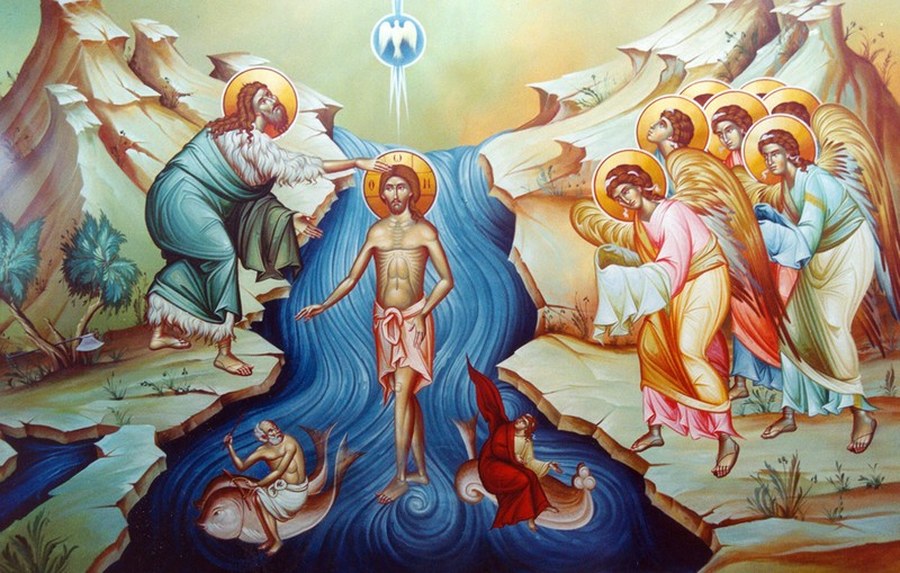
Byzantine icon of the Theophany. Christ stands in the Jordan as John baptizes Him; the Spirit descends as a dove within rays from the opened heavens while the Father's voice declares the Beloved Son. The three Persons are manifest and distinct, yet perfectly one -- the great revelation of the Most Holy Trinity at the beginning of Christ's public ministry.
Matthew 3:16-17
And Jesus, when he was baptized, went up straightway out of the water: and, lo, the heavens were opened unto him, and he saw the Spirit of God descending like a dove, and lighting upon him: And lo a voice from heaven, saying, This is my beloved Son, in whom I am well pleased.
The same revelation continues through the Transfiguration, where the Father again bears witness to the Son and the Spirit overshadows the holy mountain; through the upper-room discourse, where Christ promises to send the Spirit of truth from the Father; through the Cross and Resurrection, where the Son offers Himself to the Father in the power of the Spirit; and through Pentecost, where the ascended Christ pours out what the Father had promised. What God does for us in time (economic Trinity) shows us who God is eternally (immanent Trinity). The missions do not create the Persons; they disclose Them. We know this transcendent mystery only through the incarnate Mediator (mediation). When Philip asked to be shown the Father, Christ answered:
John 14:9
Jesus saith unto him, Have I been so long time with you, and yet hast thou not known me, Philip? he that hath seen me hath seen the Father; and how sayest thou then, Shew us the Father?
St. Spyridon and the Defense of Nicaea
By the fourth century the Church had to defend what Christ revealed. Arius argued that the Son was made, not begotten -- divine, perhaps, but not true God of true God. The First Council of Nicaea (A.D. 325) answered with the word homoousios: the Son is of one substance with the Father. Among the bishops who confessed that faith stood St. Spyridon of Trimithous, a shepherd and wonderworker from Cyprus, barefoot and simple, bearing in his body the authority of apostolic truth.
When an Arian challenged how three can be one, Spyridon took a brick in his hand and squeezed it. Fire rose upward, water flowed downward, and the clay remained in his palm -- three distinct realities from one substance, undivided yet not confused. The miracle was not a substitute for theology. It was a sign that the mystery exceeds syllogism without violating reason: one essence, three Persons. What the council defined in Greek precision, the saint displayed with pastoral clarity.
St. Spyridon of Trimithous
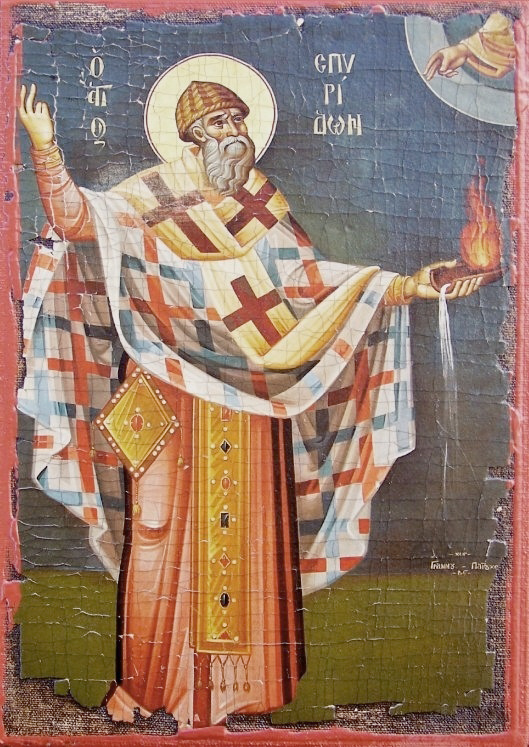
Traditional Orthodox icon of St. Spyridon at the brick miracle. Fire rises from the brick, water falls, and clay remains in his hand -- three distinct manifestations from one substance. A hand blessing from heaven crowns the image, marking the revelation defended at Nicaea as divine and not human invention.
Nicaea was not philosophy imposed on the Gospel. It was the Church refusing to lose Christ in the very act of confessing Him. If the Son through whom the Father is known is merely a creature, then the God we worship is unknown again, and the ancient world wins.
Patristic and Conciliar Formulation
The councils did not invent the Trinity. They guarded the apostolic faith against distortions the ancient mind kept producing. Nicaea (A.D. 325) confessed the Son as true God of true God, begotten, not made, consubstantial with the Father. Constantinople (A.D. 381) extended the same truth to the Holy Spirit: Lord and giver of life, worshipped and glorified with the Father and the Son. The Cappadocian Fathers supplied the grammar the Church still uses: one ousia (essence), three hypostases (persons). We do not say three essences or one person. We say one God who is three Persons -- Father, Son, and Holy Spirit.
St. Gregory Nazianzen
No sooner do I conceive of the One than I am illumined by the splendor of the Three; no sooner do I distinguish Them than I am carried back to the One.
Chalcedon (A.D. 451) is remembered chiefly for Christology, yet it presupposes Trinitarian faith: the same Son who is begotten of the Father before all ages is the one born of Mary in time. Destroy the Trinity, and the Incarnation collapses into either mere adoption or mere appearance. The Fathers knew that to confess Christ truly is to confess the Father and the Spirit truly as well.
One God, Three Persons
The Father is the unbegotten source, the fountain of divinity. The Son is eternally begotten of the Father, Light from Light, the Word through whom all things were made. The Holy Spirit proceeds from the Father -- the living bond of love between Father and Son, given to the Church in Pentecost. What is one: the divine essence, will, glory, and worship. What is three: the personal properties by which each Person is distinguished -- unbegotten, begotten, proceeding. We do not confess three gods. We do not confess one Person wearing three names.
Rublev, The Hospitality of Abraham
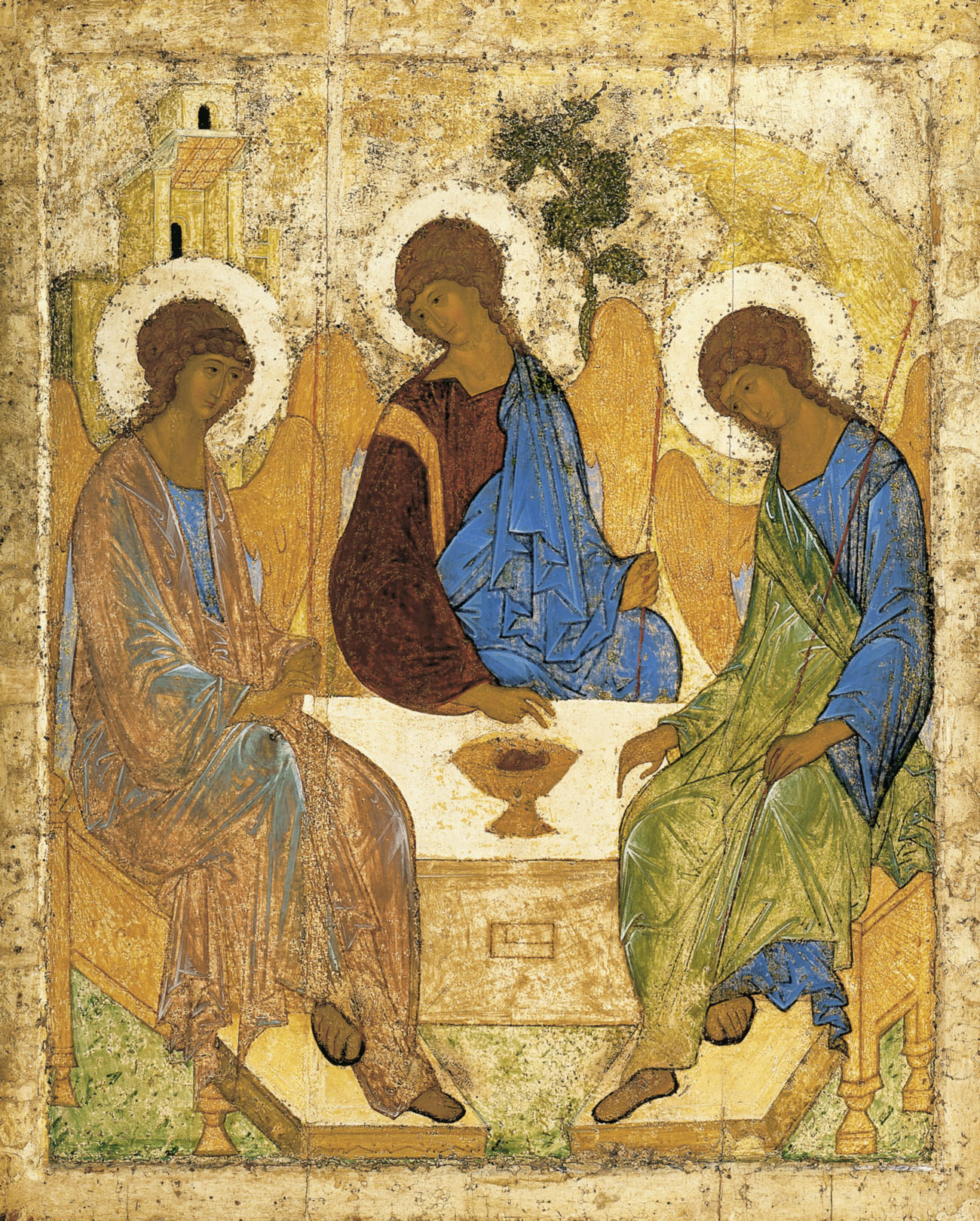
Andrei Rublev's icon of the three angels at Mamre (Genesis 18), read in the Church as a figure of the Holy Trinity. Three distinct Persons seated at one table, one chalice, one house of communion -- distinct, equal, eternally one.
Procession of the Spirit
How the Spirit relates eternally to the Father and the Son became a wound between East and West after the filioque controversy. That dispute must not be mistaken for the foundation of Trinitarian faith itself. East and West alike confess one essence and three Persons, one God worshipped in the baptismal formula Christ gave. The question is how to speak precisely of the Spirit's eternal procession without introducing two principles in the Godhead or reducing the Son to a merely economic role. The Catholic Church, following Scripture and the Fathers, defines that the Holy Spirit proceeds from the Father and the Son as from one single principle, preserving the Father's monarchy while confessing the eternal bond between Son and Spirit. The filioque debate is a tragedy of division within a faith already shared; it is not an excuse to abandon the revelation Christ made at the Jordan and entrusted to His Church.
Trinity as First Principle
The Trinity is not an appendix to Christianity. As who Christ is discloses, it is the first principle from which cosmology, reason, and salvation proceed. Before creation and before time, there was the Father's will, the Son who is the Word of truth, and the Spirit who is the love from the Father to the Son. From this communion there emerges everything that is: time, space, personhood, moral order, and the possibility of metanoia at all. We exist because God is eternal interpersonal love, not solitary force.
Father, Son, and Holy Spirit are therefore not decorative titles. They name how the transcendent God becomes knowable to us. All fatherhood springs from the Father; all truth from the Word; all life from the Spirit who is Love. Christ did not reveal a God who remains infinitely remote behind symbols. He revealed a God who sends His Son, breathes His Spirit, and draws us into Their life. Without the Trinity, Christ cannot be Truth in the full sense, and the Church cannot know what it professes.
St. Basil the Great
For the Son is in the Father and the Father in the Son; since such as is the latter, such is the former, and such as is the former, such is the latter; and one cannot be separated from the other.
Living the Mystery
The Trinity is not stored in a textbook. It is lived in the Church Christ founded. Every baptism administers what He commanded: immersion into the one name of Father, Son, and Holy Ghost, as the Holy Mysteries unite the visible and invisible. Triple immersion in the ancient rite still confesses what Nicaea defended: one God, three Persons, undivided. Every doxology -- Glory be to the Father, and to the Son, and to the Holy Ghost -- ascribes equal honor to each Person. The sign of the cross marks the believer's forehead and breast with the pattern of revelation, a daily remembrance that we belong to the God who is three and one.
Prayer itself is Trinitarian. We address the Father, through the Son, in the Holy Spirit -- not as a formula recited once and forgotten, but as the shape of communion God opened at the Jordan and sealed at Pentecost. The Lord's Prayer itself is addressed to the Father, taught by the Son, and prayed in the Spirit who cries in our hearts. Even the Jesus Prayer -- Lord Jesus Christ, Son of God, have mercy on me -- presupposes the Son who is begotten of the Father and the Spirit who makes Christ present in the soul. To live the mystery is to let this pattern govern worship, work, and repentance until the Name we were baptized into becomes the truth we inhabit.
This is the faith the Church has guarded from Nicaea to the present:
Nicene-Constantinopolitan Creed
I believe in one God, the Father Almighty, Maker of heaven and earth, and of all things visible and invisible.
And in one Lord Jesus Christ, the only-begotten Son of God, begotten of the Father before all worlds; God of God, Light of Light, very God of very God; begotten, not made, being of one substance with the Father; by whom all things were made.
And I believe in the Holy Ghost, the Lord and Giver of life; who proceedeth from the Father; who with the Father and the Son together is worshipped and glorified; who spake by the prophets.
Catechism of the Catholic Church, 253
The Trinity is One. We do not confess three Gods, but one God in three persons, the "consubstantial Trinity". The divine persons do not share the one divinity among themselves but each of them is God whole and entire: "The Father is that which the Son is, the Son that which the Father is, the Father and the Son that which the Holy Spirit is, that is, by nature one God." In the words of the Fourth Lateran Council (1215), "Each of the persons is that supreme reality, viz., the divine substance, essence or nature."
To live the mystery is to enter that communion -- baptized, praying, worshipping -- and to refuse every ancient reduction that would make Christ less than God, the Spirit less than Lord, or the Father less than the source of eternal love.
2 Corinthians 13:14
The grace of the Lord Jesus Christ, and the love of God, and the communion of the Holy Ghost, be with you all. Amen.
Christ revealed the Trinity so that we might know God and be baptized into His life. The ancient world offered triads without truth, monism without communion, and hierarchies without love. The heresies that troubled the Church were those same patterns wearing Christian names. Against them the Church held fast to what Christ showed: one God in three Persons, fully revealed in the Son who is the way, the truth, and the life. The wound of division over how to speak of the Spirit's procession must not obscure the greater gift -- that God has opened His inner life to us at all.
Come to the waters Christ sanctified. Confess the Father, the Son, and the Holy Spirit as the apostles did. The mystery is not a problem to solve and set aside. It is the living God inviting you in.
Gloria Patri
Gloria Patri, et Filio, et Spiritui Sancto. Sicut erat in principio, et nunc, et semper, et in saecula saeculorum. Amen.
Glory be to the Father, and to the Son, and to the Holy Ghost. As it was in the beginning, is now, and ever shall be, world without end. Amen.