Visitation
The Visitation is the first encounter of the incarnate Logos -- the Word of God -- with the world. Still hidden in the womb of the Virgin Mary, Christ already begins His saving work by sanctifying John the Baptist in the womb of Elizabeth. This is the moment the Word made flesh first makes Himself known, not with words, but with His mere presence.
Visitation
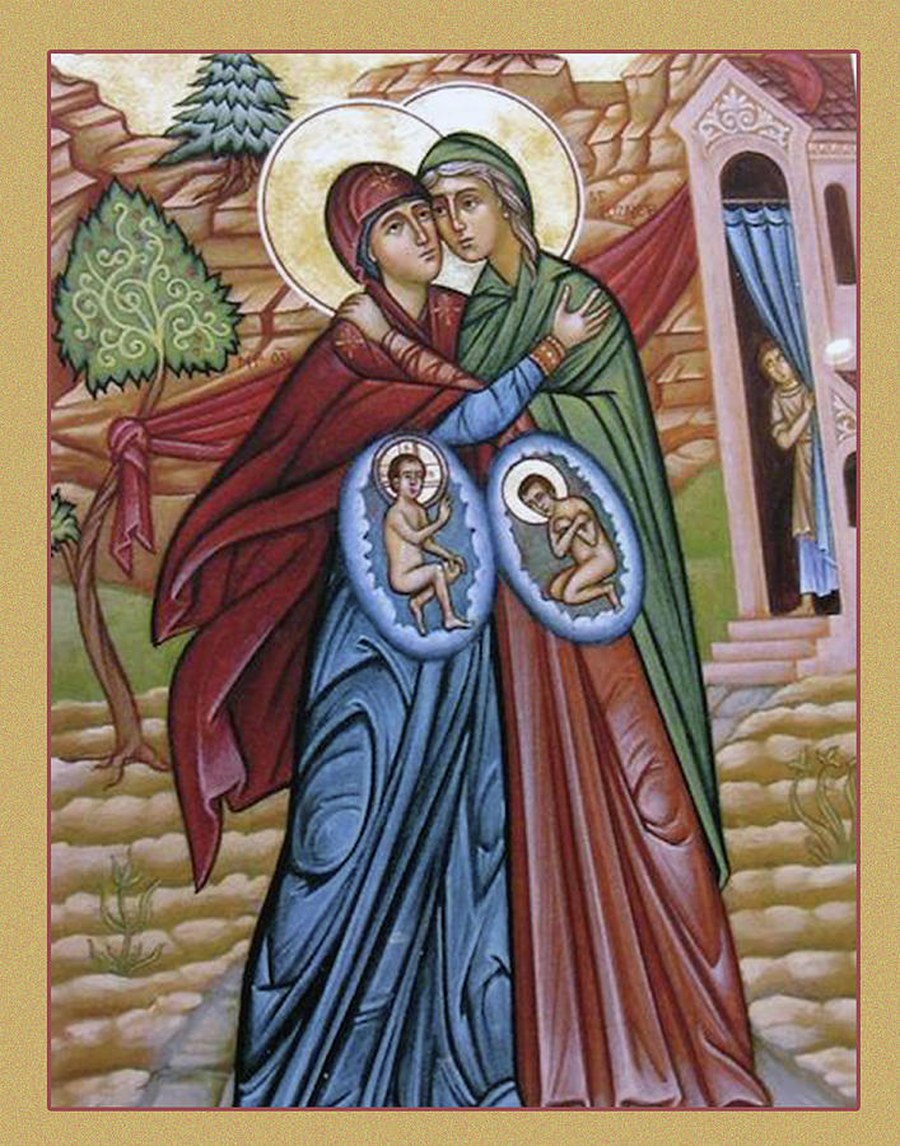
Byzantine icon of the Visitation (Ἐπισκέψις / Ὁ Ἀσπασμός) by Samuel Epperly. Mary and Elizabeth embrace in greeting; the infant Christ and John are visible in the womb medallions as John leaps for joy at the nearness of his Lord. A servant waits in the doorway of Elizabeth's house as stylized hills and architecture frame the hill-country meeting in which the incarnate Word, still hidden in Mary's womb, already sanctifies the Baptist before his birth.
Mary and Elizabeth
After the Annunciation, Mary arose and went with haste into the hill country, to a city of Judah. She entered the house of Zechariah and greeted Elizabeth. In this simple journey of a young girl we see the first movement of the Gospel: the Word, now made flesh, is already on mission.
Luke 1:39-45
And Mary arose in those days, and went into the hill country with haste, into a city of Juda; And entered into the house of Zacharias, and saluted Elisabeth. And it came to pass, that, when Elisabeth heard the salutation of Mary, the babe leaped in her womb; and Elisabeth was filled with the Holy Ghost: And she spake out with a loud voice, and said, Blessed art thou among women, and blessed is the fruit of thy womb. And whence is this to me, that the mother of my Lord should come to me? For, lo, as soon as the voice of thy salutation sounded in mine ears, the babe leaped in my womb for joy. And blessed is she that believed: for there shall be a performance of those things which were told her from the Lord.
In that moment two mothers meet -- one carrying the forerunner, the other carrying the Lord Himself. Elizabeth, filled with the Holy Spirit, becomes the first person in Scripture to proclaim Mary as “the mother of my Lord.”
John Leaps for Joy
The unborn John the Baptist leaps for joy at the sound of Mary’s voice. This is no ordinary movement. In that single instant, the forerunner is sanctified in the womb and becomes the first prophet to recognize the Messiah.
The Church has always seen in this moment the power of the incarnate Word of God. Even before birth, the presence of Christ fills John with the Holy Spirit and grants him prophetic knowledge. What the adult John would later proclaim in the wilderness -- “Behold the Lamb of God” -- he first proclaimed silently, with a leap of joy, while still hidden in Elizabeth’s womb.
St. Ambrose reflects on this mystery with wonder:
St. Ambrose
The child leaped, the mother was filled with the Spirit. The mother was not filled before the son, but when the son was filled with the Holy Spirit, he filled his mother also.
An unborn child is the first to proclaim that Jesus is the Lord. Before he can speak a single word, before he can see the light of day, the forerunner already recognizes his Messiah and rejoices. This silent, joyful leap is the very first proclamation of the Gospel.
Blessed Is the Fruit of Thy Womb
Elizabeth’s greeting reaches its climax as she recognizes the profound reality before her. The fruit of Mary’s womb is not merely a child, but the long-awaited Messiah, the incarnate Word of God.
Luke 1:42-45
And she spake out with a loud voice, and said, Blessed art thou among women, and blessed is the fruit of thy womb. And whence is this to me, that the mother of my Lord should come to me? For, lo, as soon as the voice of thy salutation sounded in mine ears, the babe leaped in my womb for joy. And blessed is she that believed: for there shall be a performance of those things which were told her from the Lord.
These words of Elizabeth would one day become the second half of the Hail Mary, repeated by millions of Christians throughout the centuries. In them we see both the dignity of Mary and the power of her faith. She believed the angel’s word when it seemed impossible, and because she believed, the promise of God was fulfilled in her.
Blessed is she that believed -- and blessed is the fruit of her womb, Jesus Christ, the Word of God made flesh.
Christ is Present
What began in the quiet meeting between two mothers continues today. The same incarnate Word of God who sanctified John in the womb and filled Elizabeth with the Holy Spirit is not confined to the past.
In the Catholic Church this same Christ -- the eternal Logos -- remains objectively and fully present: Body, Blood, Soul, and Divinity, especially in the Holy Eucharist. Here the Word continues to dwell among us, sanctifying souls, filling hearts with joy, and making His presence known even before we can speak a word of faith.
Just as John leaped for joy at the mere presence of Christ, so every soul that approaches the Eucharist in faith is met by the living God. The Visitation is not only a historical event -- it is an ongoing reality in the Church Christ founded.
The Word of God is with us.