Sermon on the Mount
The Sermon on the Mount is the charter of the Kingdom of Heaven delivered by the incarnate Word of God. Where Moses once received the Law amid thunder and lightning on Sinai, the incarnate Word, the true Lawgiver who spoke the Law, now ascends the mountain and reveals its perfect fulfillment.
Jesus teaches with authority, with complete sovereignty yet respecting free-will. He speaks not as scribe or prophet, but as the divine Person who gave the Law and now fulfills it. This is the new Torah of the New Covenant: the interior law written on the heart by grace. The old Law could command external righteousness; the Logos now supplies the divine power that makes true righteousness possible. Every word of the Sermon is both command and gift, showing what the Kingdom demands and supplying the grace by which the disciple can live it.
In this teaching the eternal Logos lays the foundation of Christian life and reveals the perfect standard of the City of God on earth.
Sermon on the Mount
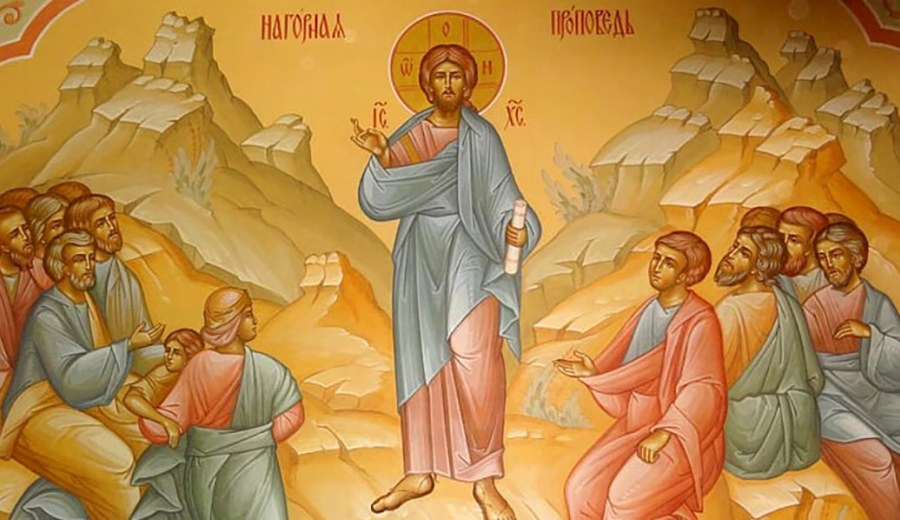
Byzantine icon of the Sermon on the Mount. Christ stands upon the rocky hillside, His right hand raised in the teaching gesture and a scroll in His left hand, as disciples listen from the slopes on either side. The incarnate Word, the true Lawgiver who gave the Law at Sinai, now ascends the mountain and reveals its perfect fulfillment -- the charter of the Kingdom of Heaven.
Matthew 5:1-2
And seeing the multitudes, he went up into a mountain: and when he was set, his disciples came unto him: And he opened his mouth, and taught them, saying,
The Beatitudes
The Lord begins not with commands but with blessings. These eight beatitudes reveal the very character of the incarnate Word of God, who embodies them in their perfection and forms the same character in every soul that receives Him.
Matthew 5:3-12
Blessed are the poor in spirit: for theirs is the kingdom of heaven.
Blessed are they that mourn: for they shall be comforted.
Blessed are the meek: for they shall inherit the earth.
Blessed are they which do hunger and thirst after righteousness: for they shall be filled.
Blessed are the merciful: for they shall obtain mercy.
Blessed are the pure in heart: for they shall see God.
Blessed are the peacemakers: for they shall be called the children of God.
Blessed are they which are persecuted for righteousness' sake: for theirs is the kingdom of heaven.
Blessed are ye, when men shall revile you, and persecute you, and shall say all manner of evil against you falsely, for my sake. Rejoice, and be exceeding glad: for great is your reward in heaven: for so persecuted they the prophets which were before you.
St. John Chrysostom, Homily on Matthew 15.1
"He does not introduce what He says by way of advice or of commandments, but by way of blessing, so making His word less burdensome, and opening to all the course of His discipline. For He said not, This or that person, but they who do so, are all of them blessed. So that though you be a slave, a beggar, in poverty, a stranger, unlearned, there is nothing to hinder you from being blessed, if you emulate this virtue."
The Beatitudes reverse the judgment of the fallen world. They declare blessed those whom the world despises: the poor in spirit, the mourning, the meek. This humility of heart is the root of all virtue and the remedy for the pride from which every sin springs.
St. Augustine teaches that the whole Sermon on the Mount is the perfect standard of the Christian life, and that the Beatitudes form its foundation and the stages of the soul's ascent to God. In the person of the Logos these blessings are no abstract ideal. He who is meek and lowly of heart now dwells within the soul that receives Him, granting the very grace He commands.
Where the old Law could only demand outward observance, the New Covenant supplies divine power. The same Word who spoke from the mountain now writes His law upon the heart, leading the disciple through poverty of spirit, mourning for sin, meekness, hunger for righteousness, mercy, purity, peacemaking, and persecution for Truth.
Salt and Light
The Beatitudes describe the character of the citizen of the Kingdom, Christ then declares the mission of those who bear this character. His disciples are not called to private virtue alone but to preserve and illuminate the entire world.
Matthew 5:13-16
Ye are the salt of the earth: but if the salt have lost his savour, wherewith shall it be salted? it is thenceforth good for nothing, but to be cast out, and to be trodden under foot of men.
Ye are the light of the world. A city that is set on an hill cannot be hid.
Neither do men light a candle, and put it under a bushel, but on a candlestick; and it giveth light unto all that are in the house.
Let your light so shine before men, that they may see your good works, and glorify your Father which is in heaven.
St. John Chrysostom, Homily on Matthew 15
"You are the salt of the earth ... He signified all human nature to have lost its savor, and to be decayed by our sins ... It is not for your own sake, he says, but for the world’s sake that the word is entrusted to you ... You are the light of the world ... not of one nation, nor of twenty states, but of the whole inhabited earth. And a light to the mind, far better than this sunbeam."
St. Augustine, Sermon 53
"The Lord said to His disciples: You are the salt of the earth; you are the light of the world. In these two names He wished to show what His disciples would accomplish: by the one, corruption is kept from the world; by the other, the darkness of ignorance is driven away."
The disciples of Christ are salt to a world corrupted by sin. Salt preserves from decay, seasons, and purifies. So the Christian, filled with the grace of the indwelling Word, must preserve society from moral corruption and restore its true savor.
They are also the light of the world. The eternal Logos who is Himself the Light of Light now shines through His disciples. Their lives, like a city set on a hill, cannot be hidden. Their good works, performed not for self-glory but in union with Christ, draw men to glorify the Father in heaven.
This mission is impossible by human strength alone. Only because the Logos has come down and now dwells within the soul through the Beatitudes can the disciple become both salt and light. Where the old Law could only restrain evil, the New Covenant through the incarnate Word releases divine power into the world through His people.
The Law Fulfilled
Christ declares that He has not come to destroy the Law or the Prophets but to fulfill them. This statement stands at the center of the Sermon on the Mount and reveals the entire purpose of the Old Covenant.
The Law given through Moses was good and holy, yet it could only command and convict; it could not give the power to obey. In Christ the Law reaches its divine completion: every precept finds its perfect obedience in the incarnate Son, and every shadow finds its substance in Him. The righteousness He demands is no longer external observance but the interior transformation that only grace can produce.
Matthew 5:17-20
Think not that I am come to destroy the law, or the prophets: I am not come to destroy, but to fulfil.
For verily I say unto you, Till heaven and earth pass, one jot or one tittle shall in no wise pass from the law, till all be fulfilled.
Whosoever therefore shall break one of these least commandments, and shall teach men so, he shall be called the least in the kingdom of heaven: but whosoever shall do and teach them, the same shall be called great in the kingdom of heaven.
For I say unto you, That except your righteousness shall exceed the righteousness of the scribes and Pharisees, ye shall in no case enter into the kingdom of heaven.
St. John Chrysostom, Homily on Matthew 16.2
"He does not say, 'I have not come to abolish the Law,' but 'I have come to fulfill it.' For He fulfilled it in two ways: first, by performing all the commandments of the Law without exception; second, by adding to it that which was lacking. He fulfilled it by adding the things which were wanting to it, and by performing the works which it commanded."
St. Augustine, On the Sermon on the Mount 1.8
"The Law is fulfilled when the things which were foretold in it are accomplished. Christ came not to destroy the Law but to fulfill it, because the Law was given through Moses, but grace and truth came through Jesus Christ."
The righteousness of the scribes and Pharisees was external and self-righteous. Christ demands a righteousness that exceeds it because it must flow from a heart renewed by grace.
The same Christ who perfectly kept the Law now dwells in the believer and enables him to keep it from the heart. What the old Law could only command, the New Covenant supplies through union with the Lawgiver Himself.
Every commandment is now kept not by human effort alone but by the indwelling power of Christ, who writes the Law upon the heart and makes true obedience possible. In this way the Sermon on the Mount is not a new legalism but the perfect expression of life in the Kingdom, where the City of God is built within the soul.
Antitheses
Christ now unfolds the surpassing righteousness He demands of the citizens of the Kingdom. In six deliberate contrasts He takes the commandments of the old Law and drives them to their hidden root in the human heart. What the Law of Moses forbade in outward act, Christ now forbids in thought, desire, and disposition. This is the heart of the New Covenant: the Law is perfected when grace writes it upon the heart and enables obedience from within.
Matthew 5:21-48
Ye have heard that it was said by them of old time, Thou shalt not kill; and whosoever shall kill shall be in danger of the judgment:
But I say unto you, That whosoever is angry with his brother without a cause shall be in danger of the judgment: and whosoever shall say to his brother, Raca, shall be in danger of the council: but whosoever shall say, Thou fool, shall be in danger of hell fire.
Therefore if thou bring thy gift to the altar, and there rememberest that thy brother hath ought against thee;
Leave there thy gift before the altar, and go thy way; first be reconciled to thy brother, and then come and offer thy gift.
Agree with thine adversary quickly, whiles thou art in the way with him; lest at any time the adversary deliver thee to the judge, and the judge deliver thee to the officer, and thou be cast into prison.
Verily I say unto thee, Thou shalt by no means come out thence, till thou hast paid the uttermost farthing.
Ye have heard that it was said by them of old time, Thou shalt not commit adultery:
But I say unto you, That whosoever looketh on a woman to lust after her hath committed adultery with her already in his heart.
And if thy right eye offend thee, pluck it out, and cast it from thee: for it is profitable for thee that one of thy members should perish, and not that thy whole body should be cast into hell.
And if thy right hand offend thee, cut it off, and cast it from thee: for it is profitable for thee that one of thy members should perish, and not that thy whole body should be cast into hell.
It hath been said, Whosoever shall put away his wife, let him give her a writing of divorcement:
But I say unto you, That whosoever shall put away his wife, saving for the cause of fornication, causeth her to commit adultery: and whosoever shall marry her that is divorced committeth adultery.
Again, ye have heard that it hath been said by them of old time, Thou shalt not forswear thyself, but shalt perform unto the Lord thine oaths:
But I say unto you, Swear not at all; neither by heaven; for it is God's throne:
Nor by the earth; for it is his footstool: neither by Jerusalem; for it is the city of the great King.
Neither shalt thou swear by thy head, because thou canst not make one hair white or black.
But let your communication be, Yea, yea; Nay, nay: for whatsoever is more than these cometh of evil.
Ye have heard that it hath been said, An eye for an eye, and a tooth for a tooth:
But I say unto you, That ye resist not evil: but whosoever shall smite thee on thy right cheek, turn to him the other also.
And if any man will sue thee at the law, and take away thy coat, let him have thy cloke also.
And whosoever shall compel thee to go a mile, go with him twain.
Give to him that asketh thee, and from him that would borrow of thee turn not thou away.
Ye have heard that it hath been said, Thou shalt love thy neighbour, and hate thine enemy.
But I say unto you, Love your enemies, bless them that curse you, do good to them that hate you, and pray for them which despitefully use you, and persecute you;
That ye may be the children of your Father which is in heaven: for he maketh his sun to rise on the evil and on the good, and sendeth rain on the just and on the unjust.
For if ye love them which love you, what reward have ye? do not even the publicans the same?
And if ye salute your brethren only, what do ye more than others? do not even the publicans so?
Be ye therefore perfect, even as your Father which is in heaven is perfect.
St. John Chrysostom, Homily on Matthew 16
"He does not say, 'It was said to them of old time,' but 'It was said by them of old time,' showing that the Law was given by God, but the interpretation was corrupted by the Jews. He corrects not the Law, but the false understanding of the Law."
St. Augustine, On the Sermon on the Mount 1.9
"The Lord shows that the righteousness of the Kingdom of Heaven exceeds that of the scribes and Pharisees, not by destroying the commandments but by commanding more than the letter of the Law. He who is angry without cause is liable to judgment; he who lusts has already committed adultery in his heart."
St. John Chrysostom, Homily on Matthew 18
"He who is angry without cause is liable to judgment; he who lusts has already committed adultery in his heart. See how He has raised the Law to a higher standard. He does not say, 'Thou shalt not commit adultery,' but 'Thou shalt not look with lust.'"
In each antithesis Christ reveals the full spiritual depth of the Law. Anger is murder in the heart. A lustful glance is adultery already committed. Hardness of heart underlies easy divorce. Oaths betray a lack of simple truthfulness. Retaliation denies the mercy that reflects the Father. Hatred of enemies is overcome by the supernatural charity that loves even persecutors.
The final command crowns the whole: "Be ye therefore perfect, even as your Father which is in heaven is perfect." This is no mere ethical ideal. It is a call to share in the very holiness of God.
The old Law could restrain the hand and expose sin, yet it could not heal the corrupt heart wounded by original sin. Christ, the Lawgiver made flesh, now supplies what the Law lacked. He who perfectly fulfilled every commandment in His own life now dwells in the baptized soul through the Holy Spirit. The same divine Person who spoke these words from the mountain writes them on the heart, restoring the will and empowering free obedience under grace. Where human effort alone would fail, union with Christ makes the impossible possible. The antitheses therefore stand as both the highest demand of the Kingdom and the clearest promise of grace. They form the practical outworking of the Beatitudes, showing how the poor in spirit, the pure in heart, and the peacemakers actually live in the City of God while still in the City of Man.
True Piety
Christ now turns from the interior demands of the Law to the outward practices of religion: almsgiving, prayer, and fasting. He does not abolish these acts of piety but purifies them from the leaven of hypocrisy.
True righteousness exceeds that of the scribes and Pharisees not only in depth but in motive. The citizen of the Kingdom performs these works not to be seen by men but to be seen by the Father who is in secret. This is the heart of New Covenant worship: the eternal Son who perfectly pleased the Father now enables His disciples to do the same through grace.
Matthew 6:1-18
Take heed that ye do not your alms before men, to be seen of them: otherwise ye have no reward of your Father which is in heaven.
Therefore when thou doest thine alms, do not sound a trumpet before thee, as the hypocrites do in the synagogues and in the streets, that they may have glory of men. Verily I say unto you, They have their reward.
But when thou doest alms, let not thy left hand know what thy right hand doeth:
That thine alms may be in secret: and thy Father which seeth in secret himself shall reward thee openly.
And when thou prayest, thou shalt not be as the hypocrites are: for they love to pray standing in the synagogues and in the corners of the streets, that they may be seen of men. Verily I say unto you, They have their reward.
But thou, when thou prayest, enter into thy closet, and when thou hast shut thy door, pray to thy Father which is in secret; and thy Father which seeth in secret shall reward thee openly.
But when ye pray, use not vain repetitions, as the heathen do: for they think that they shall be heard for their much speaking.
Be not ye therefore like unto them: for your Father knoweth what things ye have need of, before ye ask him.
After this manner therefore pray ye: Our Father which art in heaven, Hallowed be thy name.
Thy kingdom come. Thy will be done in earth, as it is in heaven.
Give us this day our daily bread.
And forgive us our debts, as we forgive our debtors.
And lead us not into temptation, but deliver us from evil: For thine is the kingdom, and the power, and the glory, for ever. Amen.
For if ye forgive men their trespasses, your heavenly Father will also forgive you:
But if ye forgive not men their trespasses, neither will your Father forgive your trespasses.
Moreover when ye fast, be not, as the hypocrites, of a sad countenance: for they disfigure their faces, that they may appear unto men to fast. Verily I say unto you, They have their reward.
But thou, when thou fastest, anoint thine head, and wash thy face;
That thou appear not unto men to fast, but unto thy Father which is in secret: and thy Father, which seeth in secret, shall reward thee openly.
St. John Chrysostom, Homily on Matthew 19.1
"He does not forbid almsgiving, prayer, or fasting, but only the doing of them to be seen of men. He who seeks the praise of men has received his reward already; he who seeks the praise of God shall receive it hereafter."
St. Augustine, On the Sermon on the Mount 2.2
"The Lord teaches that all these works of piety must be done with a single eye to the glory of the Father. Hypocrisy is the poison that kills every good work when it is done for human applause."
Christ exposes the root sin of the Pharisees: performing religious acts for human glory. True piety is hidden, offered to the Father who sees in secret. The same Christ who prayed alone on mountains now teaches His disciples to pray in the closet of the heart. He gives them the perfect prayer, the Our Father, which sums up the entire Gospel. In it the disciple addresses God as Father, seeks first the Kingdom, submits to the divine will, asks for daily bread, pleads for forgiveness on the condition of forgiving others, and begs deliverance from evil. This prayer is both petition and promise: it is the prayer of the Son to the Father, placed upon the lips of the baptized by grace.
The old Law commanded external rites; the New Covenant through Christ demands purity of intention. Only the indwelling Christ, who Himself prayed without ceasing and fasted in secret, can produce this interior devotion. The disciple who lives the Beatitudes and obeys the antitheses now performs alms, prayer, and fasting as acts of union with the Son. What was once burdensome or showy becomes the natural fruit of life in the Kingdom, where the City of God is built in the hidden depths of the soul.
Seek the Kingdom
Christ now instructs the disciple how to order the whole of life around the Kingdom of Heaven. Having purified the motives of almsgiving, prayer, and fasting, He turns to the heart's attachments: earthly treasures, anxious care for material needs, and divided service between God and mammon.
The citizen of the Kingdom stores up treasure in heaven, serves one Master alone, and seeks first the Kingdom and its righteousness. Only then will all necessary things be added. This teaching reveals the liberty of the sons of God, freed from the slavery of anxiety by the grace of the indwelling Christ.
Matthew 6:19-34
Lay not up for yourselves treasures upon earth, where moth and rust doth corrupt, and where thieves break through and steal:
But lay up for yourselves treasures in heaven, where neither moth nor rust doth corrupt, and where thieves do not break through nor steal:
For where your treasure is, there will your heart be also.
The light of the body is the eye: if therefore thine eye be single, thy whole body shall be full of light.
But if thine eye be evil, thy whole body shall be full of darkness. If therefore the light that is in thee be darkness, how great is that darkness!
No man can serve two masters: for either he will hate the one, and love the other; or else he will hold to the one, and despise the other. Ye cannot serve God and mammon.
Therefore I say unto you, Take no thought for your life, what ye shall eat, or what ye shall drink; nor yet for your body, what ye shall put on. Is not the life more than meat, and the body than raiment?
Behold the fowls of the air: for they sow not, neither do they reap, nor gather into barns; yet your heavenly Father feedeth them. Are ye not much better than they?
Which of you by taking thought can add one cubit unto his stature?
And why take ye thought for raiment? Consider the lilies of the field, how they grow; they toil not, neither do they spin:
And yet I say unto you, That even Solomon in all his glory was not arrayed like one of these.
Wherefore, if God so clothe the grass of the field, which to day is, and to morrow is cast into the oven, shall he not much more clothe you, O ye of little faith?
Therefore take no thought, saying, What shall we eat? or, What shall we drink? or, Wherewithal shall we be clothed?
(For after all these things do the Gentiles seek:) for your heavenly Father knoweth that ye have need of all these things.
But seek ye first the kingdom of God, and his righteousness; and all these things shall be added unto you.
Take therefore no thought for the morrow: for the morrow shall take thought for the things of itself. Sufficient unto the day is the evil thereof.
St. John Chrysostom, Homily on Matthew 22.1
"He does not forbid the possession of riches, but the laying up of them as treasures upon earth. For He who commanded us to lay up treasures in heaven would not have forbidden us to possess them on earth. But He forbids the heart to be fixed on them."
St. Augustine, On the Sermon on the Mount 2.13
"The single eye is the simple intention of the heart that seeks God alone. When the eye is single the whole body is full of light; when it is evil the whole body is full of darkness. No man can serve two masters. The two masters are God and mammon; the two treasures are heaven and earth; the two anxieties are the cares of this life and the care of the Kingdom."
Christ sets before the disciple the choice that determines the whole direction of the soul. Earthly treasure corrupts and is stolen; heavenly treasure endures. The eye that is single fills the whole body with light; the evil eye fills it with darkness.
No man can serve God and mammon. Anxiety about food, drink, and clothing belongs to those who do not know the Father. The disciple who lives the Beatitudes, obeys the antitheses, and practices true piety is freed from such care. The same Christ who fed the multitudes and clothed the lilies now dwells within the soul and supplies every need once the Kingdom is sought first.
The old Law could command outward justice but could not free the heart from the world. The New Covenant through Christ gives the grace that detaches the heart from earthly things and unites it wholly to God.
The incarnate Word who spoke these words from the mountain now reigns in the heart that receives Him, making the impossible command a living reality. Thus the disciple lives already as a citizen of the City of God, storing treasure where Christ is, serving Him alone, and receiving from the Father all things needful for this life and the next.
House on a Rock
Christ concludes the Sermon on the Mount with solemn warnings and the decisive image of two builders. He who has heard the words of the Kingdom must now put them into practice. Mere hearing or even orthodox profession is not enough.
The disciple who builds his life on the rock of these sayings will stand when the storms of judgment come; the one who hears but does not obey will fall in utter ruin. This final section reveals that the entire Sermon is not theory but the very foundation of eternal life.
Matthew 7:1-27
Judge not, that ye be not judged.
For with what judgment ye judge, ye shall be judged: and with what measure ye mete, it shall be measured to you again.
And why beholdest thou the mote that is in thy brother's eye, but considerest not the beam that is in thine own eye?
Or how wilt thou say to thy brother, Let me pull out the mote out of thine eye; and, behold, a beam is in thine own eye?
Thou hypocrite, first cast out the beam out of thine own eye; and then shalt thou see clearly to cast out the mote out of thy brother's eye.
Give not that which is holy unto the dogs, neither cast ye your pearls before swine, lest they trample them under their feet, and turn again and rend you.
Ask, and it shall be given you; seek, and ye shall find; knock, and it shall be opened unto you:
For every one that asketh receiveth; and he that seeketh findeth; and to him that knocketh it shall be opened.
Or what man is there of you, whom if his son ask bread, will he give him a stone?
Or if he ask a fish, will he give him a serpent?
If ye then, being evil, know how to give good gifts unto your children, how much more shall your Father which is in heaven give good things to them that ask him?
Therefore all things whatsoever ye would that men should do to you, do ye even so to them: for this is the law and the prophets.
Enter ye in at the strait gate: for wide is the gate, and broad is the way, that leadeth to destruction, and many there be which go in thereat:
Because strait is the gate, and narrow is the way, which leadeth unto life, and few there be that find it.
Beware of false prophets, which come to you in sheep's clothing, but inwardly they are ravening wolves.
Ye shall know them by their fruits. Do men gather grapes of thorns, or figs of thistles?
Even so every good tree bringeth forth good fruit; but a corrupt tree bringeth forth evil fruit.
A good tree cannot bring forth evil fruit, neither can a corrupt tree bring forth good fruit.
Every tree that bringeth not forth good fruit is hewn down, and cast into the fire.
Wherefore by their fruits ye shall know them.
Not every one that saith unto me, Lord, Lord, shall enter into the kingdom of heaven; but he that doeth the will of my Father which is in heaven.
Many will say to me in that day, Lord, Lord, have we not prophesied in thy name? and in thy name have cast out devils? and in thy name done many wonderful works?
And then will I profess unto them, I never knew you: depart from me, ye that work iniquity.
Therefore whosoever heareth these sayings of mine, and doeth them, I will liken him unto a wise man, which built his house upon a rock:
And the rain descended, and the floods came, and the winds blew, and beat upon that house; and it fell not: for it was founded upon a rock.
And every one that heareth these sayings of mine, and doeth them not, shall be likened unto a foolish man, which built his house upon the sand:
And the rain descended, and the floods came, and the winds blew, and beat upon that house; and it fell: and great was the fall of it.
St. John Chrysostom, Homily on Matthew 24.1
"He who hears these words and does them builds upon the rock. The rock is Christ Himself and the teaching that proceeds from His mouth. When the storms of temptation and the floods of persecution come, only the house founded on obedience will stand."
St. Augustine, On the Sermon on the Mount 2.25
"The Lord ends His discourse with this parable so that no one may think that hearing is enough. The house built on the rock is the life founded on obedience to these commandments. The rock is the Lord Himself, and the wise man is he who does the will of the Father."
The Sermon on the Mount therefore stands as the perfect charter of the Kingdom. It begins with the Beatitudes, which form the character of Christ in the soul; it proceeds through salt and light, the fulfillment of the Law, the antitheses of the heart, true piety, and total detachment from the world; and it ends with this urgent call to action.
Hearing without doing is self-deception.
The words of Christ are spirit and life only when they are obeyed. The same Christ who spoke from the mountain now dwells in the heart that receives Him and supplies the grace to obey every word. The narrow way, the good fruit, and the house founded on the rock are not achievements of human effort but the fruit of union with the indwelling Word. Thus the disciple who lives the Sermon becomes a visible citizen of the City of God amid the City of Man, unshaken by every storm, until he enters the eternal Kingdom where the King Himself is the Rock and the Light forever.