Crowning with Thorns
The soldiers led Jesus into the Praetorium after the scourging. They called together the whole band of soldiers, and would unknowingly crown the true King.
The soldiers, intending mockery, unwittingly enthroned the incarnate Word of God, who is King of kings and Lord of lords. He condescended down to the lowest state of our rebellion, to be scourged, to be mocked, and even to die, all in order to save us from this very sorrowful state of rebellion.
And as the earth, cursed for Adam’s disobedience, brought forth thorns and thistles, the Second Adam willingly receives these thorns and thistles woven into a crown, the perfect symbol of our treacherous disobedience: He is King over all, including our sinful rebellion. In this voluntary humiliation the New Adam bears the curse of the first Adam, and by His patient endurance He triumphs where the first man fell.
Cassiodorus beheld in the relics preserved at Jerusalem that the thorny crown was set upon the head of the Redeemer such that all the thorns of the world might be gathered together and broken. The Fathers see in this act the reversal of the fall: where thorns sprang from sin, now the crown of thorns becomes the diadem of the King who restores paradise.
Crowning with Thorns
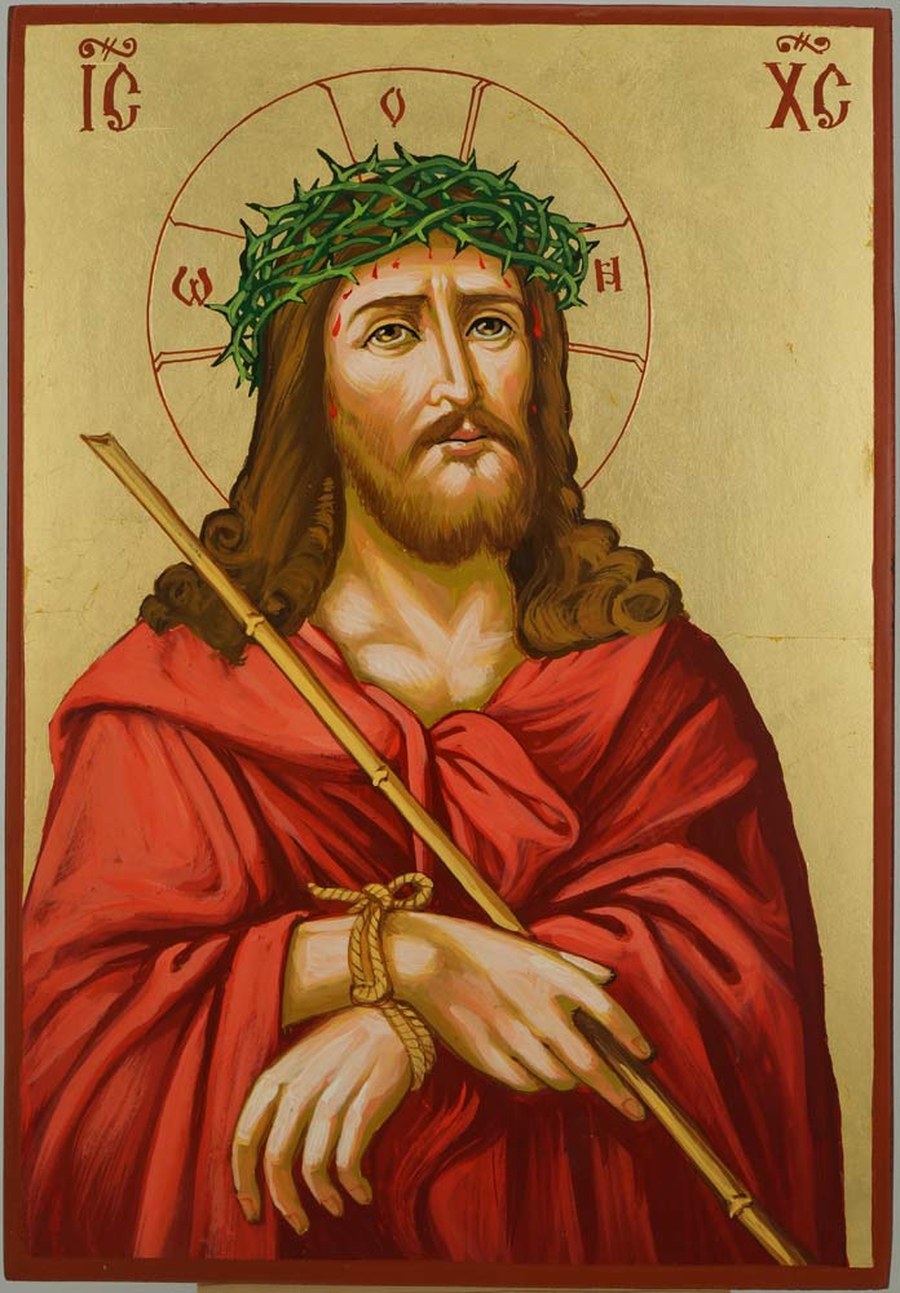
Byzantine icon of Christ the Bridegroom (ὁ Νυμφίος) in the Crown of Thorns. Christ wears the thorny circlet upon His sacred head, His hands bound and holding the reed of mockery, His gaze bowed in patient endurance. The soldiers intended ridicule; they unwittingly enthroned the King of kings. The thorns drawn from the earth cursed for Adam's sin become the diadem of the New Adam who bears the rebellion of the world upon Himself.
The Praetorium
The Praetorium was the official headquarters and judgment hall of the Roman governor, the seat of imperial power in Jerusalem. It was here, in the center of earthly authority, that the Lord willingly allowed the soldiers to mockingly crown Him with thorns.
Mark 15:16
And the soldiers led him away into the hall, called Praetorium; and they call together the whole band.
St. John Chrysostom calls upon us to marvel at the divine forbearance of Christ as He remained silent amid the assembling troops. The hall of earthly judgment became the site where the Lord accepted the first stage of public scorn. Here He submitted to the mockery of men in order to atone for the pride that had brought humanity low, demonstrating the perfect submission that reverses the ancient disobedience and opens the way to restoration.
The entire cohort was gathered, hundreds of soldiers, turning the governor’s seat into a theater of derision. Yet in this very place of Roman might the King of kings stood bound, offering His sacred head to insult. The Fathers see the Praetorium not as a mere courtroom but as the stage where worldly power unwittingly enthroned the true Sovereign, the Second Adam who bears the curse in perfect humility where the first Adam had fallen through pride.
Crown and Robe
Mark 15:17
And they clothed him with purple, and platted a crown of thorns, and put it about his head,
St. John Chrysostom bids us to fix our gaze upon the divine forbearance of Christ, who endured in utter silence the crown of thorns driven into His sacred head. Those sharp points, drawn from the earth that was cursed for Adam’s sin, were no mere instruments of torture; they were living figures of our own sins and the constant stings of a guilty conscience.
The King of Glory accepted this as the true crown of humanity’s rebellion. The purple robe of mockery and the crown of piercing pain become the first visible tokens of our redemption. Our ancient disobedience is atoned for in perfect submission. The curse is taken upon Himself by the One who alone could dissolve it, and paradise is restored to the fallen race of man.
The soldiers chose the toughest thorns growing wild around Jerusalem, plants whose long spines were well known to the local population for their pain. They wove them roughly into a circlet and forced it down upon the sacred head with repeated blows. In Homily 87 on Matthew, St. John Chrysostom stresses that every strike to this Divine Head was received without resistance, the entire cohort joining in the derision while the Lord stood bound and silent.
The purple robe, stripped from a soldier’s cloak, was thrown over His shoulders as a mock royal mantle. Though given in scorn, the color of empire and priesthood unwittingly testified to the true dignity of the One they mocked. The Fathers see here the world’s own symbols turned against it: the very insignia of earthly rule become the garments in which the King of kings accepts the full weight of human pride.
By this act the Second Adam does what the first Adam refused. Where the first grasped after forbidden likeness to God and brought the curse of thorns, the New Adam submits perfectly and wears the curse as His crown. The purple robe and the crown of thorns together mark the moment when the reign of grace begins through the very humiliation the old Adam could not endure.
Hail, King of the Jews
Matthew 27:29
And they bowed the knee before him, and mocked him, saying, Hail, King of the Jews!
St. John Chrysostom bids us contemplate the astonishing humility of the Lord who allowed these soldiers to kneel before Him in derision and hail Him as King while they spat upon His face and struck His thorn-crowned head with the reed. The very words that belong to Him by eternal right were turned into the sharpest mockery, itself a perfect representation of our rebellion.
In this scene the full measure of human pride is poured out upon the Second Adam. The soldiers, representing the nations and the powers of this world, bow the knee in scorn. Yet their false worship unwittingly confesses the truth. The King they mock is the true King who reigns not by force but by perfect submission.
Every blow of the reed upon the sacred head, every drop of spittle upon the divine face, was received without resistance. Here the ancient disobedience of Adam is atoned for in the perfect obedience of Christ. The mockery reaches its height, the purple is stripped off, and the Lord is led away to be crucified, wearing still the crown of thorns as the sign that He has taken the curse of the world truly upon Himself.