Baptism of Christ
The Baptism of Christ is the great Theophany, the solemn public revelation of the Most Holy Trinity and the sanctification of the waters for the salvation of the world. The sinless Son of God enters the Jordan not for His own purification, but to cleanse the waters themselves and to open the way for every soul to be reborn through baptism.
Baptism of Christ
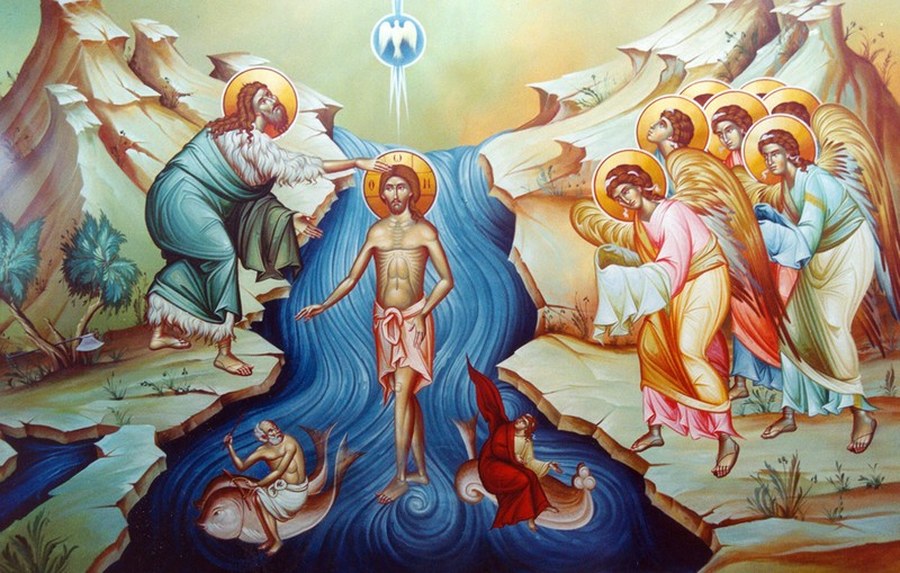
Byzantine icon of the Theophany (Ἡ Θεοφάνεια). Christ stands in the Jordan as John the Baptist baptizes Him from the rocky bank; the Spirit descends as a dove within rays from the opened heavens. Angels attend on the right with garments for the Lord while the personified Jordan and the powers lurking in the deep cower beneath the sinless Son who enters the waters not for His own purification but to sanctify them for the salvation of the world -- the great manifestation of the Most Holy Trinity.
Baptismal Prefigurations
From the very dawn of creation, water was a sacred sign of life, judgment, cleansing, and new birth.
Genesis 1:2
And the earth was without form, and void; and darkness was upon the face of the deep. And the Spirit of God moved upon the face of the waters.
The Spirit of God hovered over the primordial waters, bringing order out of chaos. This same creative Spirit would one day descend upon the waters of the Jordan at the Baptism of Christ.
Through the waters of the Flood, God judged a corrupt world while saving the righteous. Noah and his family were preserved in the ark, a clear figure of the Church and of baptism itself.
1 Peter 3:20-21
Which sometime were disobedient, when once the longsuffering of God waited in the days of Noah, while the ark was a preparing, wherein few, that is, eight souls were saved by water. The like figure whereunto even baptism doth also now save us (not the putting away of the filth of the flesh, but the answer of a good conscience toward God,) by the resurrection of Jesus Christ.
When Israel crossed the Red Sea, they passed through water from slavery into freedom, with the cloud (a figure of the Holy Spirit) leading them.
1 Corinthians 10:1-2
Moreover, brethren, I would not that ye should be ignorant, how that all our fathers were under the cloud, and all passed through the sea; And were all baptized unto Moses in the cloud and in the sea.
Later, Naaman the Syrian was healed of leprosy only after washing seven times in the Jordan at the word of the prophet Elisha. The prophets repeatedly foretold a future outpouring of cleansing and renewal through water and the Spirit.
Ezekiel 36:25-27
Then will I sprinkle clean water upon you, and ye shall be clean: from all your filthiness, and from all your idols, will I cleanse you. A new heart also will I give you, and a new spirit will I put within you: and I will take away the stony heart out of your flesh, and I will give you an heart of flesh. And I will put my spirit within you, and cause you to walk in my statutes, and ye shall keep my judgments, and do them.
The Church Fathers saw all these events as living prophecies awaiting their perfect fulfillment in Christ. St. Cyril of Jerusalem taught that when the eternal Logos descended into the Jordan, He sanctified the waters for the rebirth of every soul. St. Ambrose declared that Christ did not come to be cleansed by the waters, but to cleanse the waters themselves so that they might become the instrument of our salvation. Tertullian proclaimed that Christ “came to the waters to sanctify the waters for us.”
In the Baptism of Christ, every ancient type reaches its perfect fulfillment. The waters of creation, judgment, deliverance, and healing are all gathered together and made new by the One who is both Creator and Redeemer. The Jordan itself becomes the womb of the Church, and every baptism thereafter participates in this divine mystery.
One Baptism for the Remission of Sins
The Lord Jesus Christ instituted one baptism for the remission of sins. This is no mere ritual or outward ceremony, but a true and saving participation in His death and resurrection, through which the old man is buried and the new man is raised in Christ.
Matthew 28:19-20
Go ye therefore, and teach all nations, baptizing them in the name of the Father, and of the Son, and of the Holy Ghost: Teaching them to observe all things whatsoever I have commanded you: and, lo, I am with you alway, even unto the end of the world. Amen.
Mark 16:15-16
And he said unto them, Go ye into all the world, and preach the gospel to every creature. He that believeth and is baptized shall be saved; but he that believeth not shall be damned.
Before baptism, a person remains under the dominion of sin, death, and the powers of darkness. In baptism, the soul is truly reborn. The old self is put to death and a new creation rises. The Church Fathers describe this transformation with holy awe. St. Cyril of Jerusalem taught that baptism is not only the washing away of sins, but the beginning of a new life in which the Holy Spirit takes up His dwelling within the soul.
This is why the Church has always confessed one baptism for the remission of sins. It is the ordinary and mighty means established by Christ Himself through which the fruits of His redemption are applied to each soul. In the waters of baptism we are incorporated into His Body, made partakers of the divine nature, and transferred from the kingdom of darkness into the Kingdom of the beloved Son.
Here the victory of the Cross becomes personally ours. Here the promise of new life is fulfilled. Here the eternal Logos continues to make all things new.
The Form of Baptism
For a baptism to be valid, three elements are required: proper matter, proper form, and proper intention.
The matter is true natural water.
The form consists of the exact words spoken while the water is poured (or the person is immersed):
Matthew 28:19
Go ye therefore, and teach all nations, baptizing them in the name of the Father, and of the Son, and of the Holy Ghost.
Any deliberate change to this formula renders the baptism invalid.
The required intention is to do what the Church does, that is, to baptize according to the will and institution of Christ. The personal faith or holiness of the minister is not required. In cases of necessity, even a non-baptized person can validly baptize provided he uses natural water and the Trinitarian formula with this intention.
The Church therefore recognizes as valid all baptisms that employ natural water together with the words "in the name of the Father, and of the Son, and of the Holy Ghost" and the proper intention. This includes the vast majority of Protestant and Eastern Orthodox baptisms.
Baptism may never be repeated. The Church confesses with one voice: one baptism for the remission of sins.
CCC 1256
The ordinary ministers of Baptism are the bishop and priest and, in the Latin Church, also the deacon. In case of necessity, anyone, even a non-baptized person, with the required intention, can baptize, by using the Trinitarian baptismal formula.
Through this form the eternal Logos continues to act in His Church, incorporating souls into His Body and applying the fruits of His redemption to each person.
Romans 6:3-4
Know ye not, that so many of us as were baptized into Jesus Christ were baptized into his death? Therefore we are buried with him by baptism into death: that like as Christ was raised up from the dead by the glory of the Father, even so we also should walk in newness of life.
Jesus Comes to Be Baptized
Then Jesus came from Galilee to the Jordan to John the Baptist, to be baptized.
Matthew 3:13-16
Then cometh Jesus from Galilee to Jordan unto John, to be baptized of him. But John forbad him, saying, I have need to be baptized of thee, and comest thou to me? And Jesus answering said unto him, Suffer it to be so now: for thus it becometh us to fulfil all righteousness. Then he suffered him. And Jesus, when he was baptized, went up straightway out of the water: and, lo, the heavens were opened unto him, and he saw the Spirit of God descending like a dove, and lighting upon him.
The eternal Word of God made flesh comes to the waters of the Jordan. He who spoke the universe into being, who is Himself the source of all holiness and light, now stands before John the Baptist and asks to be baptized.
The Creator submits to the hand of His creature. The eternal Son allows a fallen man to pour water over His head. John, filled with the Holy Spirit, immediately perceives the divine reversal and protests. Yet the Word of God replies with perfect humility: “Suffer it to be so now: for thus it becometh us to fulfil all righteousness.”
At that moment the voice of the Father is heard from heaven:
Matthew 3:17
And lo a voice from heaven, saying, This is my beloved Son, in whom I am well pleased.
The Church Fathers saw in this moment the very heart of our salvation. The eternal Word made flesh is baptized not that He might be cleansed, but that He might cleanse the waters. He enters the Jordan not to receive the Spirit, but to bestow the Spirit. The Master is baptized by the servant, the Creator by the creature.
St. Gregory of Nazianzus, Oration 39
Christ is baptized, not that He might be cleansed, but that He might cleanse the waters. He is baptized, not that He might receive the Spirit, but that He might bestow the Spirit.
St. Ambrose
The Lord was baptized, not to be cleansed Himself, but to cleanse the waters, so that those waters, cleansed by the flesh of Christ which knew no sin, might have the power of Baptism.
St. John Chrysostom
The Master is baptized by the servant, the Creator by the creature, the sinless One by the sinner. He who needs no repentance submits to the baptism of repentance so that He might fulfill all righteousness and open the way for us.
By descending into the Jordan, the eternal Word made flesh sanctifies the waters from within. He takes the place of sinners so that sinners might become sons. The New Adam steps into the river corrupted by the first Adam so that the waters might become the womb of the new creation.
Because the incarnate Word of God was baptized for us, the waters now have power to cleanse us. Because He entered the river of repentance, we can be buried with Him in baptism and rise with Him to everlasting life.
The Dual Testimony
At the moment Jesus rises from the water, two distinct voices bear witness to who He is.
John the Baptist, the forerunner, had already seen the Spirit descend and remain upon Jesus. He now testifies openly:
John 1:32-34
And John bare record, saying, I saw the Spirit descending from heaven like a dove, and it abode upon him. And I knew him not: but he that sent me to baptize with water, the same said unto me, Upon whom thou shalt see the Spirit descending, and remaining on him, the same is he which baptizeth with the Holy Ghost. And I saw, and bare record that this is the Son of God.
At the same instant the voice of the Father Himself is heard from heaven:
Matthew 3:17
And lo a voice from heaven, saying, This is my beloved Son, in whom I am well pleased.
In this dual testimony the Most Holy Trinity is revealed to the world for the first time in its fullness. The eternal Word of God made flesh stands in the Jordan. The Holy Spirit descends upon Him like a dove. The Father declares His eternal delight. The three Persons are present and distinct, yet perfectly one.
This is the true Epiphany. The baptismal formula Christ would later command: “in the name of the Father, and of the Son, and of the Holy Ghost”. The Trinity is fully revealed in this moment. God reveals His own inner life to us in the very act by which He begins to save us.
The Church Fathers saw here the foundation of every Christian baptism. The same Trinity that was manifested over the Jordan is now invoked over every soul that is baptized. Because the incarnate Word of God was baptized for us, the waters now have power to cleanse us. Because the Trinity was revealed in this act, we are baptized into the very life of God.
Preaching to the Spirits in Prison
The baptism of Christ is not only a public revelation of the Trinity. It is also the moment when the incarnate Word of God begins His victory over the powers of darkness.
St. Peter connects this mystery directly to baptism:
1 Peter 3:19-22
By which also he went and preached unto the spirits in prison; Which sometime were disobedient, when once the longsuffering of God waited in the days of Noah, while the ark was a preparing, wherein few, that is, eight souls were saved by water. The like figure whereunto even baptism doth also now save us (not the putting away of the filth of the flesh, but the answer of a good conscience toward God,) by the resurrection of Jesus Christ.
The Fathers understood these “spirits in prison” as the rebellious angels and the souls held captive by sin and death since the days of Noah. When Christ descended into the waters of the Jordan, He was already beginning the work of liberation. His baptism was the first public act of the New Adam confronting and overcoming the forces that had held humanity in bondage.
Just as Noah and his family were saved through water in the ark, so now the Church is saved through the waters of baptism. The flood judged the world, but the ark preserved the righteous. In the same way, baptism buries the old life and raises the new life in Christ.
Through His baptism, the eternal Word made flesh entered the realm of death and judgment so that He might proclaim victory there. The same power that was at work in the Jordan is now at work in every baptism: the powers of darkness are confronted, sin is forgiven, and the soul is transferred from the kingdom of death into the Kingdom of the beloved Son.
This is why the Church has always seen baptism as far more than a personal ritual. It is a participation in Christ’s own victorious descent and rising, the moment when the prisoner becomes free and the dead are made alive.
Christ is Present
The eternal Word of God made flesh, who came to the waters of the Jordan, who sanctified them from within, and in whom the Most Holy Trinity was revealed, is the same Christ who is with us today.
In the Catholic Church this same incarnate Lord remains objectively and fully present. Body, Blood, Soul, and Divinity, He is truly present in the Most Holy Eucharist. The waters He sanctified in the Jordan are the same waters in which every Christian is baptized. The Trinity that was manifested over the river is the same Trinity into whose name we are baptized.
Every valid baptism participates in the mystery that began at the Jordan. Every time the words “in the name of the Father, and of the Son, and of the Holy Ghost” are spoken over water, the power of Christ’s own baptism is made present again. The same Lord who descended into the river descends into the font. The same Spirit who rested upon Him rests upon the baptized. The same voice of the Father who declared His delight now calls each new son and daughter into His life.
Because the incarnate Word of God was baptized for us, baptism now has power to save us. Because He entered the river of repentance, we can be buried with Him and rise with Him to everlasting life.
The Baptism of Christ is not only an event in the past. It is a living reality in the Church. Here the eternal Word continues to come to us in humility, to sanctify us, and to draw us into the life of the Most Holy Trinity.