Signs and Wonders
During His public ministry Jesus performed many signs and wonders, manifesting His divine authority over creation, disease, demons, and death.
These were not mere displays of power but sēmeia -- signs that revealed His identity as the Messiah, fulfilled prophecy, restored what sin had broken, and called forth faith (John 20:30-31; Acts 2:22).
Signs and Wonders
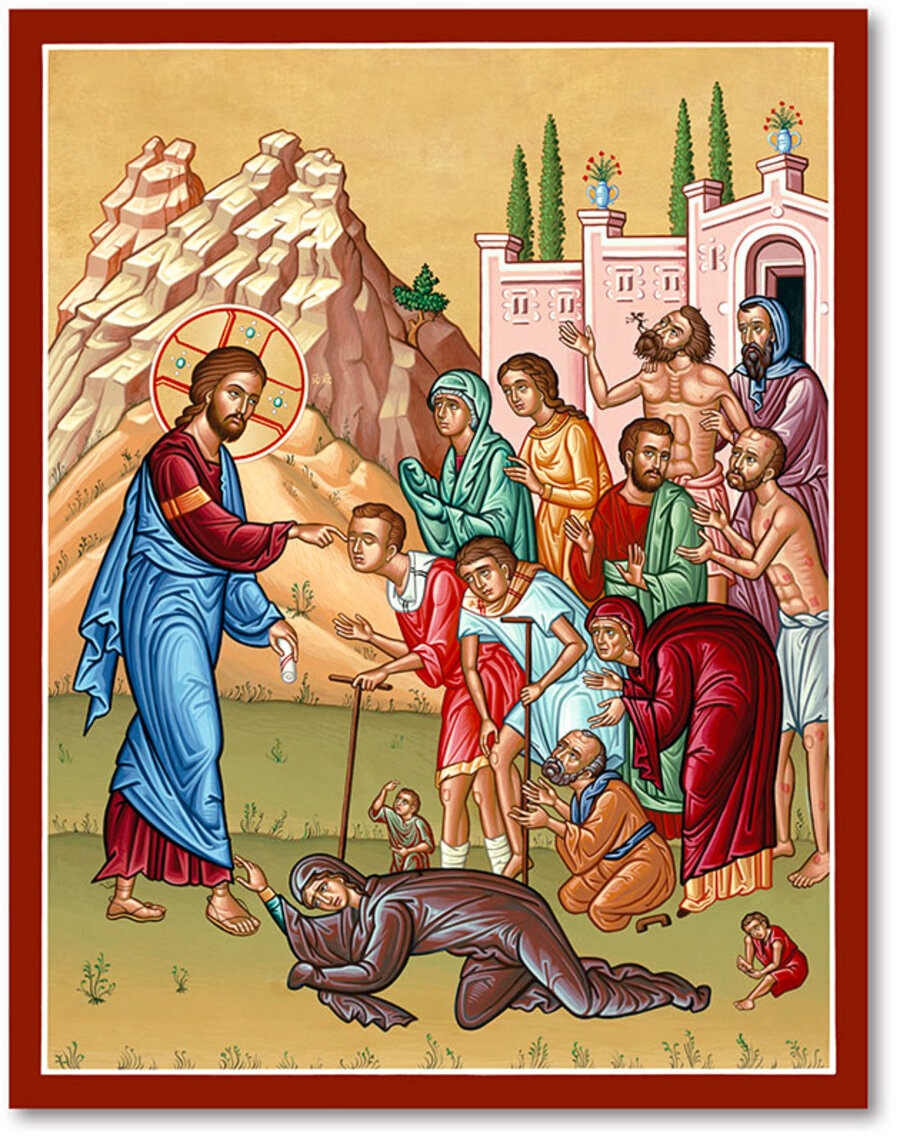
Byzantine icon of Christ Healing the Sick. Christ grants sight to a young blind man while a multitude of the lame, leprous, and possessed petition Him for mercy; the woman with an issue of blood reaches for the hem of His garment. Virtue goes out of Him and heals them all -- signs that reveal His identity as the Messiah, restore what sin has broken, and call forth faith.
Authority over Sickness
Christ healed many and demonstrated His complete authority ober sickness. Two examples -- the centurion’s servant (Matthew 8:5-13) and the man born blind (John 9:1-7) -- show His sovereign lordship over the body broken by original sin.
Matthew 8:5-8
When he had entered Capernaum, a centurion came forward to him, appealing to him, "Lord, my servant is lying paralyzed at home, suffering terribly." And he said to him, "I will come and heal him." But the centurion replied, "Lord, I am not worthy to have you come under my roof, but only say the word, and my servant will be healed."
Matthew 8:13
And Jesus said to the centurion, "Go; let it be done for you as you have believed." And the servant was healed at that very moment.
Patristic consensus marvels that a Gentile military officer recognized Christ’s word as sufficient to heal at a distance, without presence or ritual. This faith reverses the disobedience of the first Adam; where sin introduced paralysis and disorder into human nature, Christ restores order by the same commanding word that once spoke creation into existence. The miracle is a public sign that the Kingdom has arrived for all nations.
John 9:1-3
As he passed by, he saw a man blind from birth. And his disciples asked him, "Rabbi, who sinned, this man or his parents, that he was born blind?" Jesus answered, "It was not that this man sinned, or his parents, but that the works of God might be displayed in him."
John 9:6-7
Having said these things, he spit on the ground and made mud with the saliva. Then he anointed the man's eyes with the mud and said to him, "Go, wash in the pool of Siloam" (which means Sent). So he went and washed and came back seeing.
Christ performs an act of new creation identical to the original formation of man from the dust. The pre-schism Fathers emphasize that the use of clay and saliva is no mere remedy but a deliberate echo of Genesis: the same divine hands that shaped the first Adam now reshape the fallen image. The healing displays the works of God precisely so that faith may arise in the midst of suffering caused by original sin.
In each case Christ reclaims what sin had corrupted, prefiguring the Sacraments by which the Church continues His healing work.
Authority over Demons
Christ cast out demons. Two examples of His authority over demons -- the Syrophoenician woman’s daughter (Mark 7:24-30) and the Gerasene demoniac (Mark 5:1-20) -- show His sovereign lordship over the powers of darkness that hold humanity in bondage because of original sin.
Mark 7:24-27
And from there he arose and went away to the region of Tyre and Sidon. And he entered a house and did not want anyone to know, yet he could not be hidden. But immediately a woman whose little daughter had an unclean spirit heard of him and came and fell down at his feet. Now the woman was a Gentile, of Syrophoenician origin. She begged him to cast the demon out of her daughter. And he said to her, "Let the children be fed first, for it is not right to take the children's bread and throw it to the dogs."
Mark 7:28-30
But she answered him, "Yes, Lord; yet even the dogs under the table eat the children's crumbs." And he said to her, "For this statement you may go your way; the demon has left your daughter." And she went home and found the child lying in bed and the demon gone.
The Syrophoenician woman’s humble persistence wins deliverance for her daughter. Patristic consensus sees in her the archetype of the Church of the Gentiles: an outsider who recognizes Christ’s lordship and receives even the crumbs of His mercy, proving that demonic bondage yields to faith beyond the borders of Israel.
Mark 5:6-9
And when he saw Jesus from afar, he ran and fell down before him. And crying out with a loud voice, he said, "What have you to do with me, Jesus, Son of the Most High God? I adjure you by God, do not torment me." For he was saying to him, "Come out of the man, you unclean spirit!" And Jesus asked him, "What is your name?" He replied, "My name is Legion, for we are many."
Mark 5:13-15
And the unclean spirits came out and entered the pigs; and the herd, numbering about two thousand, rushed down the steep bank into the sea and drowned in the sea. The herdsmen fled and told it in the city and in the country. And people came to see what it was that had happened. And they came to Jesus and saw the demon-possessed man, the one who had had the legion, sitting there, clothed and in his right mind.
In the Gerasene demoniac Christ confronts and defeats an entire legion with a single word. The Church Fathers regard this as the New Adam entering the strong man’s house and plundering his goods. Where the first Adam was enslaved to the devil through sin, Christ liberates man completely, restoring him to his right mind and true humanity. The drowning of the swine reveals that demonic powers are permitted only what Christ allows.
In both miracles Christ reclaims humanity from demonic tyranny, prefiguring the Church’s ongoing ministry of deliverance through the Sacraments and the name of Christ.
Authority over Creation
Jesus commanded the elements and multiplied creation. Four examples of His authority over creation -- the calming of the storm (Mark 4:35-41), walking on water (Matthew 14:22-33), feeding the five thousand (John 6:1-14), and feeding the four thousand (Mark 8:1-10) -- show His sovereign lordship over the material cosmos disrupted by original sin.
Mark 4:37-39
And a great windstorm arose, and the waves were breaking into the boat, so that the boat was already filling. But he was in the stern, asleep on the cushion. And they woke him and said to him, "Teacher, do you not care that we are perishing?" And he awoke and rebuked the wind and said to the sea, "Peace! Be still!" And the wind ceased, and there was a great calm.
Mark 4:41
And they were filled with great fear and said to one another, "Who then is this, that even the wind and the sea obey him?"
The Church Fathers see in the calming of the storm the New Adam restoring the order of creation that the first Adam had subjected to futility. Where sin brought chaos and danger into the natural world, Jesus’ single commanding word returns it to peace, proving that the Creator reigns over every element.
Matthew 14:25-27
And in the fourth watch of the night he came to them, walking on the sea.
But when the disciples saw him walking on the sea, they were terrified, and said, "It is a ghost!" and they cried out in fear. But immediately Jesus spoke to them, saying, "Take heart; it is I. Do not be afraid."
Matthew 14:31-33
Jesus immediately reached out his hand and took hold of him, saying to him, "O you of little faith, why did you doubt?"
And when they got into the boat, the wind ceased. And those in the boat worshiped him, saying, "Truly you are the Son of God."
In walking on the sea Jesus demonstrates mastery over the very waters that, since the fall, had become a symbol of chaos and death. The Church Fathers recognize here the same divine Word who separated the waters in Genesis now treading upon them as on dry land, calling His people to faith that conquers fear.
John 6:5-6
Lifting up his eyes, then, and seeing that a large crowd was coming toward him, Jesus said to Philip, "Where are we to buy bread, so that these people may eat?"
John 6:10-11
Jesus said, "Have the people sit down." Now there was much grass in the place. So the men sat down, about five thousand in number. Jesus then took the loaves, and when he had given thanks, he distributed them to those who were seated. So also the fish, as much as they wanted.
John 6:14
When the people saw the sign that he had done, they said, "This is indeed the Prophet who is to come into the world!"
The feeding of the five thousand reveals Jesus as the true Provider who multiplies what is given in faith. The Church Fathers note that the same Logos who created all things from nothing now multiplies loaves and fish, prefiguring the Eucharist in which He will feed the Church with His own Body.
Even the numbers bear witness to profound theological truth, the five loaves signify the five books of Torah, the twelve baskets represent the twelve tribes. Jesus is mot only feeding a crowd, He is fulfilling the Messianic prophecy.
Mark 8:1-3
In those days, when again a great crowd had gathered, and they had nothing to eat, he called his disciples to him and said to them, "I have compassion on the crowd, because they have been with me now three days and have nothing to eat. And if I send them away hungry to their homes, they will faint on the way."
Mark 8:6-8
And he directed the crowd to sit down on the ground. And he took the seven loaves, and when he had given thanks, he broke them and gave them to his disciples to set before the people; and they set them before the crowd. And they had a few small fish. And having blessed them, he said that these also should be set before them. And they ate and were satisfied.
The seven loaves and seven baskets represent universality, with the four-thousand representing multitudes in the four corners of rhe earth. The feeding of the four thousand shows the same compassionate multiplication extended even to Gentiles in a remote place.
The Church Fathers see both feedings as the Logos reversing the curse of toil and scarcity that came through Adam’s sin, restoring creation’s abundance for those who follow Him. In each case Jesus reclaims the material world from the disorder of the fall, prefiguring the Sacraments by which the Church continues to receive His creative and sustaining power.
Victory over Death
Jesus raised the dead. Three examples of His authority over death -- the widow of Nain’s son (Luke 7:11-17), Jairus’ daughter (Mark 5:21-43), and Lazarus (John 11:1-44) -- show His sovereign lordship over the final enemy introduced by original sin.
Luke 7:12-13
As he drew near to the gate of the town, behold, a man who had died was being carried out, the only son of his mother, and she was a widow. And a considerable crowd from the town was with her. And when the Lord saw her, he had compassion on her and said to her, "Do not weep."
Luke 7:14-15
Then he came up and touched the bier, and the bearers stood still. And he said, "Young man, I say to you, arise." And the dead man sat up and began to speak, and Jesus gave him to his mother.
The Church Fathers see in the raising of the widow’s son the New Adam confronting death itself on the road. Where the first Adam’s disobedience brought mortality into the human family, Jesus’ compassionate word reverses the sentence, restoring the son to his mother and proving that death must obey the voice of the Creator.
Mark 5:38-40
They came to the house of the ruler of the synagogue, and Jesus saw a commotion, people weeping and wailing loudly. And when he had entered, he said to them, "Why are you making a commotion and weeping? The child is not dead but sleeping." And they laughed at him.
Mark 5:41-43
But he put them all outside and took the child's father and mother and those who were with him and went in where the child was. Taking her by the hand he said to her, "Talitha cumi," which means, "Little girl, I say to you, arise." And immediately the girl got up and began walking, for she was twelve years of age. And immediately they were overcome with amazement.
In the raising of Jairus’ daughter Jesus treats death as sleep, commanding the child to arise with the same creative word. The Church Fathers emphasize that this act reveals death’s powerlessness before the incarnate Logos: the girl who was truly dead returns to life instantly, prefiguring the general resurrection and showing that faith in Jesus overcomes even the grave.
John 11:38-39
Then Jesus, deeply moved again, came to the tomb. It was a cave, and a stone lay against it. Jesus said, "Take away the stone." Martha, the sister of the dead man, said to him, "Lord, by this time there will be an odor, for he has been dead four days."
John 11:43-44
When he had said these things, he cried out with a loud voice, "Lazarus, come out." The man who had died came out, his hands and feet bound with linen strips, and his face wrapped with a cloth. Jesus said to them, "Unbind him, and let him go."
The raising of Lazarus is the climactic sign before the Passion. The Church Fathers teach that by calling Lazarus forth after four days Jesus demonstrates complete victory over corruption and decay -- the very consequences of original sin. The same voice that once called creation into being now summons the dead from the tomb, proving that Jesus is the resurrection and the life.
In each case Jesus reclaims humanity from the dominion of death, prefiguring the Sacraments by which the Church continues to receive His life-giving power.
The Purpose of the Signs
Jesus performed these signs and wonders so that the world might believe that He is the Son of God and have life in His name (John 20:30-31). Each miracle reveals His divine identity while reversing the concrete effects of original sin: sickness and paralysis, demonic bondage, chaos in creation, and finally death itself. The Church Fathers teach that in every case Jesus acts as the New Adam, restoring with His creative word what the first Adam had lost through disobedience.
The signs authenticate His messianic claim and His divinity. They fulfill the prophets who foretold that the coming One would heal the blind, cast out demons, feed the hungry, and raise the dead. They demonstrate that the Kingdom of God has arrived in person, not as abstract power but as compassionate authority exercised for the sake of faith.
Yet the miracles are more than proof. They prefigure the Sacraments of the Church. The healings point to Baptism and Confirmation, which restore the image of God wounded by sin. The feedings foreshadow the Eucharist, in which Jesus multiplies His own Body to nourish the multitude. The victories over death anticipate the Resurrection and the final raising of all the dead. In each sign the Church Fathers see the same divine economy: what Jesus did once in the flesh He now continues through the Church until He returns.
Above all, the signs call for faith. They do not compel belief; they invite it. The centurion, the Syrophoenician woman, the disciples in the storm, Martha and Mary; each is drawn from doubt or fear into trust by a word from Jesus. This is the pattern for every believer: the signs confront the brokenness caused by sin and demand the response that alone receives grace -- humble, persistent faith in the One who commands wind and sea, demons and death, and who will one day command the graves to open.
Thus the signs and wonders of the public ministry stand as living testimony that Jesus is the incarnate Word pf God, that God condescended down into His creation as a man, to save us from our rebellion while respecting our freedom to rebel (revealing His nature and character). He is the restorer of all that sin had ruined, and the author of the new creation that will be consummated in His Cross and Resurrection.