Institution of the Eucharist
The Lord Jesus Christ instituted the Eucharist on the night He was betrayed. At the Passover table He took bread, gave thanks, broke it, and gave it to the apostles with the words that made it His Body. He took the cup, gave thanks, and gave it to them with the words that made it His Blood of the new testament.
This single act is the source and summit of the Christian life and the most profound mystery of the faith: the true Flesh and Blood of the Saviour given as food and drink for eternal life. The Church Fathers received these words from the Apostles as the reality of the New Covenant, in which the same Flesh that suffered for our sins becomes our nourishment unto everlasting life.
Institution of the Eucharist
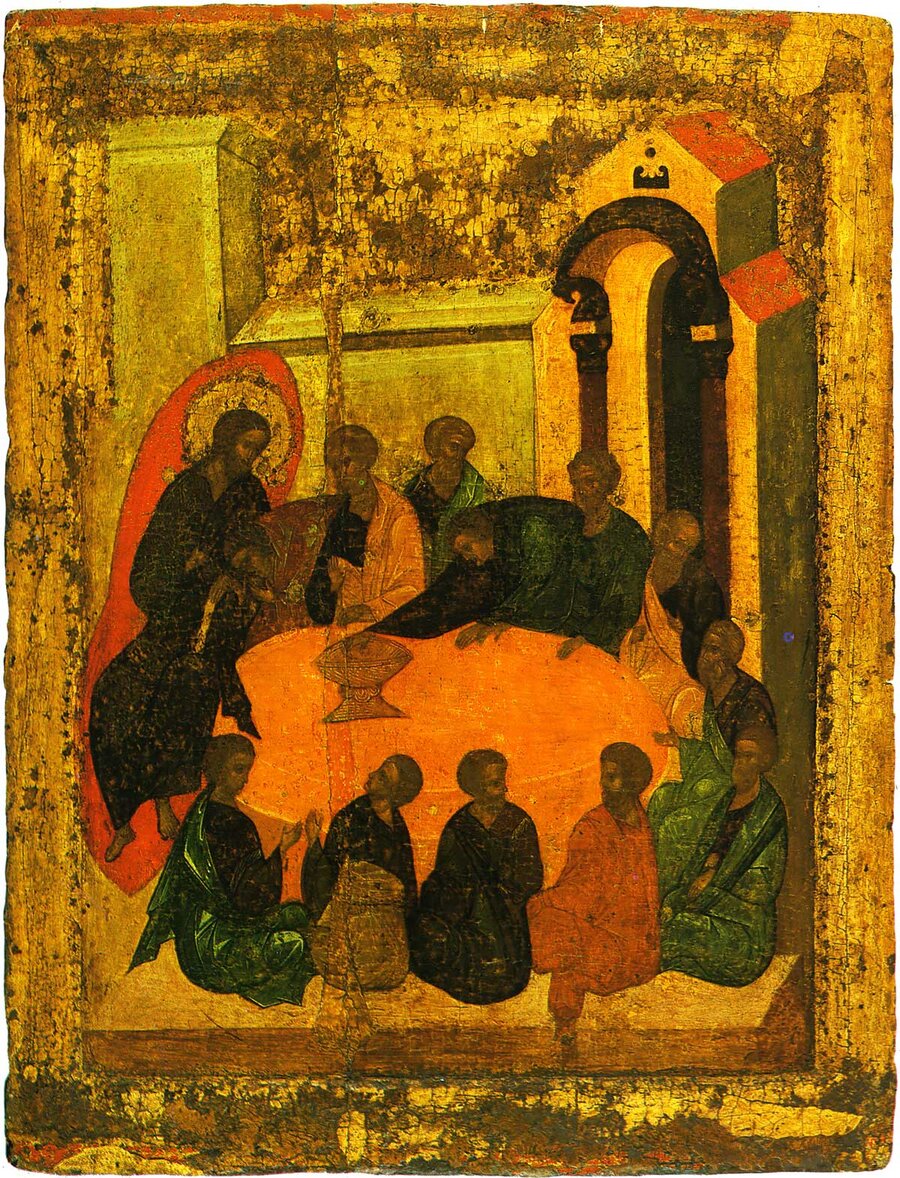
Byzantine icon of the Mystical Supper (Τὸ Μυστικὸν Δεῖπνον). From the festal tier of the iconostasis at Trinity Cathedral, Trinity-St. Sergius Lavra (Sergiev Posad), 1420s; workshop of Daniel Chorny and Andrey Rublev. Christ stands at the center of the horseshoe table distributing the Eucharist to the apostles; Judas reaches for the dipped morsel while the others receive the Body and Blood of the New Covenant.
Prefigurations
From the beginning God was preparing us for the gift of the Eucharist through sacred prefigurations in the Old Testament. These divine signs used bread, wine, blood, and sacrificial meals to unveil the Holy Mystery of the true Flesh and Blood of Christ given as food and drink for eternal life.
Genesis 14:18
And Melchizedek king of Salem brought forth bread and wine: and he was the priest of the most high God.
The Church Fathers received this offering as an image of the Eucharistic sacrifice. Melchizedek giving bread and wine points to Christ (in the order of Melchizedek) offering His own Body and Blood under the same forms for the salvation of the world.
Exodus 16:15
And when the children of Israel saw it, they said one to another, It is manna: for they wist not what it was.
And Moses said unto them, This is the bread which the LORD hath given you to eat.
The Fathers recognized in this manna from heaven the prefiguration of the true Bread from heaven, the Flesh of Christ, that whoever eats of it may live forever.
Exodus 12:7-8
And they shall take of the blood, and strike it on the two side posts and on the upper door post of the houses, wherein they shall eat it. And they shall eat the flesh in that night, roast with fire, and unleavened bread; and with bitter herbs they shall eat it.
In this the Church sees the clearest image of Christ, the true Passover Lamb. His Flesh and Blood, once offered, delivers us from death and becomes the food and drink of immortality in the New Covenant.
This preparation reaches its open revelation in the New Testament, even at the Wedding at Cana, where water is changed into wine, pointing forward to the Last Supper.
The Living Bread
In Capernaum Jesus taught openly about the Holy Mystery that would be fulfilled at the Last Supper.
He declared that the true food and drink for eternal life is his own Flesh and Blood.
John 6:51
I am the living bread which came down from heaven: if any man eat of this bread, he shall live for ever: and the bread that I will give is my flesh, which I will give for the life of the world.
The Church Fathers received these words as the direct announcement of the Eucharist. The same Flesh that would be offered on the Cross is given as food so that whoever eats it may live forever.
John 6:53
Then Jesus said unto them, Verily, verily, I say unto you, Except ye eat the flesh of the Son of man, and drink his blood, ye have no life in you.
This teaching caused a crisis among the disciples. They found it too difficult and stopped following him.
John 6:68-69
Then Simon Peter answered him, Lord, to whom shall we go? thou hast the words of eternal life. And we believe and are sure that thou art that Christ, the Son of the living God.
Peter’s confession stands as the response of faith. The Church has always seen in these words the foundation of belief in the real presence of Christ in the Eucharist: the Flesh and Blood given for the life of the world.
The Last Supper
On the night He was betrayed, at the Passover table, Jesus instituted the Eucharist.
1 Corinthians 11:23-24
For I have received of the Lord that which also I delivered unto you, That the Lord Jesus the same night in which he was betrayed took bread: And when he had given thanks, he brake it, and said, Take, eat: this is my body, which is broken for you: this do in remembrance of me.
The Church Fathers received these words as the moment the bread became the actual Body of Christ. Ignatius of Antioch taught that the Eucharist is the flesh of our Saviour which suffered for our sins. This is not a figure of speech. It is the true Flesh given as food for eternal life.
Matthew 26:27-28
And he took the cup, and gave thanks, and gave it to them, saying, Drink ye all of it; For this is my blood of the new testament, which is shed for many for the remission of sins.
The Fathers understood these words as establishing the New Covenant in His literal Blood. Irenaeus records that Christ confessed the cup to be His own Blood. This is the same Blood shed on the Cross, now given to be drunk for the remission of sins and the life of the world.
The institution of the Eucharist is therefore the giving of Christ’s own Flesh and Blood under the forms of bread and wine, the source of the Church’s life until He returns.
House Churches
While Christianity remained illegal under Roman law the Church gathered secretly in private homes to celebrate the Eucharist on the first day of the week.
Acts 2:42
And they continued stedfastly in the apostles' doctrine and fellowship, and in breaking of bread, and in prayers.
The Church Fathers received this breaking of bread as the continuation of the Last Supper. Ignatius of Antioch taught that the Eucharist is the flesh of our Saviour which suffered for our sins and is the medicine of immortality. In these house churches the true Flesh and Blood of Christ united the scattered faithful into one body despite persecution.
Acts 20:7
And upon the first day of the week, when the disciples came together to break bread, Paul preached unto them, ready to depart on the morrow; and continued his speech until midnight.
The Fathers understood this gathering on the first day as the apostolic pattern of the Sunday liturgy. Justin Martyr described how the faithful assembled in one place, read the writings of the apostles and prophets, prayed, and received the blessed food which is the flesh and blood of Jesus incarnate. This was no mere symbol but the real presence given in the midst of danger, for example, during Roman persecutions the acolyte Tarcisius carried the Eucharist to imprisoned Christians in Rome. When a pagan mob attacked him demanding the sacred gifts, he protected the Body of Christ with his own body and life rather than surrender it, dying a martyr for the Real Presence.
Beyond any doubt, the early Christians (under apostolic direction) understood that the Eucharist is the real presence of the incarnate Word of God, the very "hard teaching" that scandalized the first disciples.
1 Corinthians 11:26
For as often as ye eat this bread, and drink this cup, ye do shew the Lord's death till he come.
The Church has always seen in these words the command to continue the Holy Mystery until the return of Christ. Even in house churches under threat of death the Eucharist remained the source and summit of Christian life, the same Flesh and Blood received from the apostles and handed on without interruption.