Wedding at Cana
The eternal Logos, by whose word all things were made, performs His first public sign at a wedding in Cana. At Mary's intercession He changes water into wine, manifesting His glory, sanctifying marriage, and revealing the abundance of the new covenant. This sign points forward to Baptism, to the water and blood from His side on the Cross, and to the Eucharist, where the best wine is kept until now.
Wedding at Cana
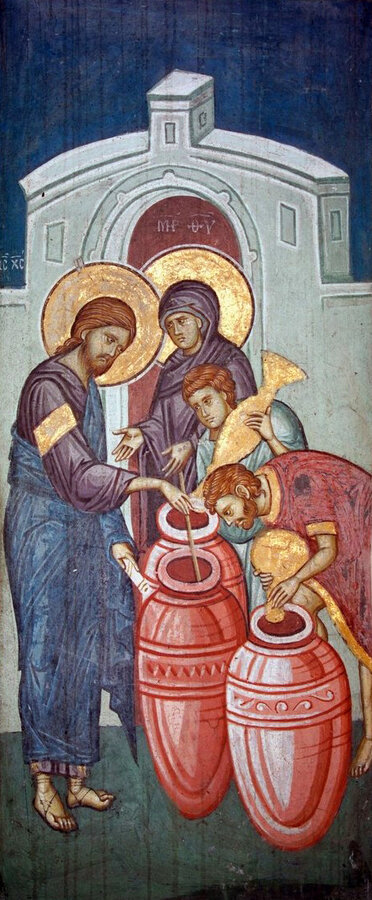
Byzantine fresco of the Wedding at Cana (ὁ Γάμος ἐν Κανᾷ). From Visoki Dečani monastery, Kosovo, c. 1350. Christ stands among the wedding guests as Mary directs the servants to do whatever He tells them; the stone water jars of Jewish purification stand filled to the brim, and at His word the water becomes the finest wine. The steward, tasting what he does not know is a miracle, declares that the good wine has been kept until now.
The Setting
John 2:1-2
On the third day there was a wedding at Cana in Galilee, and the mother of Jesus was there. Jesus also was invited to the wedding with his disciples.
The event takes place early in the public ministry, shortly after the Baptism in the Jordan and the calling of the first disciples. The phrase “the third day” carries typological weight, echoing the third day of creation and anticipating the third day of the resurrection.
A wedding feast in a small Galilean village reflects the ordinary joys of human life which the Logos comes to elevate and sanctify. Marriage, instituted by God from the beginning as the foundational covenant (Genesis 2:24), is here honored by the presence of the eternal Word. This foreshadows the mystery of Christ’s spousal union with the Church (Ephesians 5:31-32) and the messianic banquet foretold by the prophets, marked by abundant wine and restored joy (Isaiah 25:6; Amos 9:13; Joel 3:18).
When the wine ran out, the joy of the feast was threatened. In the culture of the time, wine was essential to festive hospitality. Its depletion sets the stage for the first of the signs.
Mary’s Intercession
John 2:3-5
When the wine failed, the mother of Jesus said to him, “They have no wine.” And Jesus said to her, “O woman, what have you to do with me? My hour has not yet come.” His mother said to the servants, “Do whatever he tells you.”
Mary intercedes when the wine fails at the wedding feast. She brings the need directly to the Logos. Jesus’ reply -- “O woman, what have you to do with me? My hour has not yet come” -- refers to the hour of His passion, death, and glorification (John 12:23; 13:1; 17:1). Yet at her request He advances the manifestation of His glory.
Her command to the servants -- “Do whatever he tells you” -- is the model of Christian discipleship and obedience. This is the first explicit instance in the Gospels of Mary’s mediation. She directs others to the Logos as the sole source of grace and abundance.
The Church Fathers consistently see here the restoration of obedience lost in Eden. Where Eve led Adam into disobedience, Mary leads servants to perfect obedience to the New Adam.
St. John Chrysostom, Homily on John 21.2
"See how great is the authority of His mother ... Although He said, 'My hour has not yet come,' He does not contradict her, but rather shows that He honors His mother."
St. Augustine, Tractate on John 8.9
"The Lord said, 'My hour has not yet come,' and yet He does what His mother asks ... In this He teaches us that even when His hour had not come, He could still grant what was asked out of honor for His mother."
The eternal Logos responds to Mary’s intercession while remaining sovereign over the hour of salvation. This event reveals both His divine power and the fitting role of Mary in the economy of grace.
Water into Wine
With the vessels prepared and the servants attentive, the Logos now acts with divine authority.
John 2:6-8
And there were set there six waterpots of stone, after the manner of the purifying of the Jews, containing two or three firkins apiece. Jesus saith unto them, Fill the waterpots with water. And they filled them up to the brim. And he saith unto them, Draw out now, and bear unto the governor of the feast. And they bare it.
The transformation is instantaneous and complete. At the command of the eternal Logos, the humble water of purification is changed into the richest wine. No visible gesture. No elaborate ritual. Only the sovereign word of the One by whom all things were made (John 1:3).
This first public sign reveals the creative power of the Logos acting within His creation. The stone jars, symbols of the old ritual law and its repeated but imperfect purifications, become vessels of new and abundant joy. The servants obey without hesitation, filling the jars to the brim in an act of complete trust. Their obedience becomes the conduit for the miracle.
Here Christ demonstrates that He is no mere teacher or prophet, but the Master of creation itself. What was water becomes wine, prefiguring the greater transformation that will occur in the sacraments of the New Covenant.
This miracle stands as the first of His signs. He manifested His glory, and His disciples believed in Him (John 2:11).
The Good Wine
The steward of the feast, ignorant of the miracle’s source, now tastes the result and speaks words heavy with meaning.
John 2:9-10
When the ruler of the feast had tasted the water that was made wine, and knew not whence it was: (but the servants which drew the water knew;) the governor of the feast called the bridegroom, And saith unto him, Every man at the beginning doth set forth good wine; and when men have well drunk, then that which is worse: but thou hast kept the good wine until now.
In the order of this world, the best is given first. Once the senses are dulled, the lesser is served. Yet here the Logos reverses the pattern of fallen creation. He reserves the finest wine for the end. The old wine of the Law and its rites has run its course. What He now provides is not merely better in quality. It is the abundant, transforming wine of the New Covenant.
This good wine, drawn from the waterpots of purification, signifies the surpassing gift of grace that the Logos brings in the fullness of time. The servants who obeyed knew its origin. The steward and the guests experienced only its excellence. So it is with the signs of Christ. The world receives the fruit without yet perceiving the divine Source. But for those who see with the eyes of faith, the miracle declares that the Bridegroom has come and the best is now being poured out.
The Logos does not improve the old. He replaces it with something new and infinitely superior. The good wine kept until now is the foretaste of the eternal banquet and the joy of the Kingdom.
Patristic Witness
The Fathers of the Church -- both East and West -- behold in this sign the Logos Himself acting as Creator and Bridegroom of the New Covenant.
St. John Chrysostom, Homily on John 21
"He who had changed the nature of the waters in the beginning, and had made them into blood in Egypt, now changes the nature of the wine also, or rather He makes wine of that which was not wine. For it was not a change of one substance into another, but the production of that which was not, out of that which was not. For He made the water wine, as He made the earth bring forth plants, and the sea produce living creatures."
St. Augustine teaches that this miracle shows the same creative power by which the Logos made all things at the beginning now at work within His creation to bring it to perfection.
St. Augustine, Tractate on John 8.1
"The Lord did not create new wine, but He changed water into wine. He who had created wine in the vine now changed water into wine. He who had made wine from nothing now made it from water. For He is the same who in the beginning made all things out of nothing, and in this miracle He showed that He is the same."
St. Cyril of Alexandria, Commentary on John 2
"By this first sign the Logos made manifest His glory, that He is God by nature, the Maker and Fashioner of all things. For it was fitting that He who is the Bridegroom of the Church should begin His signs at a marriage, showing that the old things had passed away and that all things were become new."
St. John Chrysostom further explains that the miracle was performed without outward display so that faith might arise not from spectacle but from the reality of the deed itself, and that the servants who obeyed became witnesses to the power of the Logos.
The unanimous voice of the Church Fathers is clear: in the water made wine the eternal Logos is revealed as the One who renews creation, fulfills the Law, and prepares the wedding feast of the Lamb.