Nativity of Christ
The Nativity is the moment the eternal Logos -- the Word of God -- entered the world as a helpless infant. In the poverty of a stable in Bethlehem, the Creator of the universe was born among us. This is the fulfillment of every promise.
Nativity of Christ
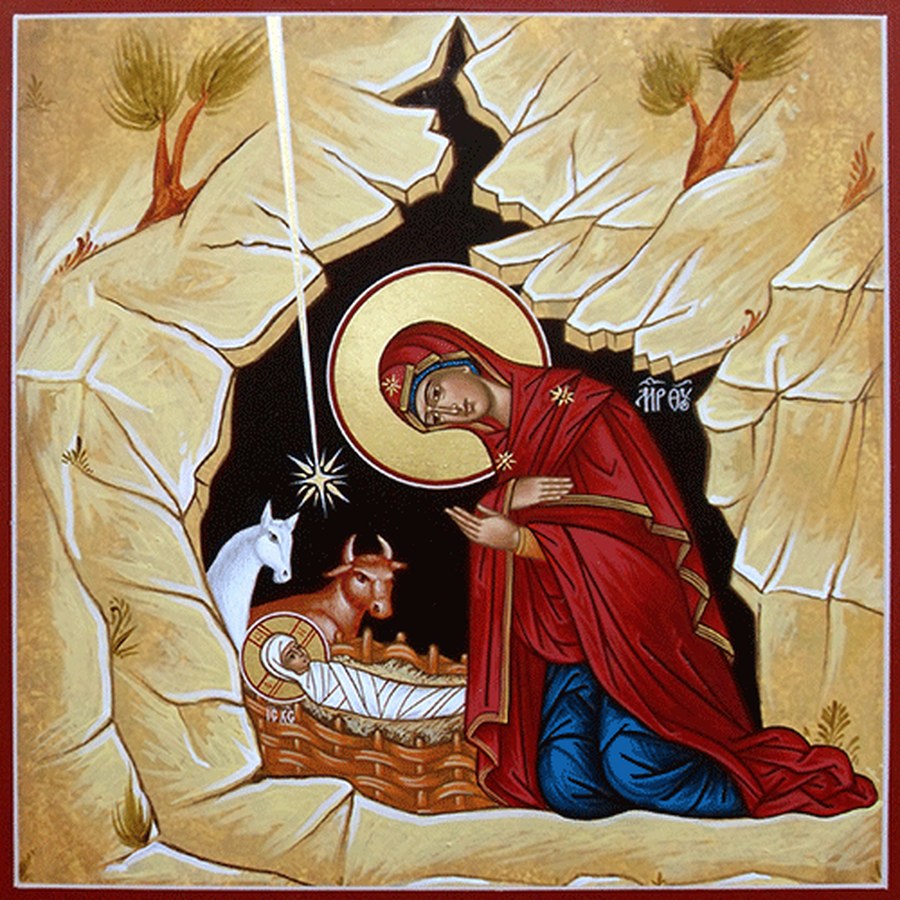
Byzantine icon of the Nativity (Ἡ Γέννησις). The Star of Bethlehem shines above the cave; the infant Christ lies in the manger as the Virgin Mary rests beside Him and Joseph sits apart in contemplation. Angels announce the birth; the ox and ass look upon the newborn Lord. In the poverty of Bethlehem the eternal Logos enters the world in true human flesh.
Birth of Jesus
A decree went out from Caesar Augustus that all the world should be taxed. And so Joseph traveled with Mary, who was nine months pregnant, from Nazareth in Galilee to Bethlehem, the city of David.
Luke 2:6-7
And so it was, that, while they were there, the days were accomplished that she should be delivered. And she brought forth her firstborn son, and wrapped him in swaddling clothes, and laid him in a manger; because there was no room for them in the inn.
And so it was. The Creator of the universe, the very Word of God, condescended to be born in poverty in the town of Bethlehem. There was no room for Him in the inn, yet He made room for us in the heart of the Father.
To the Jews
Outside of Bethlehem stands an ancient tower known as Migdal Eder -- the tower of the flock -- said to be the very place from which the Messiah would be revealed.
Luke 2:8-14
And there were in the same country shepherds abiding in the field, keeping watch over their flock by night. And, lo, the angel of the Lord came upon them, and the glory of the Lord shone round about them: and they were sore afraid. And the angel said unto them, Fear not: for, behold, I bring you good tidings of great joy, which shall be to all people. For unto you is born this day in the city of David a Saviour, which is Christ the Lord. And this shall be a sign unto you; Ye shall find the babe wrapped in swaddling clothes, lying in a manger. And suddenly there was with the angel a multitude of the heavenly host praising God, and saying,
Glory to God in the highest, and on earth peace, good will toward men.
And so it was that the birth of the Messiah was first announced to the Jews -- not to kings or scholars, but to simple shepherds watching their flocks by night. The good news of great joy came first to the lowly, exactly as the prophets had foretold.
To the Gentiles
While the birth of the Messiah was first announced to the Jews through shepherds, the news soon reached the Gentiles as well. Wise men from the East ((scholars most likely from the Medo-Persian empire)) -- the Magi -- saw a star and came seeking the prophesied King.
Matthew 2:1-2
Now when Jesus was born in Bethlehem of Judaea in the days of Herod the king, behold, there came wise men from the east to Jerusalem, Saying, Where is he that is born King of the Jews? for we have seen his star in the east, and are come to worship him.
The Magi, representing the nations of the world, followed the star and found the child with Mary his mother. They fell down and worshipped Him, presenting gifts of gold, frankincense, and myrrh. In their journey we see something profound: God inspired these Gentiles, these pagans, through honest truth-seeking. They knew of Jewish tradition, they recognized the monotheistic God of the Bible, and they came to worship the infant Christ.
Herod did not learn of the Messiah from the shepherds of Migdal Eder, nor from the people under his own rule. He learned it from these outsiders -- the Gentiles. The Word of God, born in obscurity to Israel, was already drawing the nations of the world to Himself.
Matthew 2:12
And being warned of God in a dream that they should not return to Herod, they departed into their own country another way.
The coming of the Magi fulfills the ancient promise that the light of Israel would shine for all peoples. The incarnate Word of God is not only the hope of the Jews -- He is the Savior of the whole world, restoring humanity to the purpose for which we were created: to be very good in the eyes of God.
Flight to Egypt
The joy of the Magi’s visit was short-lived. Warned in a dream, they departed another way, and the Holy Family was immediately plunged into danger.
Matthew 2:13-15
And when they were departed, behold, the angel of the Lord appeareth to Joseph in a dream, saying, Arise, and take the young child and his mother, and flee into Egypt, and be thou there until I bring thee word: for Herod will seek the young child to destroy him.
When he arose, he took the young child and his mother by night, and departed into Egypt: And was there until the death of Herod: that it might be fulfilled which was spoken of the Lord by the prophet, saying, Out of Egypt have I called my son.
Hosea 11:1
When Israel was a child, I loved him, And out of Egypt I called My son.
Once again the Word of God fulfills the ancient Scriptures in the most unexpected way. The true Israel, the eternal Son, relives the history of His people -- going down into Egypt and being called out again. St. John Chrysostom saw in this flight a profound lesson:
St. John Chrysostom
See how the Lord from the very beginning teaches us to bear suffering and persecution. He Himself flees into Egypt, not because He could not overcome His enemies, but to teach us that it is better to flee than to put ourselves in danger.
In the darkness of night the Creator of the universe became a refugee. The King of kings fled from the wrath of a tyrant, showing that true greatness is found in humility and obedience, not in earthly power.
Massacre of the Innocents
Herod’s wrath was not satisfied when the Magi did not return to him. In a fit of demonic rage he ordered the slaughter of every male child in Bethlehem and its surrounding region, two years old and under.
Matthew 2:16
Then Herod, when he saw that he was mocked of the wise men, was exceeding wroth, and sent forth, and slew all the children that were in Bethlehem, and in all the coasts thereof, from two years old and under, according to the time which he had diligently inquired of the wise men.
This atrocity echoes the cruelty of Pharaoh, who once commanded the death of every Hebrew male child:
Exodus 1:22
And Pharaoh charged all his people, saying, Every son that is born ye shall cast into the river, and every daughter ye shall save alive.
The lamentation was bitter and inconsolable. As Scripture records:
Matthew 2:17-18
Then was fulfilled that which was spoken by Jeremiah the prophet, saying,
“A voice was heard in Ramah, Lamentation, weeping, and great mourning, Rachel weeping for her children, Refusing to be comforted, Because they are no more.”
Jeremiah 31:15
Thus saith the LORD; A voice was heard in Ramah, lamentation, and bitter weeping; Rachel weeping for her children refused to be comforted for her children, because they were not.
Yet even in this great sorrow the hand of God was working. The same chapter of Jeremiah that records Rachel’s weeping immediately continues with the promise of the New Covenant:
Jeremiah 31:31-34
Behold, the days come, saith the LORD, that I will make a new covenant with the house of Israel, and with the house of Judah: Not according to the covenant that I made with their fathers in the day that I took them by the hand to bring them out of the land of Egypt; which my covenant they brake, although I was an husband unto them, saith the LORD: But this shall be the covenant that I will make with the house of Israel; After those days, saith the LORD, I will put my law in their inward parts, and write it in their hearts; and will be their God, and they shall be my people. And they shall teach no more every man his neighbour, and every man his brother, saying, Know the LORD: for they shall all know me, from the least of them unto the greatest of them, saith the LORD: for I will forgive their iniquity, and I will remember their sin no more.
St. Augustine teaches that these innocent children were the first martyrs for Christ. Their blood, shed before they could speak or choose, was the first offering given in witness to the newborn King. In their deaths the New Covenant was already being sealed in blood -- not yet the blood of the Lamb on the Cross, but the blood of the first lambs offered for Him.
The Holy Innocents did not die in vain. They stand as eternal witnesses that the coming of the Word of God into the world immediately provoked the fury of the enemy, yet even that fury could not prevent the dawn of the New Covenant, and the salvation of man.
Return to Israel
After the death of Herod, the danger finally passed. Once again the angel of the Lord appeared to Joseph in a dream and gave him clear command:
Matthew 2:19-21
But when Herod was dead, behold, an angel of the Lord appeareth in a dream to Joseph in Egypt, Saying, Arise, and take the young child and his mother, and go into the land of Israel: for they are dead which sought the young child's life. And he arose, and took the young child and his mother, and came into the land of Israel.
In this return from Egypt the eternal Logos -- the Word of God -- once more fulfills the ancient pattern of Israel’s history. Jesus is the new Moses, the new David, and ultimately the new Adam.
Exodus 4:19
Now the LORD said to Moses in Midian, “Go, return to Egypt; for all the men who sought your life are dead.”
Psalms 80:8
You have brought a vine out of Egypt; You have cast out the gentile nations, and planted it.
The true Vine, the true Son, is brought out of Egypt so that He might be planted in the land of promise.
Yet when Joseph heard that Archelaus reigned in Judaea in the room of his father Herod, he was afraid to go further. Being warned of God in a dream, he turned aside into the parts of Galilee and came to dwell in the city of Nazareth:
Matthew 2:22-23
But when he heard that Archelaus did reign in Judaea in the room of his father Herod, he was afraid to go thither: notwithstanding, being warned of God in a dream, he turned aside into the parts of Galilee: And he came and dwelt in a city called Nazareth: that it might be fulfilled which was spoken by the prophets, He shall be called a Nazarene.
The very idea of the Messiah coming from Nazareth in Galilee would have been looked upon with scandal and horror by the rabbis of the time. Nathanael voiced the common prejudice when he asked:
John 1:46
And Nathanael said unto him, Can there any good thing come out of Nazareth? Philip saith unto him, Come and see.
Yet this too was prophesied:
Isaiah 9:1-2
Nevertheless the dimness shall not be such as was in her vexation, when at the first he lightly afflicted the land of Zebulun and the land of Naphtali, and afterward did more grievously afflict her by the way of the sea, beyond Jordan, in Galilee of the Gentiles. The people that walked in darkness have seen a great light: they that dwell in the land of the shadow of death, upon them hath the light shined.
St. John Chrysostom marvels at the deliberate humility of the divine plan: the King of kings chooses not Jerusalem, not the temple, not the palaces of the mighty, but the obscure and despised village of Nazareth. In this lowly place the eternal Word of God was raised as a carpenter’s son, sanctifying the hidden, ordinary, and seemingly insignificant life. The return to Israel was the deliberate choice of the incarnate Logos to embrace the very margins of society, so that no one -- however lowly -- would be excluded from the salvation He came to bring.
The Word of God returned not in power but in poverty, not to the center of religious authority but to the edge of the map, fulfilling the prophets and teaching the world that true greatness is found in humility and obedience.
Christ is Present
The child who was born in a stable, worshipped by shepherds and Magi, driven into Egypt as a refugee, and raised in the despised village of Nazareth is the same eternal Logos -- the Word of God -- who continues to dwell among us today.
What the world saw as weakness and humiliation was in reality the greatest act of divine love. The Creator entered His creation not in splendor but in poverty, not with force but with humility. St. Leo the Great, reflecting on this mystery, wrote:
St. Leo the Great
He who is the true God became true man, that He might unite in Himself the lowliness of the one with the majesty of the other. In the form of a servant He took upon Himself what is ours, that He might bestow upon us what is His.
This same incarnate Word did not leave the world after His Ascension. In the Catholic Church He remains objectively and fully present -- Body, Blood, Soul, and Divinity -- especially in the Holy Eucharist. The stable of Bethlehem has become every altar; the manger has become the tabernacle. The same Christ who lay wrapped in swaddling clothes is now veiled under the appearance of bread and wine, given for the life of the world.
In every Mass the Nativity is made present again. The Word once more becomes flesh and dwells among us. Here the shepherds and the Magi, the Holy Innocents and the exiles in Egypt, all find their fulfillment. Here the promise of Emmanuel -- God with us -- is not a distant memory but a living reality.
The Nativity is not merely a feast of the past. It is the perpetual mystery of the Church: the eternal Word of God continues to come to us in humility, that we may come to Him in glory.