Logos
Logos (Λόγος) means literally the Word of God. Christ is the Logos incarnate, the Word made flesh. More specifically, Christ, the Logos, is Truth revealed in the flesh.
Logos
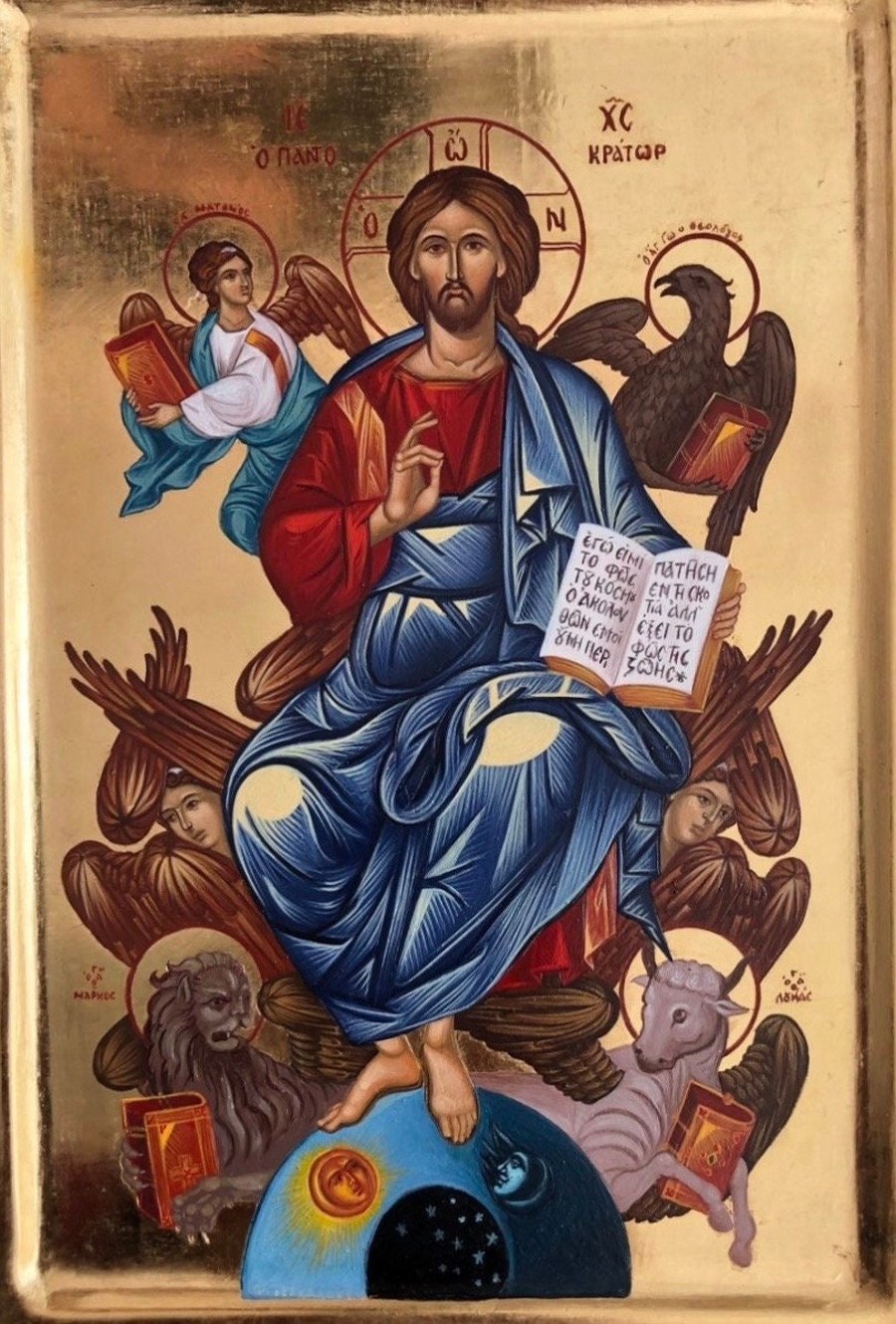
Byzantine icon of Christ Pantocrator (Χριστὸς Παντοκράτωρ) enthroned in glory, surrounded by the Tetramorph -- the winged symbols of Matthew, Mark, Luke, and John. Christ holds the open Gospel with the words I am the light of the world (John 8:12); beneath His feet the sun and stars mark the cosmos He rules. The incarnate Logos who was in the beginning is the same Christ who is forever God and who took flesh for our salvation -- the Truth revealed in the flesh.
John 15:26-27
But when the Comforter is come, whom I will send unto you from the Father, even the Spirit of truth, which proceedeth from the Father, he shall testify of me: And ye also shall bear witness, because ye have been with me from the beginning.
Truth Incarnate
Modern views offer a subtle nihilism where truth is relativistic and reductionist, a reversion to the ancient "gods" where there was no objective knowable truth. Even modern Orthodox Christians sometimes make this mistake, shying away from "truth" as if it was a western scholastic invention.
"Orthodox" means, literally, right (Ortho) praise or worship (Doxa), and there is nothing more right worship than the Logos, the Truth, made flesh.
John 1:1
In the beginning was the Word (Logos), and the Word (Logos) was with God, and the Word (Logos) was God.
John 15:16-17
Ye have not chosen me, but I have chosen you, and ordained you, that ye should go and bring forth fruit, and that your fruit should remain: that whatsoever ye shall ask of the Father in my name, he may give it you. These things I command you, that ye love one another.
Truth is transcendent, and knowable through Christ Jesus. It was in the person of Christ that knowable objective truth was born, literally, born in Bethlehem. The only scholastic invention was the demonic attempt to remove God from truth and epistemology, pretending truth was merely an attribute, a human articulation, rather than the person of Christ.
We cannot separate morality and meaning from truth, in other words, the words of God are true as well as good and meaningful. The words of God are truth, morality, and meaning in life. And Christ is truth, morality, and meaning -- made flesh. He is the literal embodiment of the answer to the fundamental questions of life.
Alexander of Alexandria
For he set forth His proper personality, saying,
"In the beginning was the Word, and the Word was with God, and the Word was God. All things were made by Him; and with out Him was not anything made that was made."
For who ever heard such things? or who, now hearing them, is not astonished, and does not stop his ears that these words should not touch them?
Logia
Our nihilistic modern view tells us that words ending in -ology refer to "the study of". The etymology is from Logia and refers to divine stories or words, specifically the word (Logos) who is Christ Jesus. It does not mean "the study of". This can be demonstrated by the fact that most -ology suffixes make no reference to "the study of", e.g.,
the study of?
- trilogy -- the study of 3?
- epistemology -- the study of understanding?
- apology -- the study of from/of?
The clearest refutation that -ology does not mean "the study of" is the word "apology". Note the ap- in apology simply means "from" or "of", but what is an apology the study of, exactly? The study of of?
None of these make much sense. However, if we recognize the etymological root Logia and Logos then these all make perfect sense, e.g.,
Logos/Logia suffix
- trilogy -- 3 stories
- epistemology -- understanding the word (revealed truth)
- apology -- from the word of God. We still have this connotation with Christian Apologetics
We can even get a better sense of the supposed "study of" scholastic disciplines,
- biology -- life's story
- eschatology -- the end story
- etymology -- the original meaning of a word
- geology -- the ground/soil's story
- technology -- techne (art, skill, technique) stories
The ancient understanding of Logia dispels much of the confusion found in our modern view, and reveals the divine nature of knowledge and revelatory truth across all disciplines (and note that an academic discipline means literally to be a disciple). It would seem that "the study of" inference is a vain and demonic attempt to remove God, replacing God with self-worship, as if man were God.
These are echoes of that same snake in the garden,
Ye shall be as gods
Let us not use our God-given mind for self-worship or nihilism, but instead worship and glorify God, our creator -- the Spirit of Truth made known to us through Christ Jesus.
Christology
Christology, the doctrines of Christ, or literally: the stories (Logia) of Christ (the Logos incarnate) -- the Logia of the Logos. The revealed truth of Truth.
This is the only justifiable and sufficient epistemology, as the person of Christ is why we even have the word "epistemology".
John 14:6
Jesus saith unto him, I am the way, the truth, and the life: no man cometh unto the Father, but by me.
As affirmed in orthodox Christology, Christ Jesus is both God and man, fully human and fully God. He has two natures, two wills, human and divine working in perfect synergy. The Word (Logos) of God condescended down into His creation, and further down into death (the actual death of God), so that He may save us by overcoming sin and death.
These are the doctrines of Christ -- of the Logos incarnate -- His life, death, resurrection and ascension. This is the story of Truth, how we can know truth, and of our redemption and salvation from a fallen state.
Joyful Mysteries
The Joyful Mysteries proclaim the Incarnation of the only-begotten Son. In the Annunciation, Visitation, Nativity, Presentation, and Finding in the Temple, Jesus -- true God from true God -- enters creation as a child for us and for our salvation, revealing the Father in the flesh.
St. Irenaeus
The Word of God became what we are, that He might make us what He is.
Around the age of thirty, Jesus is led by the Spirit into the wilderness to confront the tempter. There He fasts for forty days and refuses every false path to power and glory, remaining faithful to the Father and beginning His public ministry in perfect obedience.
Luminous Mysteries
The Luminous Mysteries reveal the public ministry of the incarnate Son. Through Baptism, the Wedding at Cana, the Proclamation of the Kingdom, the Transfiguration, and the Institution of the Eucharist, Jesus manifests the light of divine Truth to the world and establishes the new and eternal covenant.
St. John Chrysostom
He who is the Light of the world was baptized with water, that He might sanctify the waters.
- Baptism of Jesus
- Wedding at Cana
- Proclamation of the Kingdom
- Transfiguration
- Institution of the Eucharist
During the years of His public ministry, Jesus teaches with divine authority throughout Galilee and Judea. He delivers the Sermon on the Mount, performs signs and wonders, proclaims the coming of the Kingdom, and sets His face toward Jerusalem, gathering disciples and revealing the Father to those who would listen.
Sorrowful Mysteries
The Sorrowful Mysteries display Jesus entering the depths of human suffering and death. In the Agony, Scourging, Crowning with Thorns, Carrying of the Cross, and Crucifixion, the Word who is Life submits to death and descends into hell so that Truth may overcome the lie of sin and the power of death.
St. Leo the Great
He who was crucified in weakness is the same who rose in power.
Having conquered death on the Cross, Jesus descends in His soul into the realm of the dead. There He shatters the gates of hell and frees the righteous who had waited in hope, fulfilling the promise that not even death could hold the Author of Life.
Glorious Mysteries
The Glorious Mysteries crown the victory of the risen Christ. In the Resurrection, Ascension, Descent of the Holy Spirit, Dormition, and Coronation of the Theotokos, Jesus is exalted at the right hand of the Father, and the Spirit of Truth is poured out upon the Church.
St. Athanasius
He became man that we might become God.
- Resurrection
- Ascension
- Descent of the Holy Spirit
- Dormition of the Theotokos
- Coronation of the Theotokos
At the end of the age, Jesus will come again in glory to judge the living and the dead. He will bring the story of Truth to its final consummation and establish His kingdom that will have no end.