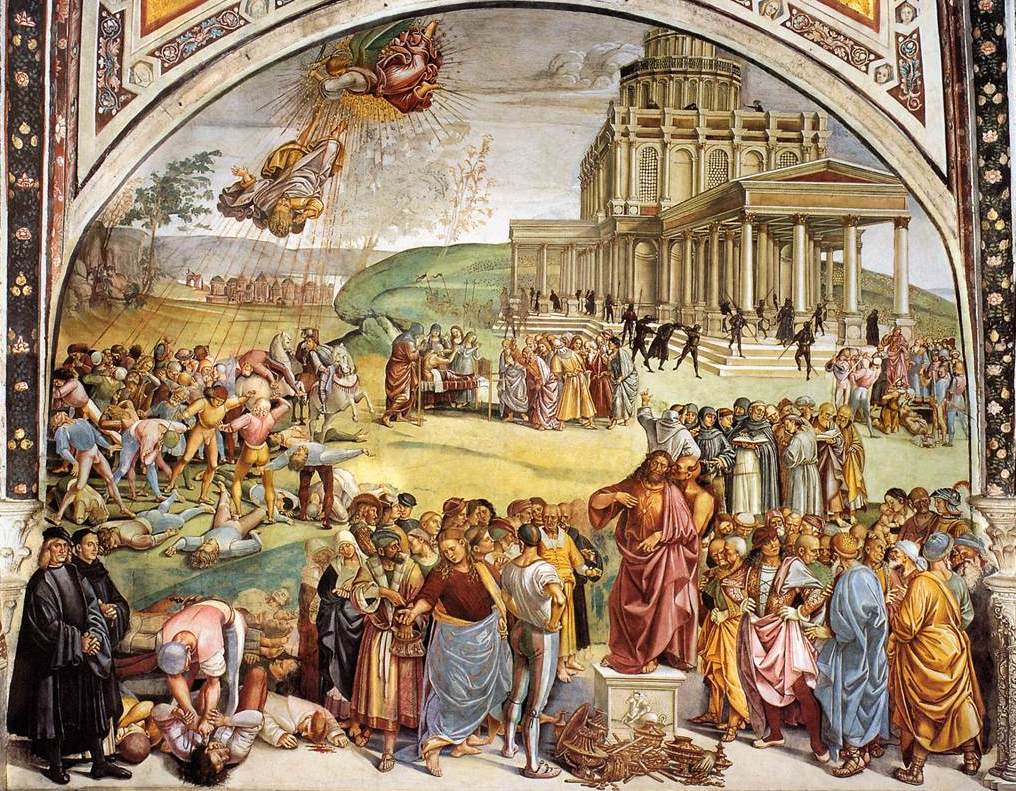
Antichrist
The prophesied antichrist -- both a person and a spirit -- is best understood in light of Christ’s decisive victory over the demons, principalities, and powers (the fallen angels). The term "antichrist" derives from the Greek "anti," which can mean "instead of" or "in front of / before," rather than merely "opposite." Thus, the antichrist represents a substitute or counterfeit Christ, one who positions himself in place of or before the true Messiah. Through His life, death, and resurrection, Christ bound the "strong man" (Satan), stripping him of his authority and establishing the Kingdom of God on earth. Yet, in the midst of Christ’s reign, the devil, though defeated, persists as a foil to the divine order, sowing the spirit of antichrist as his desperate countermove.
Satan’s Defeat
Mark 3:27
No man can enter into a strong man’s house, and spoil his goods, except he will first bind the strong man; and then he will spoil his house.
Before Christ, humanity languished under Satan’s dominion, enslaved by sin and death. The devil even boasted authority over the world’s kingdoms, offering them to Jesus during the temptation in the wilderness.
Luke 4:5-7
And the devil took him up and showed him all the kingdoms of the world in a moment of time, and said to him, “To you I will give all this authority and their glory, for it has been delivered to me, and I give it to whom I will. If you, then, will worship me, it will all be yours.”
Even God’s chosen people, the Israelites, groaned under Roman rule and the diaspora, subject to Satan’s worldly powers. But Christ -- as God incarnate and perfect man -- shattered this dominion. He cast out demons, healed the sick, forgave sins, and triumphed over death itself, manifesting the Kingdom of God on earth as it is in heaven.
Christ’s Reign
In this Messianic Age, Christ reigns supreme, even as His enemies strike his heel.
Psalms 110:2
The Lord shall send the rod of Your strength out of Zion. Rule in the midst of Your enemies!
Though Satan and his legions lost their authority, their influence lingers for a time, as foretold in Daniel’s vision.
Daniel 7:12
As for the rest of the beasts, they had their dominion taken away, yet their lives were prolonged for a season and a time.
Daniel’s vision describes three beasts -- a leopard, a bear, and a lion -- followed by a fourth, the serpent or great dragon. In Revelation, these merge into a final beast, empowered by the dragon himself.
Revelation 13:2
Now the beast which I saw was like a leopard, his feet were like the feet of a bear, and his mouth like the mouth of a lion. The dragon gave him his power, his throne, and great authority.
This final beast -- the prophesied antichrist -- emerges in the last days before judgment. The spirit of antichrist has appeared throughout history, preparing the way for a kingdom of man that opposes God’s rule.
False Christs
Jesus warned of deceivers who would lead many astray.
Matthew 24:24
For there shall arise false Christs, and false prophets, and shall show great signs and wonders; insomuch that, if it were possible, they shall deceive the very elect.
The antichrist, understood through the etymology of "anti" as "instead of" or "in front of / before," serves as a false substitute for Christ -- an imitation that inverts truth itself. Where Christ submits wholly to the Father and offers eternal life, the antichrist exalts himself, peddling lies of a worldly kingdom that leads only to death. This spirit manifests in globalist ideologies, from ancient empires to modern transhumanism, where elites seek godhood through their own power.
The spirit of antichrist lures the Church away from Christ, often under the guise of compassion or progress. Calls to “modernize” the Church -- whether through innovations in Rome or the reformations of Protestantism -- risk aligning with this spirit, leading the flock not to Christ but to the lost sheep of the world.
Man of Sin
The final antichrist -- the “man of sin” -- will rise not from heaven but from the earth, deceiving even the faithful.
2 Thessalonians 2:3
Let no man deceive you by any means: for that day shall not come, except there come a falling away first, and that man of sin be revealed, the son of perdition.
This figure will embody the ultimate rebellion against God, cloaked in counterfeit signs and wonders. Yet, discernment is possible through the lens of Christ’s truth.
To discern Christ from the antichrist, Scripture provides clear guidance. The Apostle John instructs believers to test the spirits:
1 John 4:1-3
Beloved, do not believe every spirit, but test the spirits to see whether they are from God, for many false prophets have gone out into the world. By this you know the Spirit of God: every spirit that confesses that Jesus Christ has come in the flesh is from God, and every spirit that does not confess Jesus is not from God. This is the spirit of the antichrist, which you heard was coming and now is in the world already.
This test emphasizes the Incarnation: the antichrist spirit denies that Jesus is the Christ come in the flesh, often promoting a distorted or humanistic version of spirituality that rejects divine truth.
Furthermore, consider the parable of the lost sheep (Luke 15:3-7). Christ, the Good Shepherd, leaves the ninety-nine righteous sheep to seek and rescue the one lost sheep, bringing it back to the fold and rejoicing in its restoration. In contrast, the antichrist inverts this divine compassion: under the guise of tolerance and false mercy, he leads the entire flock astray to accommodate the lost sheep, compromising truth and leading all toward perdition rather than salvation.
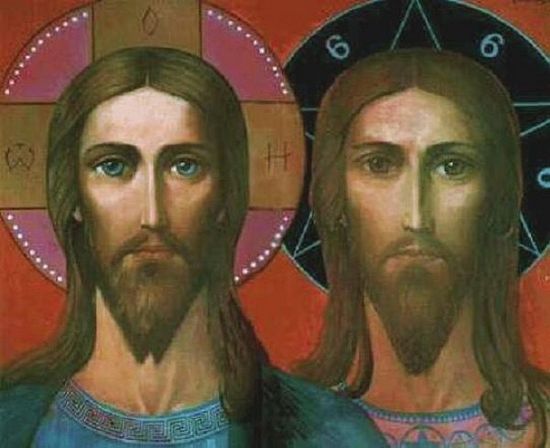
For deeper insight, explore the patristic understanding of the antichrist and its depiction in art, such as Luca Signorelli’s Preaching of the Antichrist.
Luca Signorelli’s Preaching of the Antichrist